
睡眠模式和遗传易感性与阻塞性睡眠呼吸暂停的关联:英国生物银行的前瞻性分析
Association of Sleep Pattern and Genetic Susceptibility with Obstructive Sleep Apnea: A Prospective Analysis of the UK Biobank.
作者信息
Zhou Rong, Suo Chen, Jiang Yong, Yuan Liyun, Zhang Tiejun, Chen Xingdong, Zhang Guoqing
机构信息
Department of Epidemiology, School of Public Health, Fudan University, Shanghai, 200433, People's Republic of China.
Shanghai Southgene Technology Co., Ltd., Shanghai, 201203, People's Republic of China.
出版信息
Nat Sci Sleep. 2024 May 23;16:503-515. doi: 10.2147/NSS.S443721. eCollection 2024.
PURPOSE
The prevalence of obstructive sleep apnea (OSA) is high worldwide. This study aimed to quantify the relationship between the incidence of OSA and sleep patterns and genetic susceptibility.
METHODS
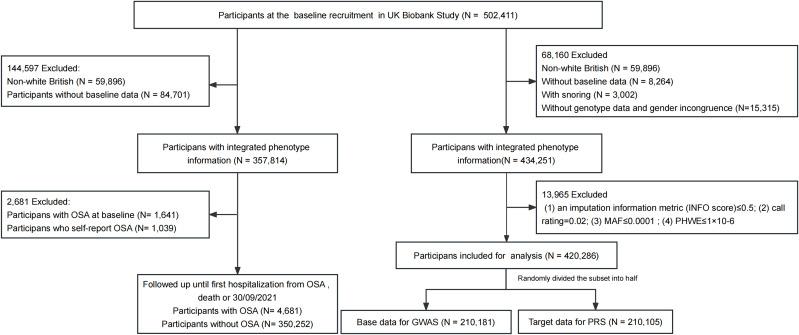
A total of 355,133 white British participants enrolled in the UK Biobank between 2006 and 2010 with follow-up data until September 2021 were recruited. We evaluated sleep patterns using a customized sleep scoring method based on the low-risk sleep phenotype, defined as follows: morning chronotype, 7-8 hours of sleep per day, never/rarely experience insomnia, no snoring, no frequent daytime sleepiness, never/rarely nap, and easily getting up early. The polygenic risk score was calculated to assess genetic susceptibility to OSA. Cox proportional hazard models were used to evaluate the associations between OSA and sleep patterns and genetic susceptibility.
RESULTS
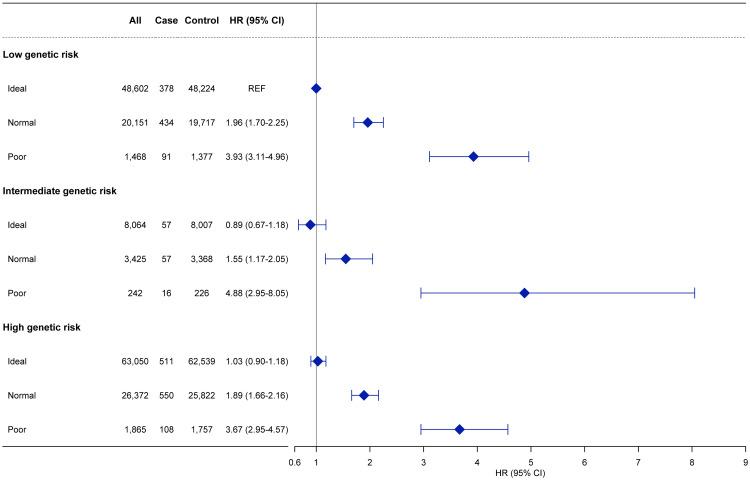
During a mean follow-up of 12.57 years, 4618 participants were diagnosed with OSA (age: 56.83 ± 7.69 years, women: 31.3%). Compared with those with a poor sleep pattern, participants with a normal (HR: 0.42, 95% CI: 0.38-0.46), ideal (HR: 0.21, 95% CI: 0.19-0.24), or optimal (HR: 0.15, 95% CI: 0.12-0.18) sleep pattern were significantly more likely to have OSA. The genetic susceptibility of 173,239 participants was calculated, and the results showed that poor (HR: 3.67, 95% CI: 2.95-4.57) and normal (HR: 1.89, 95% CI: 1.66-2.16) sleep patterns with high genetic susceptibility can increase the risk for OSA.
CONCLUSION
This large-scale prospective study provides evidence suggesting that sleep patterns across seven low-risk sleep phenotypes may protect against OSA in individuals with varying degrees of genetic susceptibility.
目的
阻塞性睡眠呼吸暂停(OSA)在全球范围内的患病率很高。本研究旨在量化OSA发病率与睡眠模式及遗传易感性之间的关系。
方法
招募了2006年至2010年期间参加英国生物银行的355133名英国白人参与者,并获取了截至2021年9月的随访数据。我们使用基于低风险睡眠表型的定制睡眠评分方法评估睡眠模式,定义如下:早晨型生物钟类型、每天睡眠7 - 8小时、从不/很少经历失眠、不打鼾、没有频繁的日间嗜睡、从不/很少午睡且容易早起。计算多基因风险评分以评估对OSA的遗传易感性。使用Cox比例风险模型评估OSA与睡眠模式及遗传易感性之间的关联。
结果
在平均12.57年的随访期间,4618名参与者被诊断为OSA(年龄:56.83±7.69岁,女性:31.3%)。与睡眠模式差的参与者相比,睡眠模式正常(风险比:0.42,95%置信区间:0.38 - 0.46)、理想(风险比:0.21,95%置信区间:0.19 - 0.24)或最佳(风险比:0.15,95%置信区间:0.12 - 0.18)的参与者患OSA的可能性显著更高。计算了173239名参与者的遗传易感性,结果表明遗传易感性高的睡眠模式差(风险比:3.67,95%置信区间:2.95 - 4.57)和正常(风险比:1.89,95%置信区间:1.66 - 2.16)的情况会增加患OSA的风险。
结论
这项大规模前瞻性研究提供了证据,表明七种低风险睡眠表型的睡眠模式可能在不同程度的遗传易感性个体中预防OSA。
 Zotero 插件