
细菌微聚集体作为植入物相关感染动物模型中的接种物。
Bacterial micro-aggregates as inoculum in animal models of implant-associated infections.
作者信息
Top Hartmann Katrine, Lund Nielsen Regitze, Mikkelsen Freja Cecilie, Aalbæk Bent, Lichtenberg Mads, Holm Jakobsen Tim, Bjarnsholt Thomas, Kvich Lasse, Ingmer Hanne, Odgaard Anders, Elvang Jensen Henrik, Kruse Jensen Louise
机构信息
Department of Veterinary- and Animal Sciences, University of Copenhagen, Grønnegårdsvej 7, 1870, Frederiksberg C, Denmark.
Costerton Biofilm Center, Department of Immunology and Microbiology, University of Copenhagen, Blegdamsvej 3B, 2200, Copenhagen, Denmark.
出版信息
Biofilm. 2024 May 9;7:100200. doi: 10.1016/j.bioflm.2024.100200. eCollection 2024 Jun.
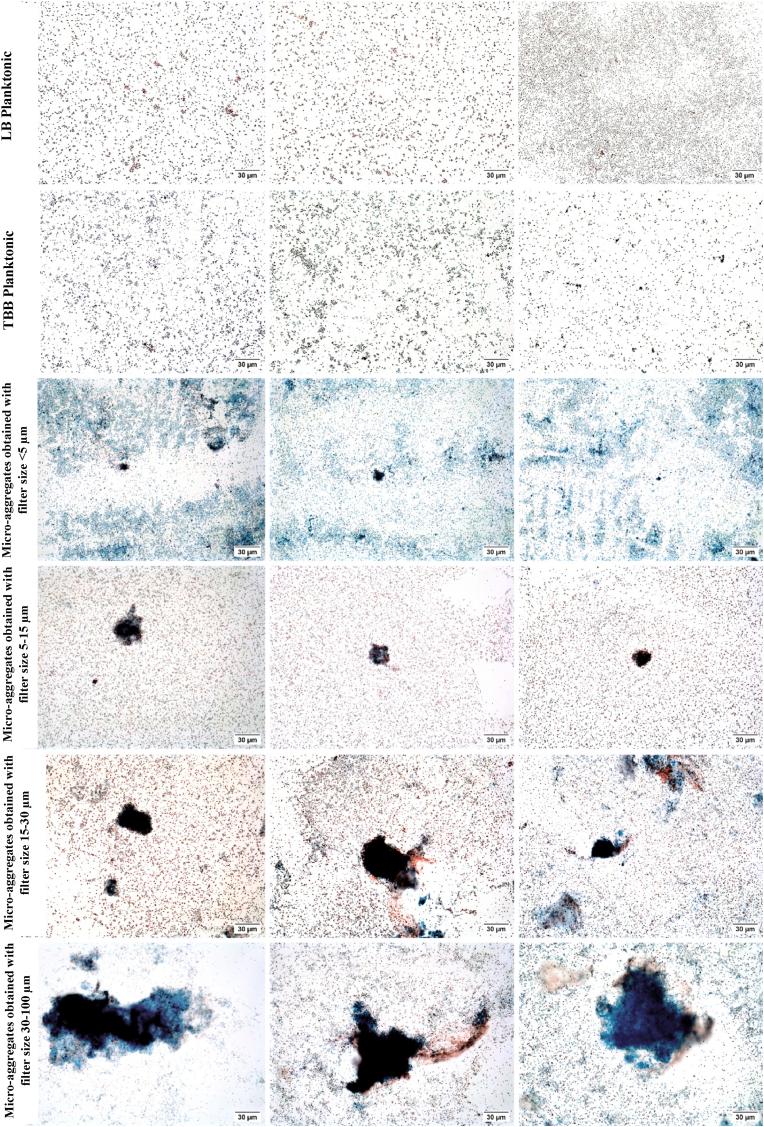
Is it time to rethink the inoculum of animal models of implant-associated infections (IAI)? Traditionally, animal models of IAI are based on inoculation with metabolically active overnight cultures of planktonic bacteria or pre-grown surface-attached biofilms. However, such inoculums do not mimic the clinical initiation of IAI. Therefore, the present study aimed to develop a clinically relevant inoculum of low metabolic micro-aggregated bacteria. The porcine strain S54F9 was cultured in Tryptone Soya Broth (TSB) for seven days to facilitate the formation of low metabolic micro-aggregates. Subsequently, the aggregated culture underwent filtration using cell strainers of different pore sizes to separate micro-aggregates. Light microscopy was used to evaluate the aggregate formation and size in the different fractions, while isothermal microcalorimetry was used to disclose a low metabolic activity. The micro-aggregate fraction obtained with filter size 5-15 μm (actual measured mean size 32 μm) was used as inoculum in a porcine implant-associated osteomyelitis (IAO) model and compared to a standard overnight planktonic inoculum and a sham inoculum of 0.9 % saline. The micro-aggregate and planktonic inoculums caused IAO with the re-isolation of from soft tissues, bones, and implants. However, compared to their planktonic counterpart, neither of the micro-aggregate inoculated animals showed signs of osteomyelitis, i.e., sequester, osteolysis, and pus at gross inspection. Furthermore, inoculation with low metabolic micro-aggregates resulted in a strong healing response with pronounced osteoid formation, comparable to sham animals. In conclusion, the formation and separation of low metabolic bacterial micro-aggregates into various size fractions is possible, however, planktonic bacteria were still seen in all size fractions. Inoculation with micro-aggregates caused a less-aggressive osteomyelitis i.e. combination of infected tissue and strong healing response. Therefore, the use of low metabolic micro-aggregates could be a relevant inoculum for animal models of less-aggressive and thereby slower developing IAI and add in to our understanding of the host-implant-bacteria interactions in slow-onset low-grade infections.
是时候重新思考植入物相关感染(IAI)动物模型的接种物了吗?传统上,IAI动物模型是基于接种代谢活跃的浮游细菌过夜培养物或预先生长的表面附着生物膜。然而,这样的接种物并不能模拟IAI的临床起始情况。因此,本研究旨在开发一种具有临床相关性的低代谢微聚集体细菌接种物。将猪菌株S54F9在胰蛋白胨大豆肉汤(TSB)中培养7天,以促进低代谢微聚集体的形成。随后,使用不同孔径的细胞筛对聚集培养物进行过滤,以分离微聚集体。利用光学显微镜评估不同组分中聚集体的形成和大小,同时使用等温微量热法揭示低代谢活性。将通过5-15μm滤器尺寸获得的微聚集体组分(实际测量平均尺寸为32μm)用作猪植入物相关骨髓炎(IAO)模型的接种物,并与标准过夜浮游接种物和0.9%生理盐水的假接种物进行比较。微聚集体和浮游接种物均导致IAO,可从软组织、骨骼和植入物中再次分离出细菌。然而,与浮游对应物相比,接种微聚集体的动物均未表现出骨髓炎的迹象,即在大体检查时未发现死骨、骨质溶解和脓液。此外,接种低代谢微聚集体导致强烈的愈合反应,并伴有明显的类骨质形成,与假手术动物相当。总之,低代谢细菌微聚集体能够形成并分离成各种大小的组分,然而,在所有大小组分中仍可见浮游细菌。接种微聚集体导致的骨髓炎侵袭性较小,即感染组织与强烈愈合反应并存。因此,使用低代谢微聚集体可能是侵袭性较小、发展较慢的IAI动物模型的相关接种物,并有助于我们理解宿主-植入物-细菌在缓慢发生的低度感染中的相互作用。


 Zotero 插件