
农业土壤中的重金属(类金属)污染及潜在生态风险评估
Heavy Metal(oid)s Contamination and Potential Ecological Risk Assessment in Agricultural Soils.
作者信息
Saleem Muhammad, Pierce David, Wang Yuqiang, Sens Donald A, Somji Seema, Garrett Scott H
机构信息
Department of Pathology, School of Medicine and Health Sciences, University of North Dakota, Grand Forks, ND 58202, USA.
Department of Chemistry, University of North Dakota, Grand Forks, ND 58202, USA.
出版信息
J Xenobiot. 2024 May 14;14(2):634-650. doi: 10.3390/jox14020037.
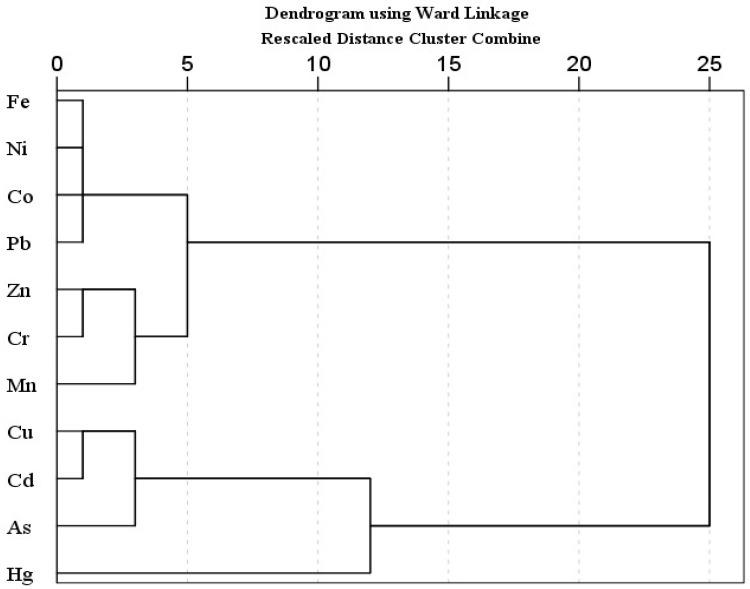
Soil pollution caused by heavy metal(oid)s has generated great concern worldwide due to their toxicity, persistence, and bio-accumulation properties. To assess the baseline data, the heavy metal(oid)s, including manganese (Mn), iron (Fe), Cobalt (Co), nickel (Ni), copper (Cu), zinc (Zn), arsenic (As), lead (Pb), mercury (Hg), chromium (Cr), and cadmium (Cd), were evaluated in surface soil samples collected from the farmlands of Grand Forks County, North Dakota. Samples were digested via acid mixture and analyzed via inductively coupled plasma mass spectrometry (ICP MS) analysis to assess the levels, ecological risks, and possible sources. The heavy metal(oid) median levels exhibited the following decreasing trend: Fe > Mn > Zn > Ni > Cr > Cu > Pb > Co > As > Cd > Hg. Principal component analysis (PCA) and hierarchical cluster analysis (HCA) suggested the main lithogenic source for the studied metal(oid)s. Metal(oid) levels in the current investigation, except Mn, are lower than most of the guideline values set by international agencies. The contamination factor (C), geo accumulation index (I) and enrichment factor (EF) showed considerable contamination, moderate contamination, and significant enrichment, respectively, for As and Cd on median value basis. Ecological risk factor (E) results exhibited low ecological risk for all studied metal(oid)s except Cd, which showed considerable ecological risk. The potential ecological risk index (PERI) levels indicated low ecological risk to considerable risk. Overall, the results indicate the accumulation of As and Cd in the study area. The high nutrients of the soils potentially affect their accumulation in crops and impact on consumers' health. This drives the impetus for continued environmental monitoring programs.
由于重金属(类金属)具有毒性、持久性和生物累积特性,其造成的土壤污染已引起全球广泛关注。为评估基线数据,对从北达科他州大福克斯县农田采集的表层土壤样本中的重金属(类金属)进行了评估,这些重金属(类金属)包括锰(Mn)、铁(Fe)、钴(Co)、镍(Ni)、铜(Cu)、锌(Zn)、砷(As)、铅(Pb)、汞(Hg)、铬(Cr)和镉(Cd)。通过混合酸消解样本,并采用电感耦合等离子体质谱(ICP MS)分析来评估其含量水平、生态风险及可能来源。重金属(类金属)的中位数水平呈现出以下递减趋势:Fe > Mn > Zn > Ni > Cr > Cu > Pb > Co > As > Cd > Hg。主成分分析(PCA)和层次聚类分析(HCA)表明了所研究金属(类金属)的主要成岩来源。本次调查中除锰之外的金属(类金属)含量均低于国际机构设定的大多数指导值。基于中位数,污染因子(C)、地累积指数(I)和富集因子(EF)分别显示出砷和镉存在相当程度的污染、中度污染和显著富集。生态风险因子(E)结果表明,除镉显示出相当程度的生态风险外,所有研究的金属(类金属)均呈现低生态风险。潜在生态风险指数(PERI)水平表明生态风险为低到相当程度。总体而言,结果表明研究区域存在砷和镉的累积。土壤的高养分可能会影响它们在作物中的累积,并对消费者健康产生影响。这推动了持续开展环境监测项目的动力。


 Zotero 插件