
主动脉几何形状与修复后狭窄患者的长期预后。
Aortic geometry and long-term outcome in patients with a repaired coarctation.
机构信息
Department of Cardiology, Erasmus Medical Center, Rotterdam, The Netherlands.
Department of Radiology, Erasmus Medical Center, Rotterdam, The Netherlands.
出版信息
Open Heart. 2024 May 28;11(1):e002642. doi: 10.1136/openhrt-2024-002642.
OBJECTIVE
This study aims to compare aortic morphology between repaired coarctation patients and controls, and to identify aortic morphological risk factors for hypertension and cardiovascular events (CVEs) in coarctation patients.
METHODS
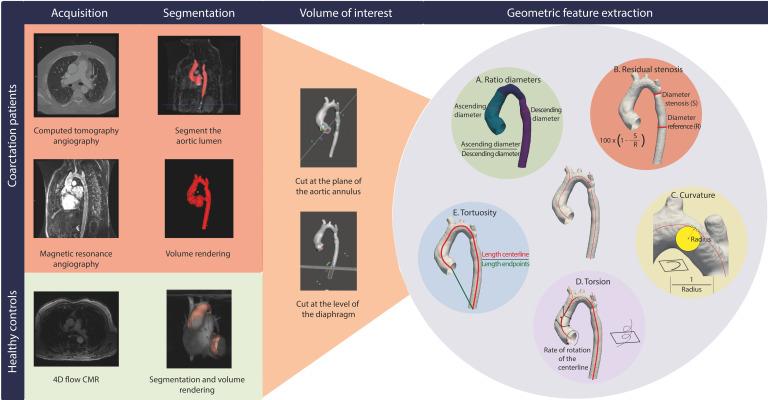
Repaired coarctation patients with computed tomography angiography (CTA) or magnetic resonance angiography (MRA) were included, followed-up and compared with sex-matched and age-matched controls. Three-dimensional aortic shape was reconstructed using patients' CTA or MRA, or four-dimensional flow cardiovascular magnetic resonance in controls, and advanced geometrical characteristics were calculated and visualised using statistical shape modelling. In patients, we examined the association of geometrical characteristics with (1) baseline hypertension, using multivariable logistic regression; and (2) cardiovascular events (CVE, composite of aortic complications, coronary artery disease, ventricular arrhythmias, heart failure hospitalisation, stroke, transient ischaemic attacks and cardiovascular death), using multivariable Cox regression. The least absolute shrinkage and selection operator (LASSO) method selected the most informative multivariable model.
RESULTS
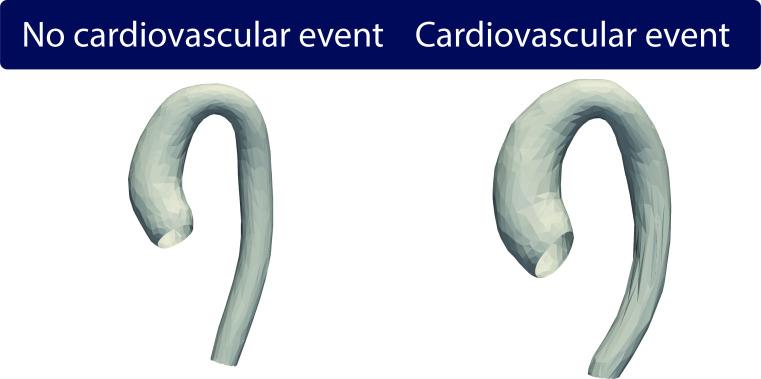
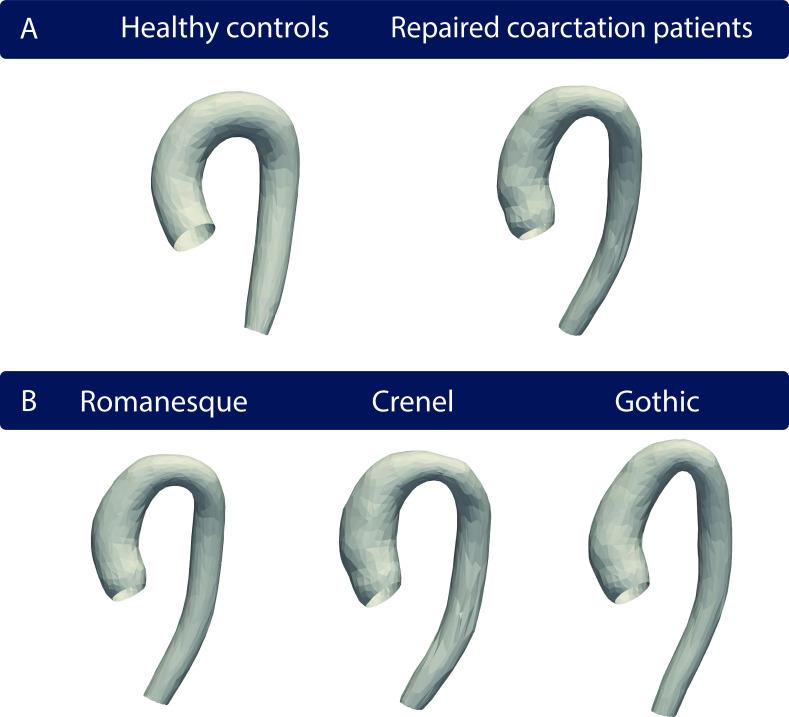
Sixty-five repaired coarctation patients (23 years (IQR 19-38)) were included, of which 44 (68%) patients were hypertensive at baseline. After a median follow-up of 8.7 years (IQR 4.8-15.4), 27 CVEs occurred in 20 patients. Aortic arch dimensions were smaller in patients compared with controls (diameter p<0.001, wall surface area p=0.026, volume p=0.007). Patients had more aortic arch torsion (p<0.001) and a higher curvature (p<0.001). No geometrical characteristics were associated with hypertension. LASSO selected left ventricular mass, male sex, tortuosity and age for the multivariable model. Left ventricular mass (p=0.014) was independently associated with CVE, and aortic tortuosity showed a trend towards significance (p=0.070).
CONCLUSION
Repaired coarctation patients have a smaller aortic arch and a more tortuous course of the aorta compared with controls. Besides left ventricular mass index, geometrical features might be of importance in long-term risk assessment in coarctation patients.
目的
本研究旨在比较修复后缩窄患者与对照组的主动脉形态,并确定缩窄患者高血压和心血管事件(CVE)的主动脉形态危险因素。
方法
纳入接受计算机断层血管造影(CTA)或磁共振血管造影(MRA)检查的修复后缩窄患者,并进行随访,然后与性别和年龄匹配的对照组进行比较。使用患者的 CTA 或 MRA 或对照组的四维血流心血管磁共振对主动脉三维形状进行重建,并使用统计形状建模计算和可视化先进的几何特征。在患者中,我们使用多变量逻辑回归检查几何特征与(1)基线高血压之间的关联;使用多变量 Cox 回归检查与(2)心血管事件(CVE,主动脉并发症、冠状动脉疾病、室性心律失常、心力衰竭住院、卒中和短暂性脑缺血发作以及心血管死亡的复合)之间的关联。最小绝对收缩和选择算子(LASSO)方法选择了信息量最大的多变量模型。
结果
共纳入 65 例修复后缩窄患者(23 岁(IQR 19-38)),其中 44 例(68%)患者基线时患有高血压。中位随访 8.7 年后(IQR 4.8-15.4),20 例患者发生 27 例 CVE。与对照组相比,患者的主动脉弓尺寸较小(直径 p<0.001,壁面面积 p=0.026,体积 p=0.007)。患者的主动脉弓扭转程度更高(p<0.001),曲率更高(p<0.001)。没有几何特征与高血压相关。LASSO 选择左心室质量、男性、迂曲度和年龄用于多变量模型。左心室质量(p=0.014)与 CVE 独立相关,主动脉迂曲度有显著趋势(p=0.070)。
结论
与对照组相比,修复后的缩窄患者主动脉弓较小,主动脉走行更为迂曲。除左心室质量指数外,几何特征在缩窄患者的长期风险评估中可能具有重要意义。
 Zotero 插件