
目前美国住院家族性高胆固醇血症患者心肌损伤模式和临床结局的流行情况:来自全国住院患者样本的观察性回顾性队列研究。
Current US prevalence of myocardial injury patterns and clinical outcomes among hospitalised patients with familial hypercholesterolaemia: insight from the National Inpatient Sample-a retrospective cohort study.
机构信息
Department of Medicine, John H Stroger Jr Hospital of Cook County, Chicago, Illinois, USA
Department of Medicine, One Brooklyn Health, Brooklyn, New York, USA.
出版信息
BMJ Open. 2024 May 28;14(5):e077839. doi: 10.1136/bmjopen-2023-077839.
BACKGROUND
Familial hypercholesterolaemia (FH) increases propensity for premature atherosclerotic disease. Knowledge of inpatient outcomes among patients with FH admitted with acute myocardial injury (AMI) is limited.
OBJECTIVES
Our study aimed to identify myocardial injury types, including type 1 myocardial infarction (MI), type 2 MI and takotsubo cardiomyopathy, assess lesion severity and study adverse short-term inpatient outcomes among patients with FH admitted with AMI.
SETTING
Our study retrospectively queried the US National Inpatient Sample from 2018 to 2020.
POPULATION
Adults admitted with AMI and dichotomised based on the presence of FH.
STUDY OUTCOMES
We evaluated myocardial injury types and complexity of coronary revascularisation. Primary outcome of all-cause mortality and other clinical secondary outcomes were studied.
RESULTS
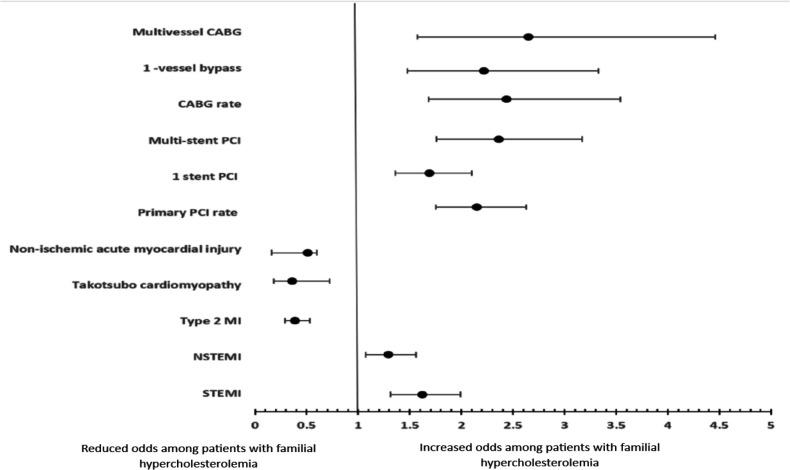
There were 3 711 765 admissions with AMI including 2360 (0.06%) with FH. FH was associated with higher odds of ST-elevation MI (STEMI) (adjusted OR (aOR): 1.62, p<0.001) and non-ST-elevation MI (NSTEMI) (aOR: 1.29, p<0.001) but lower type 2 MI (aOR: 0.39, p<0.001) and takotsubo cardiomyopathy (aOR: 0.36, p=0.004). FH was associated with higher multistent percutaneous coronary interventions (aOR: 2.36, p<0.001), multivessel coronary artery bypass (aOR: 2.65, p<0.001), higher odds of intracardiac thrombus (aOR: 3.28, p=0.038) and mechanical circulatory support (aOR: 1.79, p<0.001). There was 50% reduction in odds of all-cause mortality (aOR: 0.50, p=0.006) and lower odds of mechanical ventilation (aOR: 0.37, p<0.001). There was no difference in rate of ventricular tachycardia, cardioversion, new implantable cardioverter defibrillator implantation, cardiogenic shock and cardiac arrest.
CONCLUSION
Among patients hospitalised with AMI, FH was associated with higher STEMI and NSTEMI, lower type 2 MI and takotsubo cardiomyopathy, higher number of multiple stents and coronary bypasses, and mechanical circulatory support device but was associated with lower all-cause mortality and rate of mechanical ventilation.
背景
家族性高胆固醇血症(FH)增加了动脉粥样硬化性疾病的发生风险。患有 FH 的患者因急性心肌损伤(AMI)住院的住院结果知之甚少。
目的
我们的研究旨在确定心肌损伤类型,包括 1 型心肌梗死(MI)、2 型 MI 和心尖球形综合征,评估病变严重程度,并研究 FH 患者因 AMI 住院的短期不良住院结果。
设置
我们的研究回顾性地查询了 2018 年至 2020 年美国国家住院患者样本。
人群
因 AMI 住院的成年人,并根据是否存在 FH 进行二分类。
研究结果
AMI 共 3711765 例住院患者,其中 2360 例(0.06%)患有 FH。FH 与 ST 段抬高型心肌梗死(STEMI)(校正比值比(aOR):1.62,p<0.001)和非 ST 段抬高型心肌梗死(NSTEMI)(aOR:1.29,p<0.001)的发生几率更高,但 2 型 MI(aOR:0.39,p<0.001)和心尖球形综合征(aOR:0.36,p=0.004)的发生几率较低。FH 与更多经皮冠状动脉介入治疗(aOR:2.36,p<0.001)、多支冠状动脉旁路移植术(aOR:2.65,p<0.001)、更高的心脏内血栓形成几率(aOR:3.28,p=0.038)和机械循环支持(aOR:1.79,p<0.001)相关。FH 患者的全因死亡率降低了 50%(aOR:0.50,p=0.006),机械通气的几率降低(aOR:0.37,p<0.001)。室性心动过速、电复律、新植入式心脏复律除颤器植入、心源性休克和心脏骤停的发生率没有差异。
结论
在因 AMI 住院的患者中,FH 与 STEMI 和 NSTEMI 的发生率较高、2 型 MI 和心尖球形综合征的发生率较低、多个支架和冠状动脉旁路术以及机械循环支持装置的数量较多有关,但全因死亡率和机械通气率较低。

 Zotero 插件