
不同类型大麻对成年早期和青少年静息态大脑网络的急性影响。
Acute effects of different types of cannabis on young adult and adolescent resting-state brain networks.
机构信息
Invicro London, Burlington Danes Building, Hammersmith Hospital, Du Cane Road, W12 0NN, London, UK.
Faculty of Medicine, Imperial College London, Hammersmith Hospital, Du Cane Road, W12 0NN, London, UK.
出版信息
Neuropsychopharmacology. 2024 Sep;49(10):1640-1651. doi: 10.1038/s41386-024-01891-6. Epub 2024 May 28.
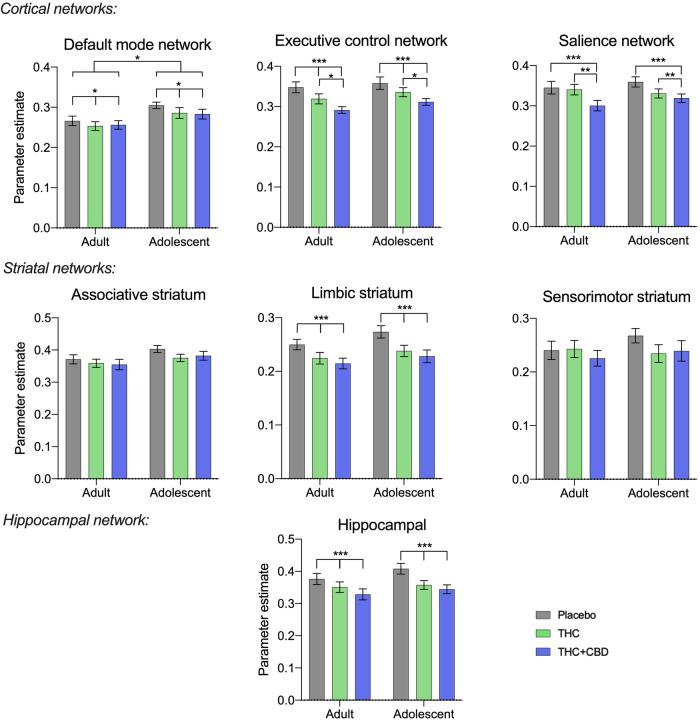
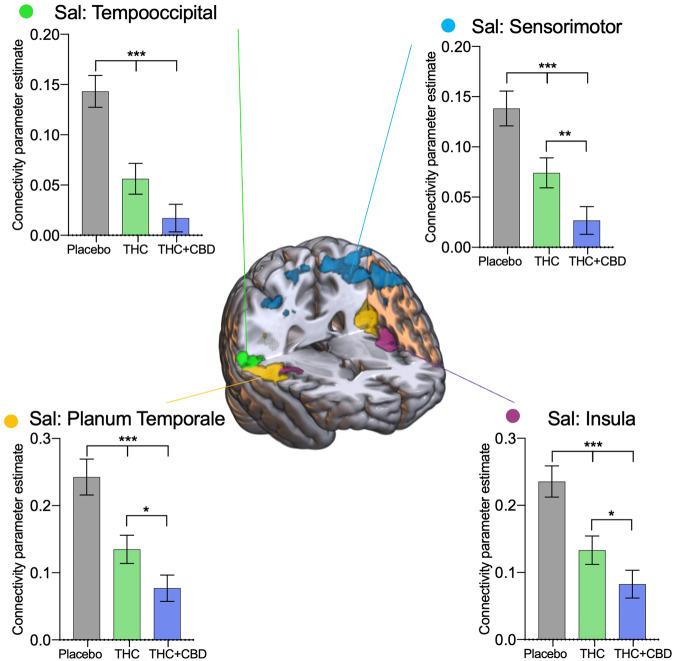
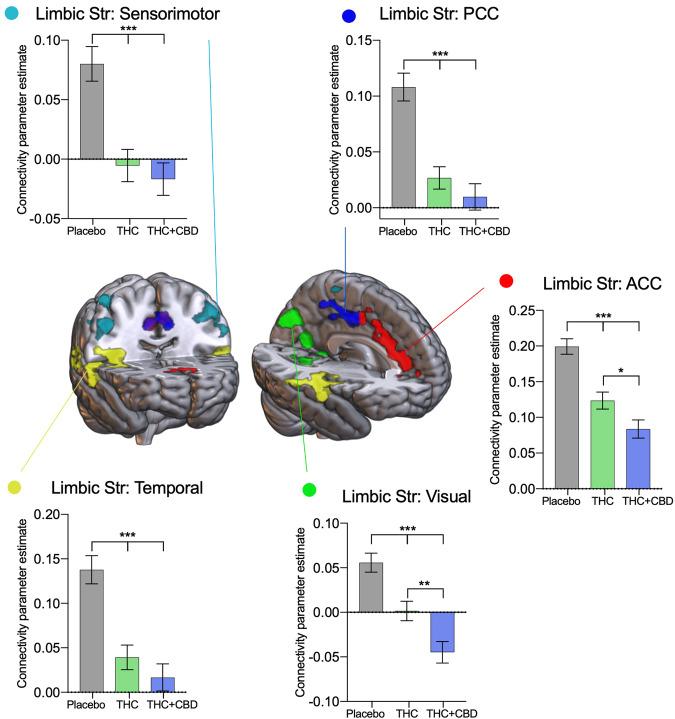
Adolescence is a time of rapid neurodevelopment and the endocannabinoid system is particularly prone to change during this time. Cannabis is a commonly used drug with a particularly high prevalence of use among adolescents. The two predominant phytocannabinoids are Delta-9-tetrahydrocannabinol (THC) and cannabidiol (CBD), which affect the endocannabinoid system. It is unknown whether this period of rapid development makes adolescents more or less vulnerable to the effects of cannabis on brain-network connectivity, and whether CBD may attenuate the effects of THC. Using fMRI, we explored the impact of vaporized cannabis (placebo, THC: 8 mg/75 kg, THC + CBD: 8 mg/75 kg THC & 24 mg/75 kg CBD) on resting-state networks in groups of semi-regular cannabis users (usage frequency between 0.5 and 3 days/week), consisting of 22 adolescents (16-17 years) and 24 young adults (26-29 years) matched for cannabis use frequency. Cannabis caused reductions in within-network connectivity in the default mode (F[2,88] = 3.97, P = 0.022, η² = 0.018), executive control (F[2,88] = 18.62, P < 0.001, η² = 0.123), salience (F[2,88] = 12.12, P < 0.001, η² = 0.076), hippocampal (F[2,88] = 14.65, P < 0.001, η² = 0.087), and limbic striatal (F[2,88] = 16.19, P < 0.001, η² = 0.102) networks compared to placebo. Whole-brain analysis showed cannabis significantly disrupted functional connectivity with cortical regions and the executive control, salience, hippocampal, and limbic striatal networks compared to placebo. CBD did not counteract THC's effects and further reduced connectivity both within networks and the whole brain. While age-related differences were observed, there were no interactions between age group and cannabis treatment in any brain network. Overall, these results challenge the assumption that CBD can make cannabis safer, as CBD did not attenuate THC effects (and in some cases potentiated them); furthermore, they show that cannabis causes similar disruption to resting-state connectivity in the adolescent and adult brain.
青春期是神经快速发育的时期,内源性大麻素系统在此期间特别容易发生变化。大麻是一种常用的药物,青少年的使用率特别高。两种主要的植物大麻素是 Delta-9-四氢大麻酚(THC)和大麻二酚(CBD),它们都会影响内源性大麻素系统。目前尚不清楚这段快速发育时期是否会使青少年更容易或更不容易受到大麻对大脑网络连接的影响,以及 CBD 是否可能减轻 THC 的影响。使用 fMRI,我们研究了蒸发大麻(安慰剂、THC:8mg/75kg、THC+CBD:8mg/75kg THC 和 24mg/75kg CBD)对半定期大麻使用者(使用频率为每周 0.5 至 3 天)静息状态网络的影响,该组由 22 名青少年(16-17 岁)和 24 名年轻成年人(26-29 岁)组成,他们的大麻使用频率相匹配。大麻导致默认模式(F[2,88] = 3.97,P = 0.022,η² = 0.018)、执行控制(F[2,88] = 18.62,P < 0.001,η² = 0.123)、突显(F[2,88] = 12.12,P < 0.001,η² = 0.076)、海马(F[2,88] = 14.65,P < 0.001,η² = 0.087)和边缘纹状体(F[2,88] = 16.19,P < 0.001,η² = 0.102)网络中的网络内连接减少,与安慰剂相比。全脑分析显示,与安慰剂相比,大麻显著破坏了与皮质区域以及执行控制、突显、海马和边缘纹状体网络的功能连接。CBD 并没有抵消 THC 的作用,反而进一步减少了网络内和整个大脑的连接。虽然观察到了与年龄相关的差异,但在任何大脑网络中,年龄组和大麻处理之间都没有相互作用。总的来说,这些结果挑战了 CBD 可以使大麻更安全的假设,因为 CBD 并没有减轻 THC 的作用(在某些情况下反而增强了 THC 的作用);此外,它们表明大麻对青少年和成年人大脑的静息状态连接造成类似的破坏。


 Zotero 插件