
吸烟与原发性和继发性不育男性精液参数的关系:一项横断面研究。
Associations between tobacco inhalation and semen parameters in men with primary and secondary infertility: a cross-sectional study.
机构信息
Reproductive Medicine Center & Department of Obstetrics and Gynecology, The First Affiliated Hospital of University of Science and Technology of China (USTC), Division of Life Sciences and Medicine, University of Science and Technology of China, Hefei, Anhui, China.
出版信息
Front Endocrinol (Lausanne). 2024 May 14;15:1396793. doi: 10.3389/fendo.2024.1396793. eCollection 2024.
OBJECTIVE
To examine the impact of tobacco smoking on seminal parameters in men with both primary and secondary infertility.
METHODS
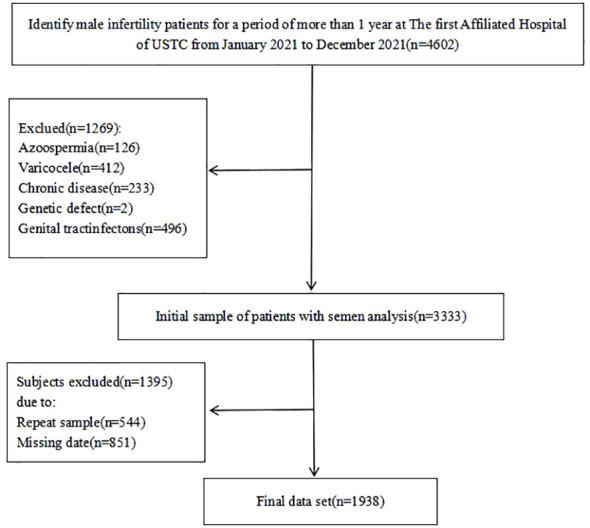
This cross-sectional study analyzed 1938 infertile men from China who were categorized as nonsmokers (n=1,067) and smokers (n=871), with the latter group further divided into moderate smokers (1-10 cigarettes per day) (n=568) and heavy smokers (>10 cigarettes per day) (n=303). We assessed semen volume, concentration, total sperm count, progressive motility, and normal morphology following World Health Organization (WHO 2010) guidelines. A logistic regression model was used to analyze the relationships between smoking and seminal parameters while also controlling for lifestyle factors.
RESULTS
The analysis demonstrated a statistically significant correlation between smoking and adverse seminal parameters in both primary and secondary infertility patients. Specifically, primary infertile men who smoked had a lower semen concentration, with heavy smokers showing a median sperm concentration of 59.2×10⁶/ml compared to 68.6×10⁶/ml in nonsmokers (P=0.01). The secondary infertile men who smoked exhibited reduced forward sperm motility, with heavy smokers demonstrating a median progressive motility of 44.7%, which was significantly lower than the 48.1% observed in nonsmokers (P=0.04).
CONCLUSION
Smoking is significantly associated with detrimental effects on seminal parameters in infertile men, thus highlighting the need for cessation programs as part of fertility treatment protocols. Encouraging smoking cessation could substantially improve semen quality and fertility outcomes in this population.
目的
探讨吸烟对原发性和继发性不育男性精液参数的影响。
方法
本横断面研究分析了来自中国的 1938 名不育男性,分为非吸烟者(n=1067)和吸烟者(n=871),后者进一步分为中烟民(每天 1-10 支烟)(n=568)和重度烟民(每天>10 支烟)(n=303)。我们按照世界卫生组织(WHO 2010)的指南评估了精液量、浓度、总精子数、前向运动和正常形态。使用逻辑回归模型分析吸烟与精液参数之间的关系,同时控制生活方式因素。
结果
分析表明,吸烟与原发性和继发性不育患者的不良精液参数之间存在统计学显著相关性。具体而言,吸烟的原发性不育男性精液浓度较低,重度吸烟者的精子浓度中位数为 59.2×10⁶/ml,而非吸烟者为 68.6×10⁶/ml(P=0.01)。吸烟的继发性不育男性前向精子运动能力降低,重度吸烟者的精子前向运动中位数为 44.7%,明显低于非吸烟者的 48.1%(P=0.04)。
结论
吸烟与不育男性的精液参数不良显著相关,因此需要将戒烟计划作为生育治疗方案的一部分。鼓励戒烟可以显著改善该人群的精液质量和生育结局。
 Zotero 插件