
过量饮食花生四烯酸对虹鳟鱼苗存活、多不饱和脂肪酸衍生的酶和非酶氧化脂质、应激反应的影响。
Adverse effects of excessive dietary arachidonic acid on survival, PUFA-derived enzymatic and non-enzymatic oxylipins, stress response in rainbow trout fry.
机构信息
Viviers de Rébénacq, 64260, Rébénacq, France.
INRAE, Univ. Pau & Pays Adour, E2S UPPA, NUMEA, 64310, Saint Pée-sur-Nivelle, France.
出版信息
Sci Rep. 2024 May 29;14(1):12376. doi: 10.1038/s41598-024-63173-x.
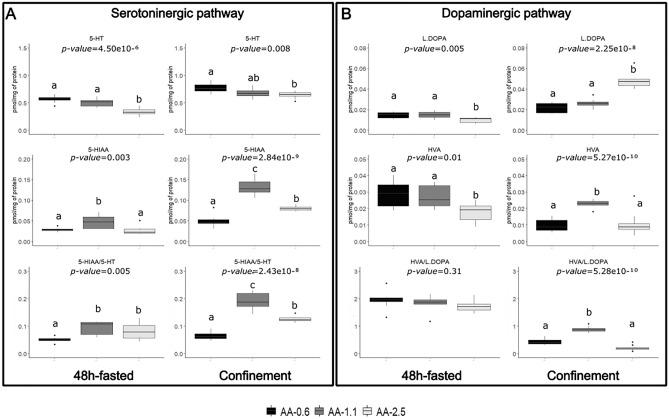
Arachidonic acid (C20: 4n-6, AA) plays a fundamental role in fish physiology, influencing growth, survival and stress resistance. However, imbalances in dietary AA can have detrimental effects on fish health and performance. Optimal AA requirements for rainbow trout have not been established. This study aimed to elucidate the effects of varying dietary AA levels on survival, growth, long-chain polyunsaturated fatty acid (LC-PUFA) biosynthetic capacity, oxylipin profiles, lipid peroxidation, and stress resistance of rainbow trout fry. Over a period of eight weeks, 4000 female rainbow trout fry at the resorptive stage (0.12 g) from their first feeding were fed diets with varying levels of AA (0.6%, 1.1% or 2.5% of total fatty acids) while survival and growth metrics were closely monitored. The dietary trial was followed by an acute confinement stress test. Notably, while the fatty acid profiles of the fish reflected dietary intake, those fed an AA-0.6% diet showed increased expression of elongase5, highlighting their inherent ability to produce LC-PUFAs from C18 PUFAs and suggesting potential AA or docosapentaenoic acid (DPA) biosynthesis. However, even with this biosynthetic capacity, the trout fed reduced dietary AA had higher mortality rates. The diet had no effect on final weight (3.38 g on average for the three diets). Conversely, increased dietary AA enhanced eicosanoid production from AA, suggesting potential inflammatory and oxidative consequences. This was further evidenced by an increase in non-enzymatic lipid oxidation metabolites, particularly in the AA-2.5% diet group, which had higher levels of phytoprostanes and isoprostanes, markers of cellular oxidative damage. Importantly, the AA-1.1% diet proved to be particularly beneficial for stress resilience. This was evidenced by higher post-stress turnover rates of serotonin and dopamine, neurotransmitters central to the fish's stress response. In conclusion, a dietary AA intake of 1.1% of total fatty acids appears to promote overall resilience in rainbow trout fry.
花生四烯酸(C20: 4n-6,AA)在鱼类生理学中起着至关重要的作用,影响生长、存活和应激抵抗能力。然而,饮食中 AA 的不平衡会对鱼类的健康和性能产生不利影响。虹鳟鱼的最佳 AA 需要量尚未确定。本研究旨在阐明不同饮食 AA 水平对虹鳟鱼苗存活、生长、长链多不饱和脂肪酸(LC-PUFA)生物合成能力、氧化脂蛋白谱、脂质过氧化和应激抵抗的影响。在为期八周的时间里,4000 条处于吸收阶段(0.12g)的雌性虹鳟鱼苗从第一次摄食开始,喂食含有不同 AA 水平(总脂肪酸的 0.6%、1.1%或 2.5%)的饮食,同时密切监测存活和生长指标。随后进行了急性约束应激试验。值得注意的是,虽然鱼类的脂肪酸谱反映了饮食摄入,但喂食 AA-0.6%饮食的鱼类表现出延长酶 5 的表达增加,这突出了它们从 C18 多不饱和脂肪酸产生 LC-PUFAs 的内在能力,并表明潜在的 AA 或二十二碳五烯酸(DPA)生物合成。然而,即使有这种生物合成能力,喂食低 AA 饮食的虹鳟鱼苗死亡率也更高。饮食对最终体重没有影响(三种饮食的平均最终体重为 3.38g)。相反,增加饮食 AA 会增强 AA 衍生的类二十烷酸的产生,表明可能存在炎症和氧化后果。这进一步通过非酶促脂质氧化代谢物的增加得到证实,特别是在 AA-2.5%饮食组中,其植物前列腺素和异前列腺素水平更高,这是细胞氧化损伤的标志物。重要的是,AA-1.1%饮食对应激恢复特别有益。这可以从应激后血清素和多巴胺的周转率升高得到证明,血清素和多巴胺是鱼类应激反应的核心神经递质。总之,虹鳟鱼苗总脂肪中 AA 的摄入量为 1.1%似乎可以促进其整体抗逆性。


 Zotero 插件