
肥胖与德黑兰居民心理健康风险之间的剂量-反应关系:一项横断面研究的结果。
Dose-response association of obesity and risk of mental health among tehranian residents: result of a cross-sectional study.
机构信息
Department of Community Nutrition, School of Nutritional Sciences and Dietetics, Tehran University of Medical Sciences, Tehran, Iran.
Social Determinants of Health Research Center, Semnan University of Medical Sciences, Semnan, Iran.
出版信息
BMC Public Health. 2024 May 29;24(1):1444. doi: 10.1186/s12889-024-18670-z.
BACKGROUND
Obesity and mental health issues are two of the most prevalent global public health issues for a significant portion of people. The purpose of this study was to investigate the relationship between obesity indicators and mental health in Tehran-dwelling Iranian adults.
METHODS
We conducted a cross-sectional study on healthy Iranian adults using a convenience sampling technique. The short form of the Depression Anxiety and Stress Scale (DASS-21) was used to measure the outcome, and independent variables included body mass index (BMI), waist-to-hip ratio (WHR), waist-to-height ratio (WHtR), body adiposity index (BAI), and a body shape index (ABSI). The relationship between obesity and mental health was investigated using a multivariate logistic regression model. The non-linear dose-response relationships were evaluated using restricted cubic splines (RCS) with three knots. The Benjamini-Hochberg procedure was used to adjust for multiple testing.
RESULTS
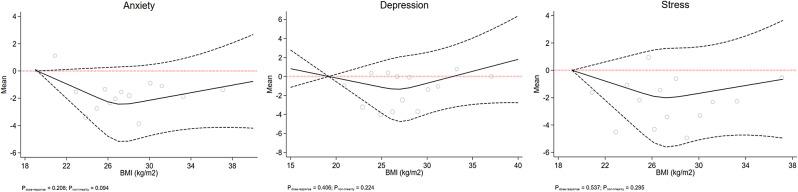
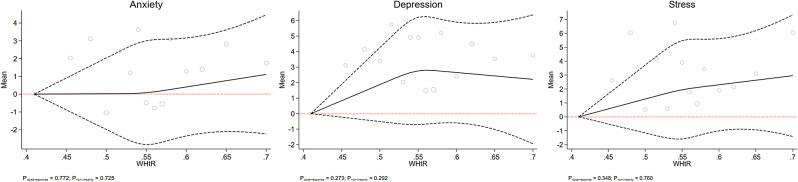
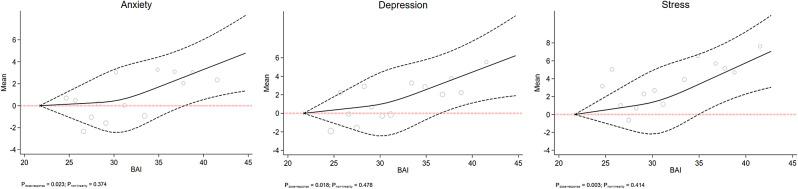
In our study of 434 participants, females made up 52% of the participants, with a mean age of 38.57 years. In all, 54.6%, 53.9%, and 56.6% were classified as having anxiety, depression, and stress respectively. Logistic regression analysis showed that the odds of mental health components including anxiety, depression, or stress was not significantly different across the tertiles of the obesity indicators. We observed a significant dose-response relationship between BAI and ABSI and the risk of anxiety (P 0.028 > P 0.023) and stress (P 0.028 > P 0.003) but not depression (P 0.014 < P 0.018). The lowest risk for anxiety was observed in people with a BAI of 28% and ABSI equal to 0.079. The risk of stress seemed to increase beyond an ABSI of 0.086.
CONCLUSION
Our findings showed no direct linear association between obesity indices and anxiety. However, a dose-response relationship was observed between BAI and ABSI and the risk of anxiety and stress, indicating the need for further investigation.
背景
肥胖和心理健康问题是全球大部分人面临的两个最普遍的公共卫生问题。本研究旨在探讨伊朗德黑兰成年人肥胖指标与心理健康之间的关系。
方法
我们采用便利抽样技术对健康的伊朗成年人进行了横断面研究。使用抑郁焦虑和压力量表(DASS-21)的简短形式来衡量结果,而独立变量包括体重指数(BMI)、腰臀比(WHR)、腰围身高比(WHtR)、体脂指数(BAI)和身体形状指数(ABSI)。使用多元逻辑回归模型研究肥胖与心理健康之间的关系。使用具有三个结的受限立方样条(RCS)评估非线性剂量反应关系。使用 Benjamini-Hochberg 程序进行多重测试调整。
结果
在我们的 434 名参与者研究中,女性占 52%,平均年龄为 38.57 岁。共有 54.6%、53.9%和 56.6%分别被归类为患有焦虑症、抑郁症和压力症。逻辑回归分析显示,在肥胖指标的三分位组中,心理健康成分(包括焦虑、抑郁和压力)的可能性没有明显差异。我们观察到 BAI 和 ABSI 与焦虑(P 0.028 > P 0.023)和压力(P 0.028 > P 0.003)的风险之间存在显著的剂量反应关系,但与抑郁(P 0.014 < P 0.018)无关。焦虑风险最低的人群是 BAI 为 28%且 ABSI 等于 0.079 的人群。压力风险似乎在 ABSI 超过 0.086 后增加。
结论
我们的研究结果表明肥胖指数与焦虑之间没有直接的线性关联。然而,我们观察到 BAI 和 ABSI 与焦虑和压力风险之间存在剂量反应关系,这表明需要进一步研究。


 Zotero 插件