
描述新处方镇静催眠药物使用者中偶发性阿片类药物使用情况:一项全国队列研究。
Characterising incident opioid use among incident users of prescription sedative hypnotics: A national cohort study.
机构信息
Department of Pharmaceutical Health Outcomes and Policy, University of Houston College of Pharmacy, Houston, Texas, USA
Prescription Drug Misuse Education and Research (PREMIER) Center, University of Houston College of Pharmacy, Houston, Texas, USA.
出版信息
BMJ Open. 2024 May 30;14(5):e082339. doi: 10.1136/bmjopen-2023-082339.
OBJECTIVE
To evaluate co-prescribing of sedatives hypnotics and opioids.
DESIGN
Retrospective study evaluating the association of patient characteristics and comorbidities with coprescribing.
SETTING AND PARTICIPANTS
Using the national Merative MarketScan Database between 2005 and 2018, we identified patients who received an incident sedative prescription with or without subsequent, incident opioid prescriptions within a year of the sedative prescription in the USA.
OUTCOME MEASURES
Coprescription of sedative-hypnotics and opioids.
RESULTS
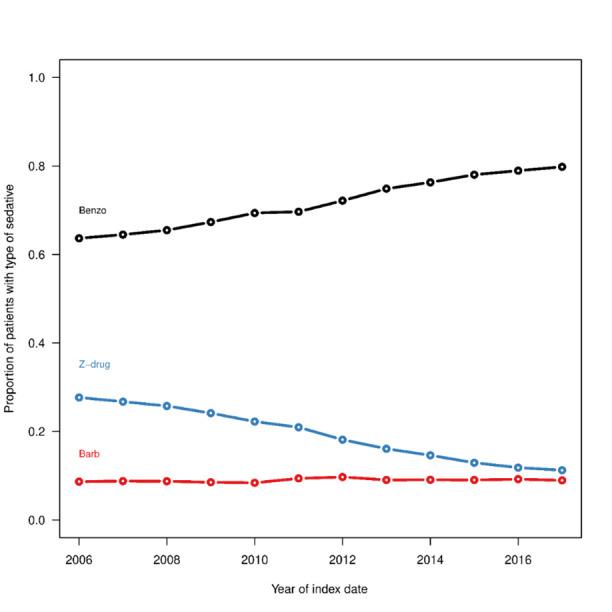
A total of 2 632 622 patients (mean (SD) age, 43.2 (12.34) years; 1 297 356 (62.5%) female) received incident prescriptions for sedatives over the course of the study period. The largest proportion of sedative prescribing included benzodiazepines (71.1%); however, z-drugs (19.9%) and barbiturates (9%) were also common. About 557 845 (21.2%) patients with incident sedatives also received incident opioid prescriptions. About 59.2% of these coprescribed patients received opioids coprescription on the same day. Multivariate logistic regression findings showed that individuals with a comorbidity index score of 1, 2 or ≥3 (aOR 1.19 (95% CI 1.17 to 1.21), 1.17 (95% C 1.14 to 1.19) and 1.25 (95% C 1.2 to 1.31)) and substance use disorder (1.21 (95% C 1.19 to 1.23)) were more likely to be coprescribed opioids and sedatives. The likelihood of receiving both opioid and sedative prescriptions was lower for female patients (aOR 0.93; 95% CI 0.92 to 0.94), and those receiving a barbiturate (aOR 0.3; 95% CI 0.29 to 0.31) or z-drugs (aOR 0.67; 95% CI 0.66 to 0.68) prescriptions at the index date.
CONCLUSIONS
Coprescription of sedatives with opioids was associated with the presence of comorbidities and substance use disorder, gender and types of sedatives prescribed at the index date. Additionally, more than half of the coprescribing occurred on the same day which warrants further evaluation of current prescribing and dispensing best practice guidelines.
目的
评估镇静催眠药和阿片类药物的联合使用情况。
设计
回顾性研究,评估患者特征和合并症与联合用药的相关性。
地点和参与者
使用美国全国 Merative MarketScan 数据库,我们在 2005 年至 2018 年间,识别出在镇静药物处方后一年内接受阿片类药物联合使用的患者。
结局测量
镇静催眠药和阿片类药物的联合使用情况。
结果
在研究期间,共有 2632622 名(平均(SD)年龄,43.2(12.34)岁;1297356 名(62.5%)为女性)患者接受了镇静药物的首发处方。最大比例的镇静药物处方包括苯二氮䓬类药物(71.1%);然而,Z 类药物(19.9%)和巴比妥类药物(9%)也很常见。约 557845 名有镇静药物首发处方的患者也接受了阿片类药物的首发处方。约 59.2%的联合用药患者在同一天接受了阿片类药物联合处方。多变量逻辑回归结果显示,共病指数评分为 1、2 或≥3(比值比 1.19(95%置信区间 1.17 至 1.21)、1.17(95%置信区间 1.14 至 1.19)和 1.25(95%置信区间 1.2 至 1.31))和物质使用障碍(1.21(95%置信区间 1.19 至 1.23))的患者更有可能同时接受阿片类药物和镇静剂处方。女性患者(比值比 0.93;95%置信区间 0.92 至 0.94)和接受巴比妥类药物(比值比 0.3;95%置信区间 0.29 至 0.31)或 Z 类药物(比值比 0.67;95%置信区间 0.66 至 0.68)处方的患者接受阿片类药物和镇静剂联合处方的可能性较低。
结论
镇静剂与阿片类药物联合使用与合并症和物质使用障碍、性别以及索引日期开的镇静剂类型有关。此外,超过一半的联合用药发生在同一天,这需要进一步评估当前的处方和配药最佳实践指南。
 Zotero 插件