
40 年来气候因素对登革热的长期影响。
Long-term effects of climate factors on dengue fever over a 40-year period.
机构信息
State Key Laboratory of Resources and Environmental Information System, Institute of Geographical Sciences and Natural Resources Research, Chinese Academy of Sciences, Beijing, China.
College of Resources and Environment, University of Chinese Academy of Sciences, Beijing, China.
出版信息
BMC Public Health. 2024 May 30;24(1):1451. doi: 10.1186/s12889-024-18869-0.
BACKGROUND
Dengue fever stands as one of the most extensively disseminated mosquito-borne infectious diseases worldwide. While numerous studies have investigated its influencing factors, a gap remains in long-term analysis, impeding the identification of temporal patterns, periodicity in transmission, and the development of effective prevention and control strategies. Thus, we aim to analyze the periodicity of dengue fever incidence and explore the association between various climate factors and the disease over an extended time series.
METHODS
By utilizing monthly dengue fever cases and climate data spanning four decades (1978-2018) in Guangdong province, China, we employed wavelet analysis to detect dengue fever periodicity and analyze the time-lag relationship with climate factors. Additionally, Geodetector q statistic was employed to quantify the explanatory power of each climate factor and assess interaction effects.
RESULTS
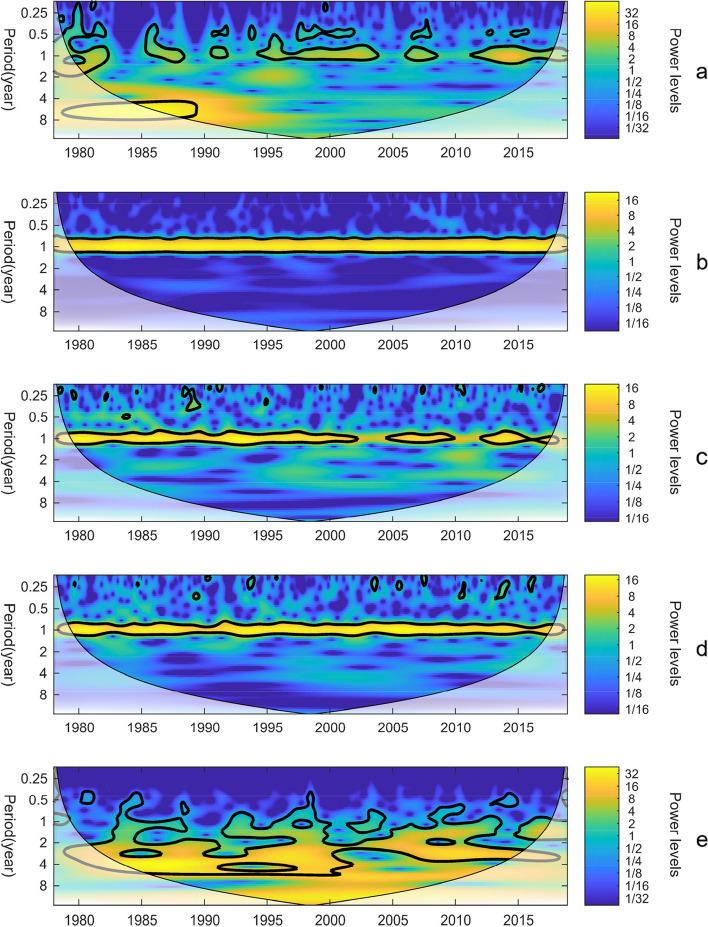
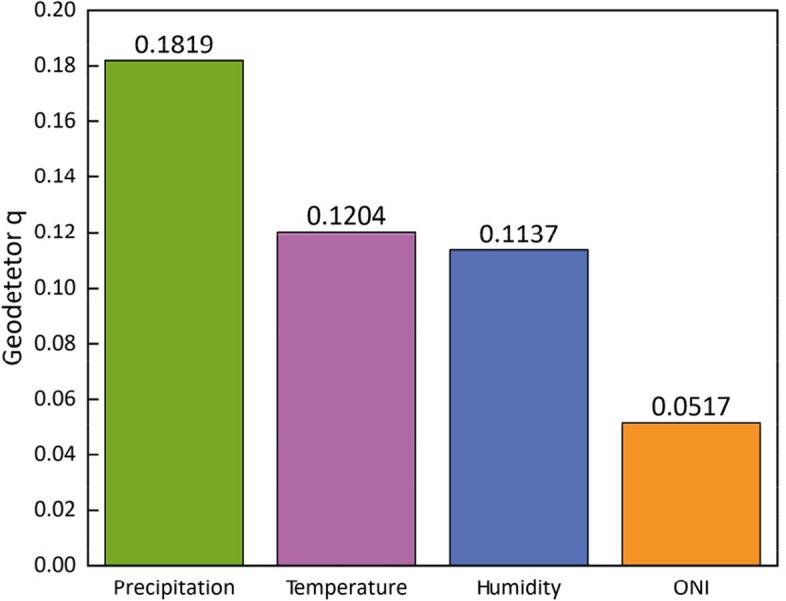
Our findings revealed a prolonged transmission period of dengue fever over the 40-year period, transitioning from August to November in the 1970s to nearly year-round in the 2010s. Moreover, we observed lags of 1.5, 3.5, and 3 months between dengue fever and temperature, relative humidity, and precipitation, respectively. The explanatory power of precipitation, temperature, relative humidity, and the Oceanic Niño Index (ONI) on dengue fever was determined to be 18.19%, 12.04%, 11.37%, and 5.17%, respectively. Dengue fever exhibited susceptibility to various climate factors, with notable nonlinear enhancement arising from the interaction of any two variables. Notably, the interaction between precipitation and humidity yielded the most significant effect, accounting for an explanatory power of 75.32%.
CONCLUSIONS
Consequently, future prevention and control strategies for dengue fever should take into account these climate changes and formulate corresponding measures accordingly. In regions experiencing the onset of high temperatures, humidity, and precipitation, it is imperative to initiate mosquito prevention and control measures within a specific window period of 1.5 months.
背景
登革热是全球传播最广泛的蚊媒传染病之一。虽然已有大量研究探讨其影响因素,但缺乏长期分析,难以确定时间模式、传播周期性,以及制定有效的预防和控制策略。因此,我们旨在分析登革热发病率的周期性,并在长时间序列上探讨各种气候因素与该疾病的关联。
方法
利用中国广东省 40 年来(1978-2018 年)的每月登革热病例和气候数据,我们采用小波分析来检测登革热的周期性,并分析与气候因素的时滞关系。此外,还采用地理探测器 q 统计量来量化每个气候因素的解释能力,并评估交互作用。
结果
我们的研究结果表明,登革热的传播期在 40 年间延长,从 70 年代 8 月至 11 月转变为 21 世纪 10 年代几乎全年。此外,我们观察到登革热与温度、相对湿度和降水之间分别存在 1.5、3.5 和 3 个月的滞后。降水、温度、相对湿度和海洋尼诺指数(ONI)对登革热的解释能力分别为 18.19%、12.04%、11.37%和 5.17%。登革热对各种气候因素具有易感性,并且两个变量之间的相互作用会产生显著的非线性增强。值得注意的是,降水和湿度之间的相互作用产生了最显著的影响,解释能力为 75.32%。
结论
因此,未来的登革热预防和控制策略应考虑这些气候变化,并相应地制定相应的措施。在高温、高湿度和高降水地区,必须在 1.5 个月的特定窗口期内启动蚊虫预防和控制措施。



 Zotero 插件