
用于在不同水生环境中高效太阳能驱动催化有害染料的Semal-ZnO纳米颗粒的绿色制备路线。
Green route to fabrication of Semal-ZnO nanoparticles for efficient solar-driven catalysis of noxious dyes in diverse aquatic environments.
作者信息
Lal Ratan, Gour Tripti, Dave Narendra, Singh Niharika, Yadav Jigyasu, Khan Afshin, Jain Akshita, Agarwal Lokesh Kumar, Sharma Yogesh Kumar, Sharma Kuldeep
机构信息
Department of Botany, Mohanlal Sukhadia University, Udaipur, Rajasthan, India.
Department of Chemistry, Mohanlal Sukhadia University, Udaipur, Rajasthan, India.
出版信息
Front Chem. 2024 May 16;12:1370667. doi: 10.3389/fchem.2024.1370667. eCollection 2024.
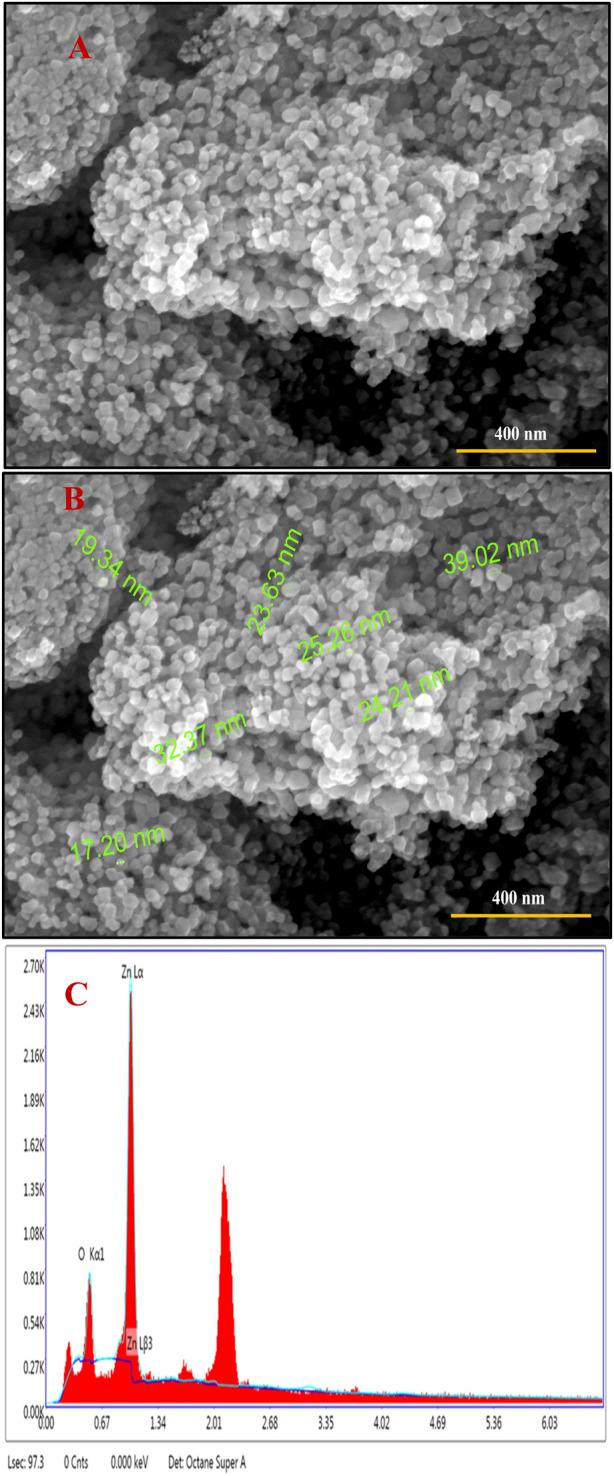
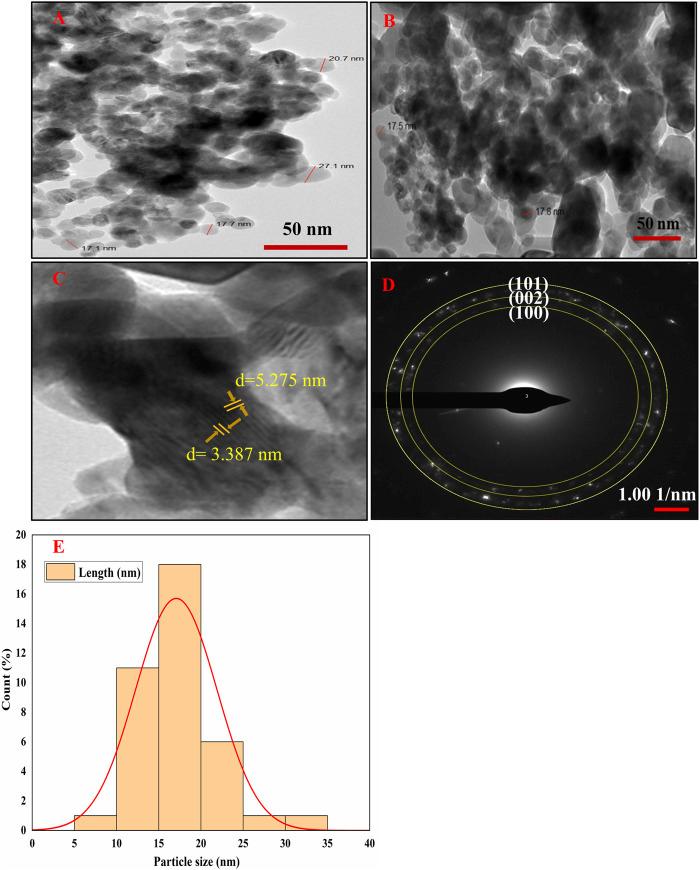
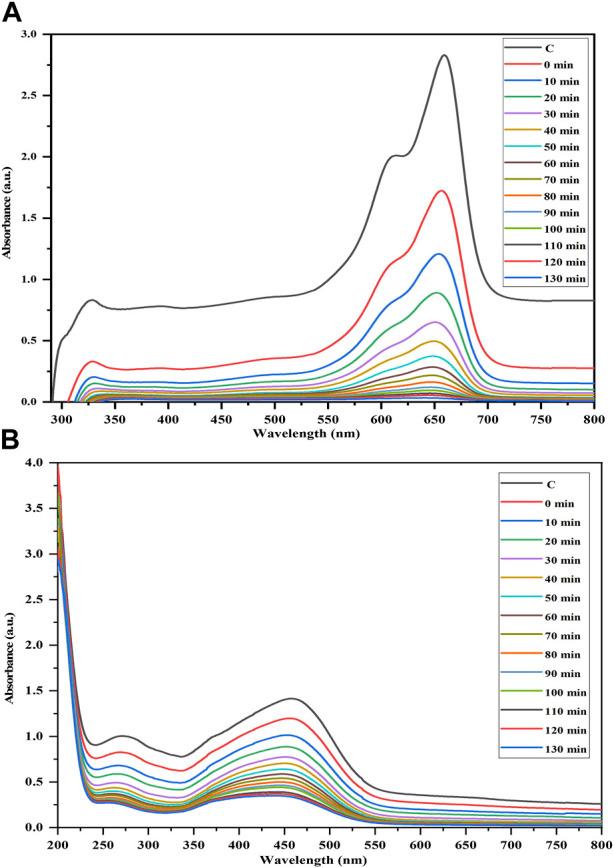
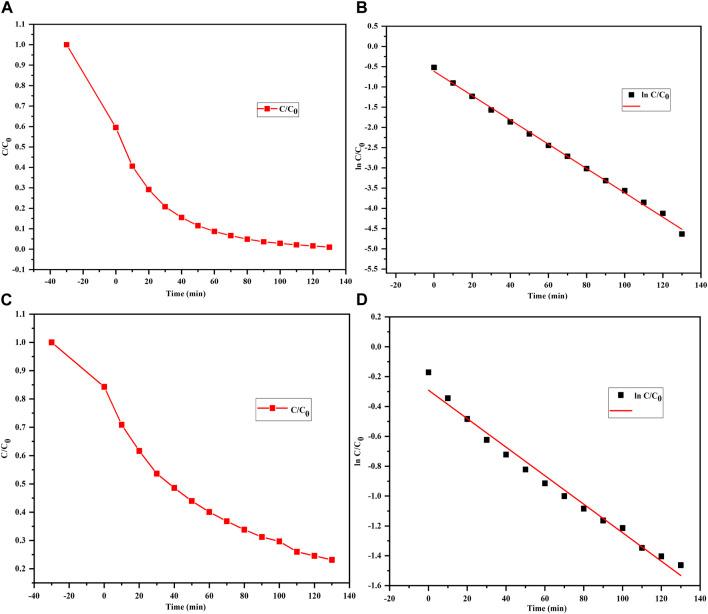
This work successfully demonstrates a sustainable and environmentally friendly approach for synthesizing Semal-ZnO nanoparticles (NPs) using the aqueous leaf extract of L. These NPs exhibit an absorption peak at approximately 390 nm in the UV-visible spectrum and an energy gap (E) of 3.11 eV. Detailed analyses of the morphology and particle size using various spectroscopic and microscopic techniques, XRD, FE-SEM with EDS, and HR-TEM reveal crystallographic peaks attributable to the hexagonal phase, with an average crystal size of 17 nm. The Semal-ZnO NPs also exhibit a notable photocatalytic efficiency for degrading methylene blue (MB) and methyl orange (MO) under sunlight in different water samples collected from diverse natural sources, indicating that they are promising photocatalysts for environmental remediation. The photocatalytic efficiency of the biofabricated Semal-ZnO NPs is impressive, exhibiting a photodegradation rate of up to 99% for MB and 79% for MO in different water samples under exposure to sunlight. The novel phytofabricated Semal-ZnO NPs are thus a beacon of hope for the environment, with their desirable photocatalytic efficiency, pseudo-first-order kinetics, and ability to break down noxious dye pollutants in various aquatic environments.
这项工作成功展示了一种可持续且环保的方法,即利用L.的水叶提取物合成塞马尔氧化锌纳米颗粒(NPs)。这些纳米颗粒在紫外可见光谱中约390nm处呈现吸收峰,能带隙(E)为3.11eV。使用各种光谱和显微镜技术、XRD、带能谱的场发射扫描电子显微镜(FE-SEM)和高分辨透射电子显微镜(HR-TEM)对形态和粒径进行的详细分析显示,存在归因于六方相的晶体峰,平均晶体尺寸为17nm。塞马尔氧化锌纳米颗粒在从不同天然来源采集的不同水样中,在阳光下对亚甲基蓝(MB)和甲基橙(MO)的降解也表现出显著的光催化效率,表明它们是用于环境修复的有前途的光催化剂。生物合成的塞马尔氧化锌纳米颗粒的光催化效率令人印象深刻,在暴露于阳光下的不同水样中,对MB的光降解率高达99%,对MO的光降解率为79%。因此,新型植物合成的塞马尔氧化锌纳米颗粒凭借其理想的光催化效率、准一级动力学以及在各种水生环境中分解有害染料污染物的能力,成为环境的希望之光。



 Zotero 插件