
德国真实世界PRAEGNANT注册研究中晚期乳腺癌患者前三线治疗的损耗情况
Attrition in the First Three Therapy Lines in Patients with Advanced Breast Cancer in the German Real-World PRAEGNANT Registry.
作者信息
Hartkopf Andreas D, Walter Christina B, Kolberg Hans-Christian, Hadji Peyman, Tesch Hans, Fasching Peter A, Ettl Johannes, Lüftner Diana, Wallwiener Markus, Müller Volkmar, Beckmann Matthias W, Belleville Erik, Huebner Hanna, Uhrig Sabrina, Goossens Chloë, Link Theresa, Hielscher Carsten, Mundhenke Christoph, Kurbacher Christian, Wuerstlein Rachel, Untch Michael, Janni Wolfgang, Taran Florin-Andrei, Michel Laura L, Lux Michael P, Wallwiener Diethelm, Brucker Sara Y, Fehm Tanja N, Häberle Lothar, Schneeweiss Andreas
机构信息
Breast Center and CCC Munich, Dept of Gynecology and Obstetrics, University Hospital LMU Munich, Munich, Germany.
Department of Obstetrics and Gynecology, University of Tübingen, Tübingen, Germany.
出版信息
Geburtshilfe Frauenheilkd. 2024 May 29;84(5):459-469. doi: 10.1055/a-2286-5372. eCollection 2024 May.
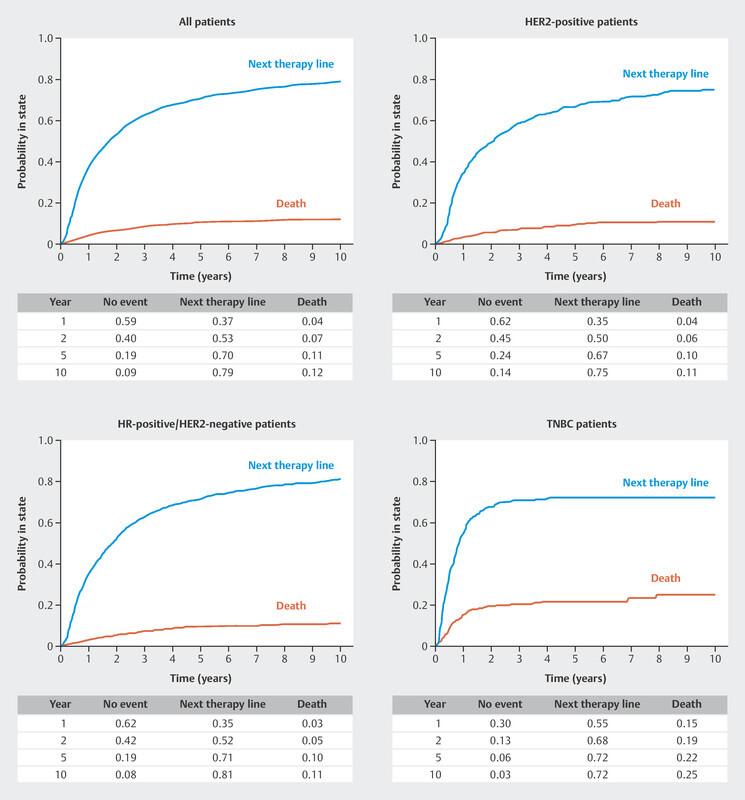
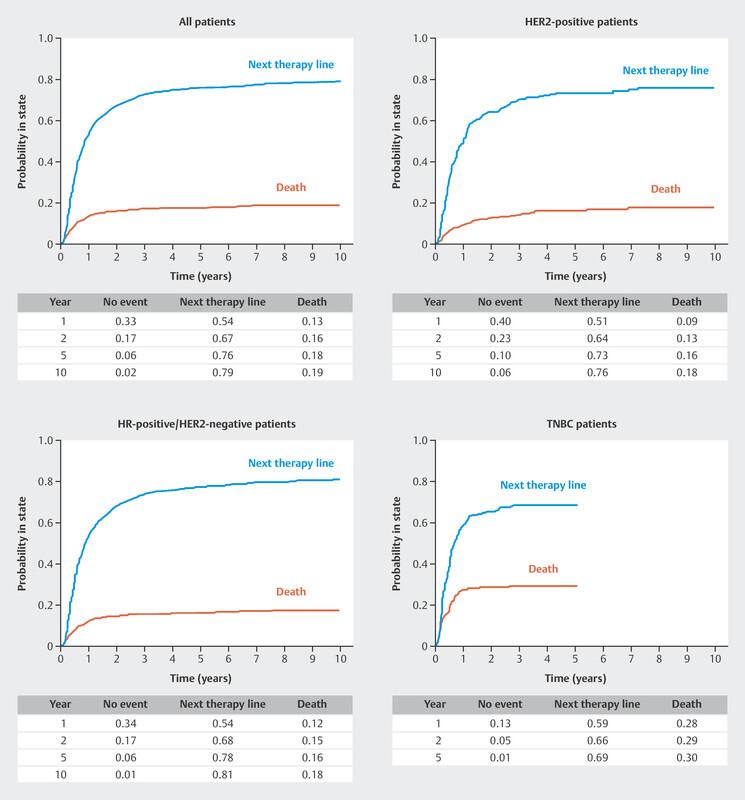
With more effective therapies for patients with advanced breast cancer (aBC), therapy sequences are becoming increasingly important. However, some patients might drop out of the treatment sequence due to deterioration of their life status. Since little is known about attrition in the real-world setting, this study assessed attrition in the first three therapy lines using a real-world registry. Patients with information available on the first three therapy lines were selected from the German PRAEGNANT registry (NCT02338167). Attrition was determined for each therapy line using competing risk analyses, with the start of the next therapy line or death as endpoints. Additionally, a simple attrition rate was calculated based on the proportion of patients who completed therapy but did not start the next therapy line. Competitive risk analyses were performed on 3988 1st line, 2651 2nd line and 1866 3rd line patients. The probabilities of not starting the next therapy line within 5 years after initiation of 1st, 2nd and 3rd line therapy were 30%, 24% and 24% respectively. Patients with HER2-positive disease had the highest risk for attrition, while patients with HRpos/HER2neg disease had the lowest risk. Attrition rates remained similar across molecular subgroups in the different therapy lines. Attrition affects a large proportion of patients with aBC, which should be considered when planning novel therapy concepts that specifically address the sequencing of therapies. Taking attrition into account could help understand treatment effects resulting from sequential therapies and might help develop treatment strategies that specifically aim at maintaining quality of life.
对于晚期乳腺癌(aBC)患者而言,随着更有效的治疗方法出现,治疗顺序变得愈发重要。然而,一些患者可能会因生活状况恶化而退出治疗序列。由于对现实环境中的脱落情况知之甚少,本研究使用一个现实世界登记系统评估了前三线治疗中的脱落情况。从德国PRAEGNANT登记系统(NCT02338167)中选取了在前三线治疗中有可用信息的患者。使用竞争风险分析确定每条治疗线的脱落情况,以下一线治疗开始或死亡作为终点。此外,根据完成治疗但未开始下一线治疗的患者比例计算了一个简单的脱落率。对3988例一线、2651例二线和1866例三线患者进行了竞争风险分析。一线、二线和三线治疗开始后5年内未开始下一线治疗的概率分别为30%、24%和24%。HER2阳性疾病患者的脱落风险最高,而HR阳性/HER2阴性疾病患者的风险最低。不同治疗线中各分子亚组的脱落率保持相似。脱落影响了很大一部分aBC患者,在规划专门针对治疗顺序的新治疗方案时应予以考虑。考虑脱落情况有助于理解序贯治疗产生的治疗效果,并可能有助于制定专门旨在维持生活质量的治疗策略。


 Zotero 插件