
可溶性髓系细胞触发受体-1作为细菌移位的生物标志物及肝硬化患者益生菌使用指征
Presepsin as a biomarker of bacterial translocation and an indicator for the prescription of probiotics in cirrhosis.
作者信息
Efremova Irina, Maslennikov Roman, Poluektova Elena, Medvedev Oleg, Kudryavtseva Anna, Krasnov George, Fedorova Maria, Romanikhin Filipp, Zharkova Maria, Zolnikova Oxana, Bagieva Gyunay, Ivashkin Vladimir
机构信息
Department of Internal Medicine, Gastroenterology and Hepatology, Sechenov University, Moscow 119435, Russia.
Department of Scientific, Scientific Community for the Promotion of the Clinical Study of the Human Microbiome, Moscow 119435, Russia.
出版信息
World J Hepatol. 2024 May 27;16(5):822-831. doi: 10.4254/wjh.v16.i5.822.
BACKGROUND
The gut-liver axis and bacterial translocation are important in cirrhosis, but there is no available universal biomarker of cellular bacterial translocation, for which presepsin may be a candidate.
AIM
To evaluate the relationship of the blood presepsin levels with the state of the gut microbiota in cirrhosis in the absence of obvious infection.
METHODS
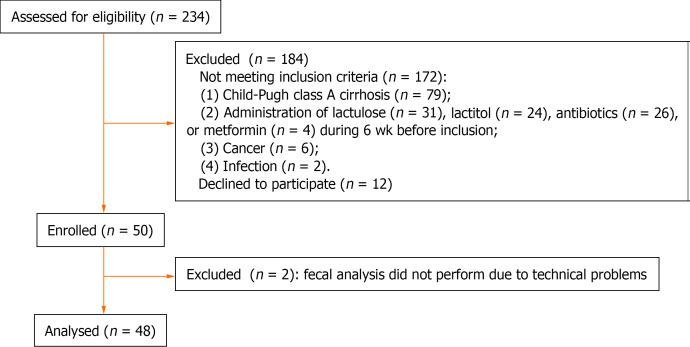
This study included 48 patients with Child-Pugh cirrhosis classes B and C and 15 healthy controls. The fecal microbiome was assessed using 16S rRNA gene sequencing. Plasma levels of presepsin were measured. A total of 22 patients received a probiotic () for 3 months.
RESULTS
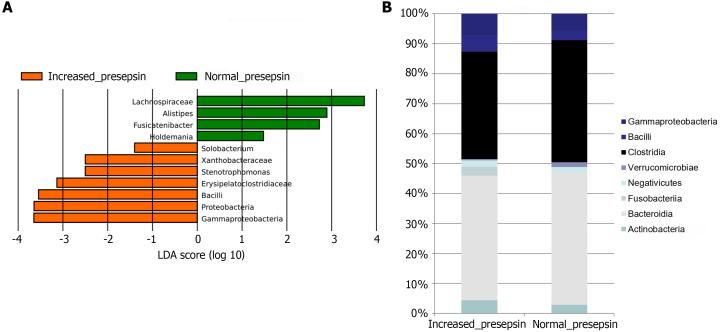
Presepsin levels were higher in patients with cirrhosis than in healthy individuals [342 (91-2875) 120 (102-141) pg/mL; = 0.048]. Patients with elevated presepsin levels accounted for 56.3% of all included patients. They had lower levels of serum albumin and higher levels of serum total bilirubin and overall severity of cirrhosis as assessed using the Child-Pugh scale. Patients with elevated presepsin levels had an increased abundance of the main taxa responsible for bacterial translocation, namely Bacilli and Proteobacteria (including the main class Gammaproteobacteria and the minor taxa Xanthobacteraceae and Stenotrophomonas), and a low abundance of bacteria from the family Lachnospiraceae (including the minor genus Fusicatenibacter), which produce short-chain fatty acids that have a positive effect on intestinal barrier function. The presepsin level directly correlated with the relative abundance of Bacilli, Proteobacteria, and inversely correlated with the abundance of Lachnospiraceae and Propionibacteriaceae. After 3 months of taking the probiotic, the severity of cirrhosis on the Child-Pugh scale decreased significantly only in the group with elevated presepsin levels [from 9 (8-11) to 7 (6-9); = 0.004], while there were no significant changes in the group with normal presepsin levels [from 8 (7-8) to 7 (6-8); = 0.123]. A high level of presepsin before the prescription of the probiotic was an independent predictor of a greater decrease in Child-Pugh scores ( = 0.046), as well as a higher level of the Child-Pugh scale ( = 0.042), but not the C-reactive protein level ( = 0.679) according to multivariate linear regression analysis.
CONCLUSION
The level of presepsin directly correlates with the abundance in the gut microbiota of the main taxa that are substrates of bacterial translocation in cirrhosis. This biomarker, in the absence of obvious infection, seems important for assessing the state of the gut-liver axis in cirrhosis and deciding on therapy targeted at the gut microbiota in this disease.
背景
肠-肝轴和细菌易位在肝硬化中具有重要意义,但目前尚无通用的细胞细菌易位生物标志物,而可溶性髓系细胞触发受体-1(presepsin)可能是一个候选指标。
目的
评估在无明显感染的肝硬化患者中,血液presepsin水平与肠道微生物群状态的关系。
方法
本研究纳入48例Child-Pugh B级和C级肝硬化患者及15名健康对照者。采用16S rRNA基因测序评估粪便微生物群。检测血浆presepsin水平。共22例患者接受益生菌治疗3个月。
结果
肝硬化患者的presepsin水平高于健康个体[342(91-2875) vs 120(102-141)pg/mL;P = 0.048]。presepsin水平升高的患者占所有纳入患者的56.3%。他们的血清白蛋白水平较低,血清总胆红素水平较高,且根据Child-Pugh量表评估的肝硬化总体严重程度较高。presepsin水平升高的患者中,负责细菌易位的主要分类群(即芽孢杆菌属和变形菌门,包括主要类群γ-变形菌纲以及次要分类群黄杆菌科和嗜麦芽窄食单胞菌)丰度增加,而产生对肠道屏障功能有积极影响的短链脂肪酸的毛螺菌科(包括次要属梭菌属)细菌丰度较低。presepsin水平与芽孢杆菌属、变形菌门的相对丰度直接相关,与毛螺菌科和丙酸杆菌科的丰度呈负相关。服用益生菌3个月后,仅presepsin水平升高组的Child-Pugh量表评估的肝硬化严重程度显著降低[从9(8-11)降至7(6-9);P = 0.004],而presepsin水平正常组无显著变化[从8(7-8)降至7(6-8);P = 0.123]。根据多因素线性回归分析,益生菌处方前presepsin水平高是Child-Pugh评分下降幅度更大(P = 0.046)以及Child-Pugh量表评分更高(P = 0.042)的独立预测因素,但不是C反应蛋白水平(P = 0.679)的独立预测因素。
结论
presepsin水平与肝硬化中作为细菌易位底物的主要分类群在肠道微生物群中的丰度直接相关。在无明显感染的情况下,该生物标志物对于评估肝硬化患者的肠-肝轴状态以及决定针对该疾病肠道微生物群的治疗似乎具有重要意义。
 Zotero 插件