
基于代理的建模研究:老年人护理设施中的 COVID-19 疫情爆发。
COVID-19 outbreaks in residential aged care facilities: an agent-based modeling study.
机构信息
Burnet Institute, Melbourne, VIC, Australia.
Department of Epidemiology and Preventive Medicine, Monash University, Melbourne, VIC, Australia.
出版信息
Front Public Health. 2024 May 21;12:1344916. doi: 10.3389/fpubh.2024.1344916. eCollection 2024.
INTRODUCTION
A disproportionate number of COVID-19 deaths occur in Residential Aged Care Facilities (RACFs), where better evidence is needed to target COVID-19 interventions to prevent mortality. This study used an agent-based model to assess the role of community prevalence, vaccination strategies, and non-pharmaceutical interventions (NPIs) on COVID-19 outcomes in RACFs in Victoria, Australia.
METHODS
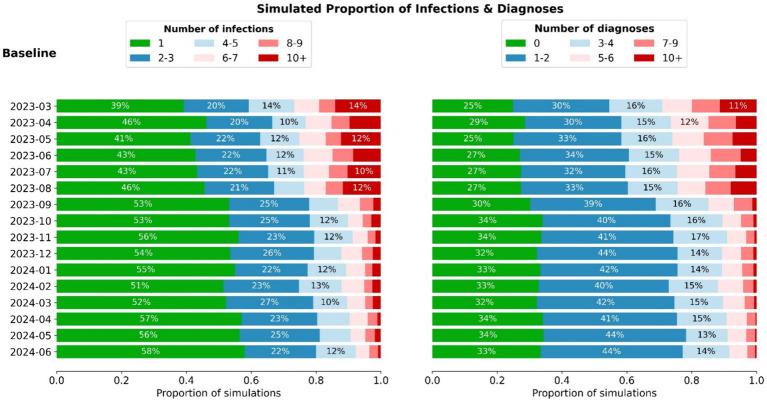
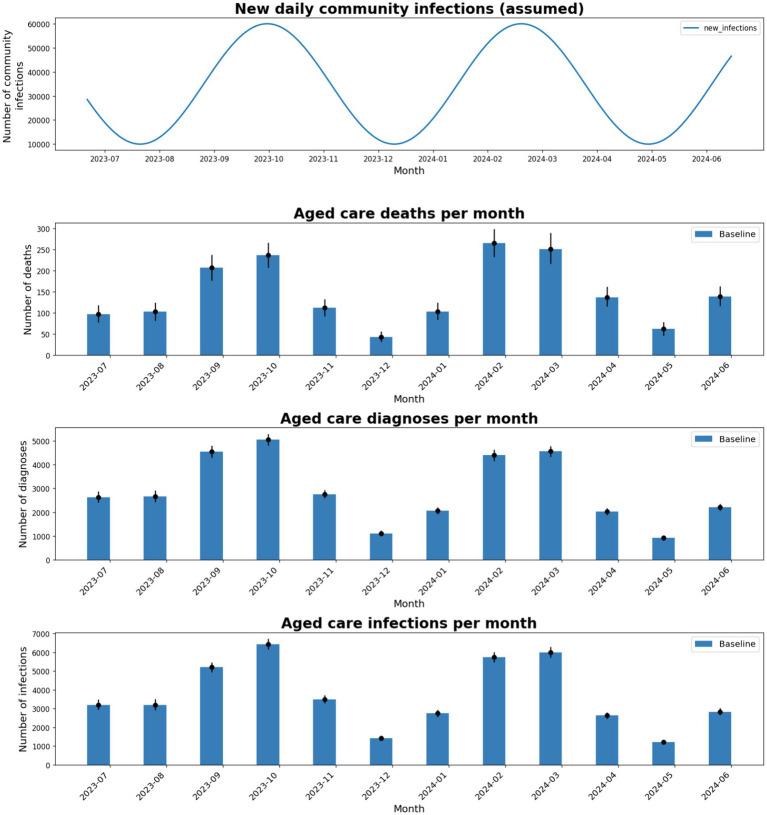
The model simulated outbreaks in RACFs over time, and was calibrated to distributions for outbreak size, outbreak duration, and case fatality rate in Victorian RACFs over 2022. The number of incursions to RACFs per day were estimated to fit total deaths and diagnoses over time and community prevalence.Total infections, diagnoses, and deaths in RACFs were estimated over July 2023-June 2024 under scenarios of different: community epidemic wave assumptions (magnitude and frequency); RACF vaccination strategies (6-monthly, 12-monthly, no further vaccines); additional non-pharmaceutical interventions (10, 25, 50% efficacy); and reduction in incursions (30% or 60%).
RESULTS
Total RACF outcomes were proportional to cumulative community infections and incursion rates, suggesting potential for strategic visitation/staff policies or community-based interventions to reduce deaths. Recency of vaccination when epidemic waves occurred was critical; compared with 6-monthly boosters, 12-monthly boosters had approximately 1.2 times more deaths and no further boosters had approximately 1.6 times more deaths over July 2023-June 2024. Additional NPIs, even with only 10-25% efficacy, could lead to a 13-31% reduction in deaths in RACFs.
CONCLUSION
Future community epidemic wave patterns are unknown but will be major drivers of outcomes in RACFs. Maintaining high coverage of recent vaccination, minimizing incursions, and increasing NPIs can have a major impact on cumulative infections and deaths.
简介
COVID-19 死亡病例中有相当大比例发生在养老院(RACFs),需要更好的证据来针对 COVID-19 干预措施以预防死亡。本研究使用基于代理的模型来评估社区流行率、疫苗接种策略和非药物干预(NPIs)在澳大利亚维多利亚州 RACFs 中 COVID-19 结局的作用。
方法
该模型随时间模拟 RACFs 中的暴发,并根据 2022 年维多利亚州 RACFs 中暴发规模、暴发持续时间和病例死亡率的分布进行校准。每天进入 RACFs 的传入次数是根据总死亡人数和随时间推移的诊断以及社区流行率来估计的。根据不同的假设(幅度和频率),对 2023 年 7 月至 2024 年 6 月期间的社区流行波假设、RACF 疫苗接种策略(每 6 个月、每 12 个月、不再接种疫苗)、额外的非药物干预措施(10%、25%、50% 效果)和传入减少(30% 或 60%)情况下 RACFs 中的总感染、诊断和死亡人数进行了估计。
结果
RACF 的总结果与累积社区感染和传入率成正比,这表明可能需要采取战略性探视/员工政策或社区为基础的干预措施来减少死亡。当流行波发生时,最近接种疫苗的时间至关重要;与每 6 个月的加强针相比,每 12 个月的加强针在 2023 年 7 月至 2024 年 6 月期间的死亡人数增加了约 1.2 倍,而不再接种疫苗的死亡人数增加了约 1.6 倍。即使只有 10-25%的效果,额外的非药物干预措施也可以使 RACFs 的死亡人数减少 13-31%。
结论
未来的社区流行波模式尚不清楚,但将是 RACFs 结果的主要驱动因素。保持最近接种疫苗的高覆盖率、最大限度地减少传入、增加非药物干预措施可以对累积感染和死亡人数产生重大影响。



 Zotero 插件