
具有明确结构的蘑菇衍生生物活性成分在缓解阿尔茨海默病发病机制中的作用。
Mushroom-derived bioactive components with definite structures in alleviating the pathogenesis of Alzheimer's disease.
作者信息
Jiang Xue, Song Yu, Lv Changshun, Li Yinghui, Feng Xiangru, Zhang Hao, Chen Yujuan, Wang Qingshuang
机构信息
College of Life Science and Technology, Changchun University of Science and Technology, Changchun, China.
Koch Biotechnology (Beijing) Co., Ltd., Beijing, China.
出版信息
Front Pharmacol. 2024 May 21;15:1373660. doi: 10.3389/fphar.2024.1373660. eCollection 2024.
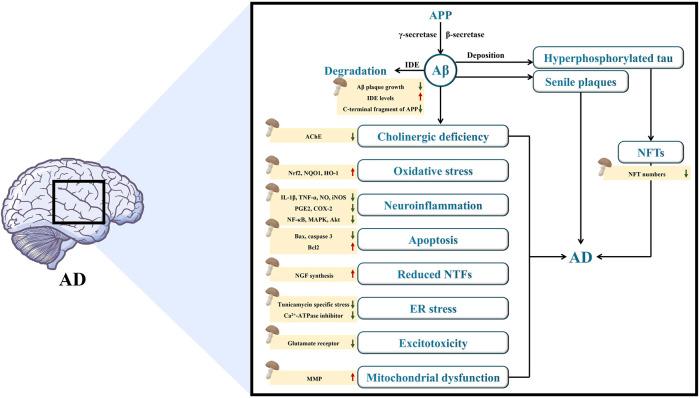
Alzheimer's disease (AD) is a complicated neurodegenerative condition with two forms: familial and sporadic. The familial presentation is marked by autosomal dominance, typically occurring early in individuals under 65 years of age, while the sporadic presentation is late-onset, occurring in individuals over the age of 65. The majority of AD cases are characterized by late-onset and sporadic. Despite extensive research conducted over several decades, there is a scarcity of effective therapies and strategies. Considering the lack of a cure for AD, it is essential to explore alternative natural substances with higher efficacy and fewer side effects for AD treatment. Bioactive compounds derived from mushrooms have demonstrated significant potential in AD prevention and treatment by different mechanisms such as targeting amyloid formation, tau, cholinesterase dysfunction, oxidative stress, neuroinflammation, neuronal apoptosis, neurotrophic factors, ER stress, excitotoxicity, and mitochondrial dysfunction. These compounds have garnered considerable interest from the academic community owing to their advantages of multi-channel, multi-target, high safety and low toxicity. This review focuses on the various mechanisms involved in the development and progression of AD, presents the regulatory effects of bioactive components with definite structure from mushroom on AD in recent years, highlights the possible intervention pathways of mushroom bioactive components targeting different mechanisms, and discusses the clinical studies, limitations, and future perspectives of mushroom bioactive components in AD prevention and treatment.
阿尔茨海默病(AD)是一种复杂的神经退行性疾病,有两种形式:家族性和散发性。家族性表现以常染色体显性为特征,通常发生在65岁以下的个体中,且发病较早;而散发性表现为迟发性,发生在65岁以上的个体中。大多数AD病例的特征是迟发性和散发性。尽管几十年来进行了广泛的研究,但仍缺乏有效的治疗方法和策略。鉴于AD尚无治愈方法,探索疗效更高、副作用更少的天然替代物质用于AD治疗至关重要。源自蘑菇的生物活性化合物已通过多种机制在AD预防和治疗中显示出显著潜力,这些机制包括靶向淀粉样蛋白形成、tau蛋白、胆碱酯酶功能障碍、氧化应激、神经炎症、神经元凋亡、神经营养因子、内质网应激、兴奋性毒性和线粒体功能障碍。这些化合物因其多通道、多靶点、高安全性和低毒性的优势而受到学术界的广泛关注。本综述聚焦于AD发生和发展过程中涉及的各种机制,介绍了近年来具有明确结构的蘑菇生物活性成分对AD的调节作用,强调了蘑菇生物活性成分针对不同机制的可能干预途径,并讨论了蘑菇生物活性成分在AD预防和治疗中的临床研究、局限性及未来前景。





 Zotero 插件