
神经丝氨酸蛋白酶抑制剂、白细胞介素-33 和白细胞介素-17A 作为感染孕妇轻度抑郁综合征潜在标志物的研究。
Neuroserpin, IL-33 and IL-17A as potential markers of mild symptoms of depressive syndrome in -infected pregnant women.
机构信息
Laboratório de Imunobiologia da Inflamação, Departamento de Ciências Biológicas/ICEB, Universidade Federal de Ouro Preto, Ouro Preto, MG, Brazil.
Programa de Pós-Graduação em Saúde e Nutrição, Universidade Federal de Ouro Preto, Ouro Preto, MG, Brazil.
出版信息
Front Immunol. 2024 May 17;15:1394456. doi: 10.3389/fimmu.2024.1394456. eCollection 2024.
INTRODUCTION
Depressive syndrome (DS) is a common complication during pregnancy and the postpartum period, and is triggered by multiple organic/genetic and environmental factors. Clinical and biochemical follow-up is essential for the early diagnosis and prognosis of DS. The protozoan Toxoplasma gondii causes infectious damage to the fetus during parasite primary-infection. However, in long-term infections, pregnant women develop immune protection to protect the fetus, although they remain susceptible to pathological or inflammatory effects induced by T. gondii. This study aimed to investigate plasma inflammatory biomarkers in pregnant women seropositive and seronegative for T. gondii, with diagnoses of minor and moderate/severe DS.
METHODS
Pregnant women (n=45; age=18-39 years) were recruited during prenatal care at health centers in Ouro Preto, Minas Gerais, Brazil. Participants were asked to complete a socio-demographic questionnaire to be submitted to well-standardized DS scale calculators (Beck Depression Inventory Questionnaire, Edinburgh Postnatal Depression Scale, and Major Depressive Episode Module). Additionally, 4 mL of blood was collected for plasma neuroserpin, CCL2, IL-17A, and IL-33 analysis.
RESULTS
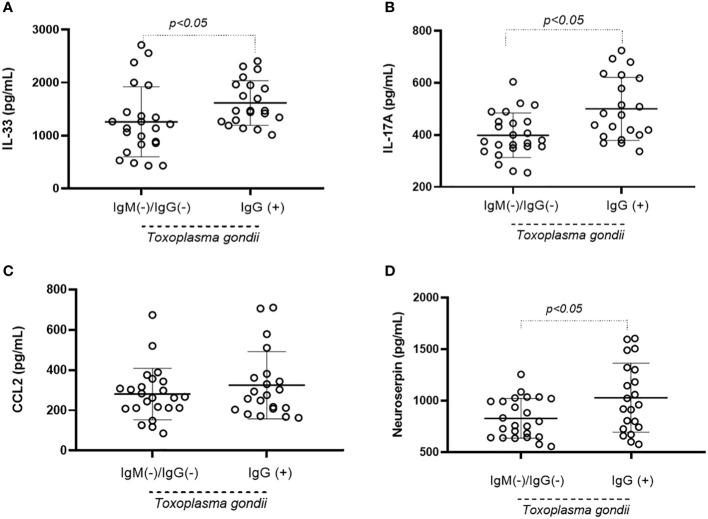
Pregnant volunteers with chronic T. gondii contact were all IgG+ (44%; n=21) and exhibited increased plasma IL-33, IL-17A, and neuroserpin levels, but not CCL2, compared to uninfected pregnant women. Using Beck's depression inventory, we observed an increase in plasma IL-17A and IL-33 in women with T. gondii infeCction diagnosed with mild DS, whereas neuroserpin was associated with minor and moderate/severe DS.
DISCUSSION
Our data suggest a close relationship between DS in pregnant women with chronic T. gondii infection and neurological conditions, which may be partially mediated by plasma neuroserpin, IL-33, and IL-17A levels.
简介
抑郁综合征(DS)是妊娠和产后期间常见的并发症,由多种有机/遗传和环境因素引发。临床和生化随访对于 DS 的早期诊断和预后至关重要。原虫弓形虫在寄生虫初次感染期间对胎儿造成感染性损伤。然而,在长期感染中,孕妇会产生免疫保护,以保护胎儿,尽管她们仍然容易受到弓形虫引起的病理或炎症影响。本研究旨在调查弓形虫血清阳性和血清阴性的孕妇的血浆炎症生物标志物,这些孕妇的 DS 诊断为轻度和中度/重度。
方法
在巴西米纳斯吉拉斯州奥罗普雷托的健康中心进行产前护理时,招募了 45 名孕妇(年龄 18-39 岁)。要求参与者完成一份社会人口统计学问卷,以提交给经过良好标准化的 DS 量表计算器(贝克抑郁问卷、爱丁堡产后抑郁量表和重度抑郁发作模块)。此外,采集 4mL 血液用于分析血浆神经丝氨酸蛋白酶、CCL2、IL-17A 和 IL-33。
结果
与未感染的孕妇相比,慢性弓形虫接触的孕妇志愿者均为 IgG+(44%;n=21),并且表现出更高的血浆 IL-33、IL-17A 和神经丝氨酸蛋白酶水平,但 CCL2 水平没有变化。使用贝克抑郁量表,我们观察到患有轻度 DS 的感染弓形虫的孕妇的血浆 IL-17A 和 IL-33 增加,而神经丝氨酸蛋白酶与轻度和中度/重度 DS 相关。
讨论
我们的数据表明,慢性弓形虫感染孕妇的 DS 与神经系统状况密切相关,这可能部分由血浆神经丝氨酸蛋白酶、IL-33 和 IL-17A 水平介导。

 Zotero 插件