
非吸烟人群和吸烟人群肺癌尿液代谢物诊断和预后液体活检生物标志物
Urinary Metabolite Diagnostic and Prognostic Liquid Biopsy Biomarkers of Lung Cancer in Nonsmokers and Tobacco Smokers.
机构信息
Laboratory of Human Carcinogenesis, Center for Cancer Research, National Cancer Institute, Bethesda, Maryland.
Division of Medical Oncology, Department of Medicine, School of Medicine, University of Colorado Anschutz Medical Campus, Aurora, Colorado.
出版信息
Clin Cancer Res. 2024 Aug 15;30(16):3592-3602. doi: 10.1158/1078-0432.CCR-24-0637.
PURPOSE
Nonsmokers account for 10% to 13% of all lung cancer cases in the United States. Etiology is attributed to multiple risk factors including exposure to secondhand smoking, asbestos, environmental pollution, and radon, but these exposures are not within the current eligibility criteria for early lung cancer screening by low-dose CT (LDCT).
EXPERIMENTAL DESIGN
Urine samples were collected from two independent cohorts comprising 846 participants (exploratory cohort) and 505 participants (validation cohort). The cancer urinary biomarkers, creatine riboside (CR) and N-acetylneuraminic acid (NANA), were analyzed and quantified using liquid chromatography-mass spectrometry to determine if nonsmoker cases can be distinguished from sex and age-matched controls in comparison with tobacco smoker cases and controls, potentially leading to more precise eligibility criteria for LDCT screening.
RESULTS
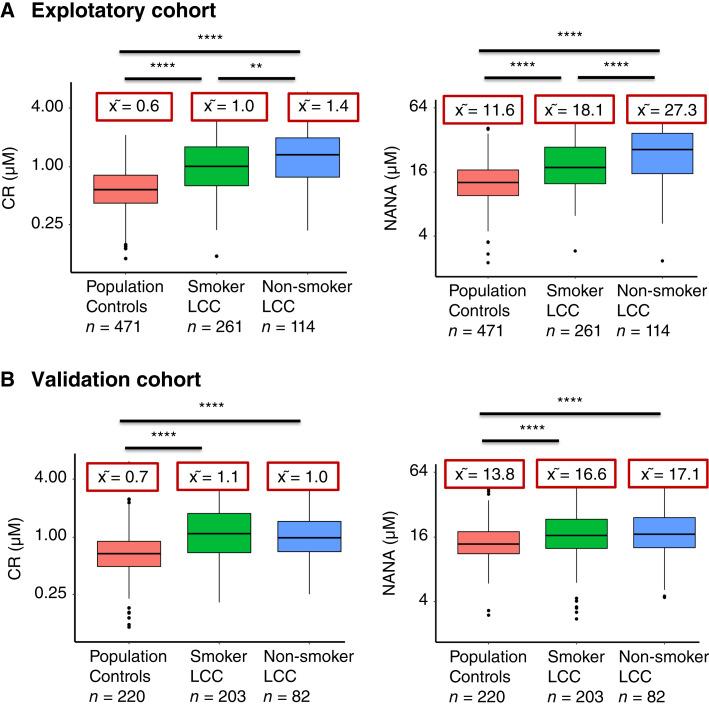
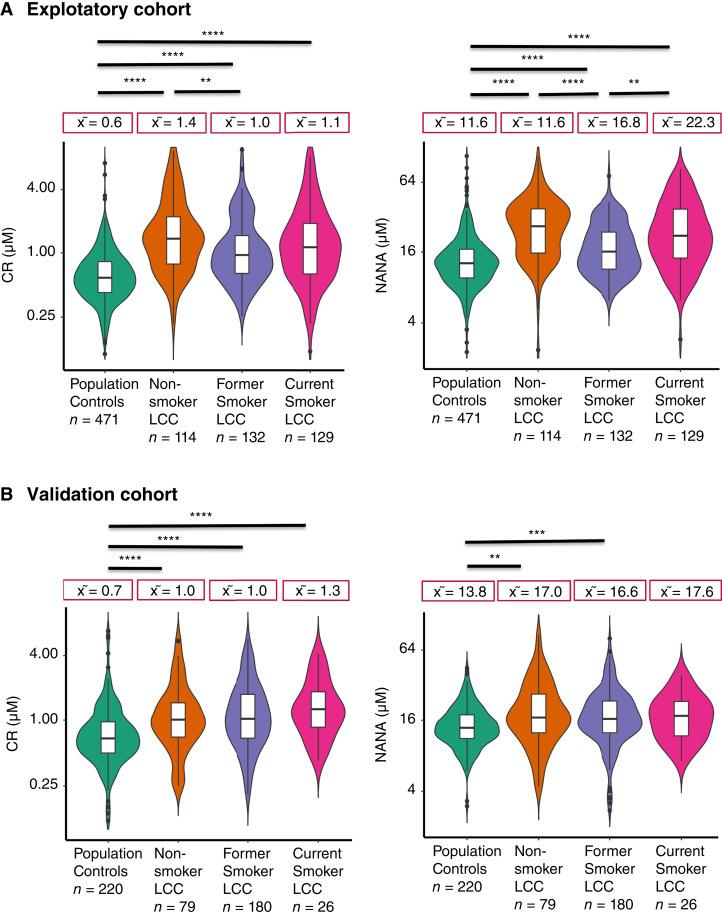
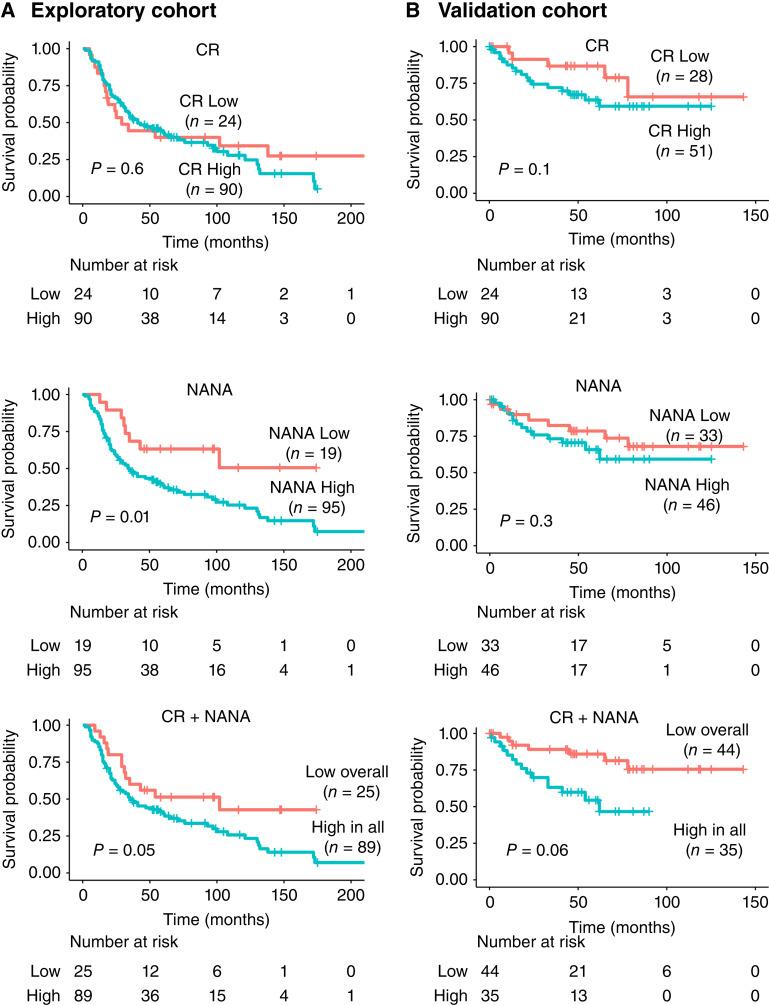
Urinary levels of CR and NANA were significantly higher and comparable in nonsmokers and tobacco smoker cases than population controls in both cohorts. Receiver operating characteristic analysis for combined CR and NANA levels in nonsmokers of the exploratory cohort resulted in better predictive performance with the AUC of 0.94, whereas the validation cohort nonsmokers had an AUC of 0.80. Kaplan-Meier survival curves showed that high levels of CR and NANA were associated with increased cancer-specific death in nonsmokers as well as tobacco smoker cases in both cohorts.
CONCLUSIONS
Measuring CR and NANA in urine liquid biopsies could identify nonsmokers at high risk for lung cancer as candidates for LDCT screening and warrant prospective studies of these biomarkers.
目的
在美国,10%至 13%的肺癌病例发生在非吸烟者中。病因可归因于多种危险因素,包括接触二手烟、石棉、环境污染和氡,但这些暴露并不属于低剂量 CT(LDCT)早期肺癌筛查的当前入选标准。
实验设计
从两个独立的队列中收集了 846 名参与者(探索性队列)和 505 名参与者(验证性队列)的尿液样本。使用液相色谱-质谱法分析和定量尿液中的癌症生物标志物肌苷核糖(CR)和 N-乙酰神经氨酸(NANA),以确定非吸烟者病例是否可以与吸烟病例和对照组中的性别和年龄匹配的对照区分开来,从而可能为 LDCT 筛查制定更精确的入选标准。
结果
在两个队列中,非吸烟者和吸烟者病例的尿液 CR 和 NANA 水平均显著高于且与人群对照相当。对探索性队列中非吸烟者的 CR 和 NANA 联合水平进行的受试者工作特征分析显示,AUC 为 0.94,具有更好的预测性能,而验证性队列中非吸烟者的 AUC 为 0.80。Kaplan-Meier 生存曲线显示,CR 和 NANA 水平较高与非吸烟者和吸烟者病例的癌症特异性死亡增加相关。
结论
测量尿液液活检中的 CR 和 NANA 可能会识别出肺癌高危非吸烟者作为 LDCT 筛查的候选者,并需要对这些生物标志物进行前瞻性研究。

 Zotero 插件