
肾损伤的决定因素和风险因素:因严重神经性厌食症住院的患者情况如何?一项多中心研究。
Determinants and risk factors for renal damage: where do patients hospitalized for severe anorexia nervosa stand? A multi-center study.
作者信息
Stheneur Chantal, Blanchet Corinne, Mattar Lama, Dicembre Marika, Wilson Kayigan, Berthoz Sylvie, Hanachi Mouna, Godart Nathalie
机构信息
University Center for Adolescent and Young Adult Health, Fondation Santé des Etudiants de France, 75014, Paris, France.
CESP, INSERM, UMR 1018, University Paris-Sud, 94807, Villejuif Cedex, France.
出版信息
J Eat Disord. 2024 Jun 5;12(1):72. doi: 10.1186/s40337-024-01024-w.
BACKGROUND
Although renal damage is increasingly reported among the most undernourished patients with Anorexia Nervosa (AN), it remains underestimated in current practice, and often associated with acute dehydration. The purpose of our study was to evaluate the frequency, the extent, and the risk factors of renal involvement among adolescents and adults hospitalized in specialized units for AN.
METHODS
In this multi-center study, 197 consecutive participants were included, aged 13-65, from 11 inpatient eating disorder psychiatric units. Information on the course of AN, clinical characteristics, biological data, and medication were collected.
RESULTS
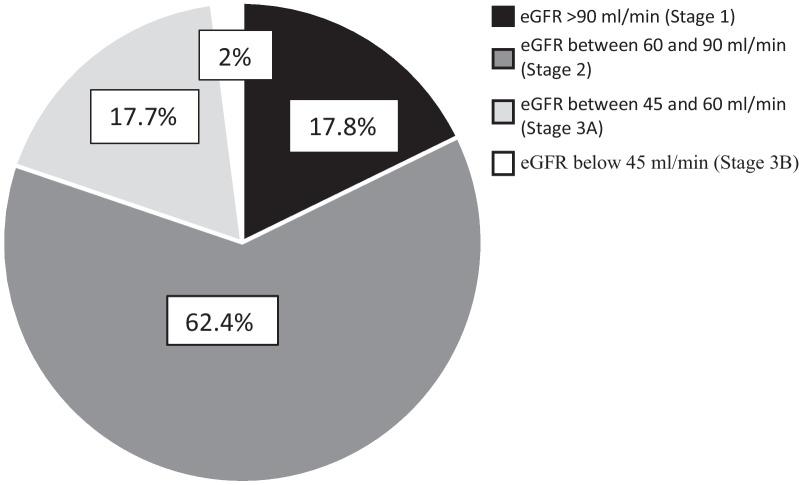
At admission, mean BMI was 13.1 (± 1.6) kg/m for a mean age of 20.74 (± 6.5) years and the z-score was - 3.6 (± 1.33). Six participants (3.0%) had hyponatremia, four (2.0%) had hypokalemia, and nine (4.5%) had hypochloremia. The Blood Urea Nitrogen/Creatinine ratio was over 20 for 21 (10.6%) participants. The mean plasma creatinine was 65.22 (± 12.8) µmol/L, and the mean eGFR was 74.74 (± 18.9) ml/min. Thirty- five participants (17.8%) had an eGFR > 90 ml/min, 123 (62.4%) from 60 to 90 ml/min, 35 (17.8%) from 45 to 60 ml/min, and 4 (2%) under 45 ml/min. In multivariate analysis, only BMI on admission was a determinant of renal impairment. The lower the BMI the more severe was the renal impairment.
CONCLUSION
When eGFR is calculated, it highlights renal dysfunction found in severe AN requiring hospitalisation in specialized units. The severity of undernutrition is an independent associated factor. Kidney functionality tests using eGFR, in addition to creatinine alone, should be part of routine care for patients with AN to detect underlying renal dysfunction.
背景
尽管在最营养不良的神经性厌食症(AN)患者中,肾脏损害的报告越来越多,但在当前临床实践中,其仍未得到充分重视,且常与急性脱水相关。我们研究的目的是评估在专门治疗AN的科室住院的青少年和成年人中肾脏受累的频率、程度及危险因素。
方法
在这项多中心研究中,纳入了来自11个住院饮食失调精神科病房的197名连续参与者,年龄在13至65岁之间。收集了有关AN病程、临床特征、生物学数据和用药情况的信息。
结果
入院时,平均体重指数(BMI)为13.1(±1.6)kg/m²,平均年龄为20.74(±6.5)岁,z评分是 -3.6(±1.33)。6名参与者(3.0%)有低钠血症,4名(2.0%)有低钾血症,9名(4.5%)有低氯血症。21名(10.6%)参与者的血尿素氮/肌酐比值超过20。平均血浆肌酐为65.22(±12.8)μmol/L,平均估算肾小球滤过率(eGFR)为74.74(±18.9)ml/min。35名参与者(17.8%)的eGFR>90 ml/min,123名(62.4%)在60至90 ml/min之间,35名(17.8%)在45至60 ml/min之间,4名(2%)低于45 ml/min。在多变量分析中,只有入院时的BMI是肾功能损害的决定因素。BMI越低,肾功能损害越严重。
结论
计算eGFR时,它凸显了在需要入住专门科室的重度AN患者中发现的肾功能障碍。营养不良的严重程度是一个独立的相关因素。除了单独检测肌酐外,使用eGFR进行肾脏功能测试应成为AN患者常规护理的一部分,以检测潜在的肾功能障碍。
 Zotero 插件