
PRODIGY 评分预测麻醉后监护病房的呼吸抑制:一项事后分析。
PRODIGY score predicts respiratory depression in the post-anesthesia care unit: A post-hoc analysis.
机构信息
Department of Anesthesia and Perioperative Medicine, Mayo Clinic, Rochester, MN, USA.
Department of Anesthesia and Pain Management, University Heath Network, University of Toronto, Toronto, ON, Canada.
出版信息
Biomol Biomed. 2024 Oct 17;24(6):1662-1668. doi: 10.17305/bb.2024.10585.
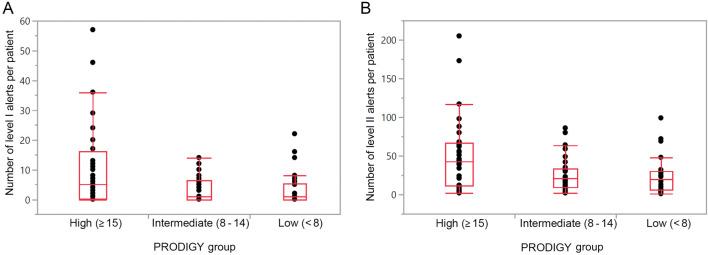
Surgical patients who experience respiratory depressive episodes (RDEs) during their post-anesthesia care unit (PACU) admission are at a higher risk of developing subsequent respiratory complications in general care wards. A risk assessment tool for PACU RDEs has not been previously assessed. The PRediction of Opioid-induced respiratory Depression In patients monitored by capnoGraphY (PRODIGY) score is an assessment tool that uses baseline patient variables to categorize patients into low, intermediate, or high risk groups for RDEs in general care wards. This study assessed whether PRODIGY groups are associated with PACU RDEs. This analysis utilized data from a previous observational trial of PACU RDEs detected by capnography. PRODIGY scores were retrospectively calculated, and the number and duration of respiratory alerts were compared among PRODIGY groups. Twenty-six (29.9%) patients were classified as low risk, 29 (33.3%) as intermediate risk, and 32 (36.8%) as high risk. A total of 3,580 alerts were recorded in the PACU, 47% of which were apnea episodes lasting ≥ 10 seconds. The total number and duration of alerts were highest in high risk group patients (median 56 [IQR 12 - 87] alerts per patient vs 22 [9 - 37] in low risk and 26 [13 - 42] in intermediate risk patients, P = 0.035; 303 [123 - 885] seconds vs 177 [30 - 779] in low risk and 301 [168 - 703] in intermediate risk patients, P = 0.042). Poisson regression analysis indicated that the rate of RDEs in the high PRODIGY risk group was higher than in the intermediate (rate ratio estimate = 2.01 [95% CI 1.86 - 2.18], P < 0.001) and low (rate ratio estimate = 2.25 [95% confidence interval 2.07 - 2.45], P < 0.001) risk groups. This analysis suggests that the PRODIGY score may be useful in assessing the risk of PACU RDEs. Trial Registration: https://www.clinicaltrials.gov/ct2/show/NCT02707003.
在麻醉后护理单元 (PACU) 住院期间经历呼吸抑制发作 (RDE) 的手术患者在普通护理病房发生后续呼吸并发症的风险较高。以前没有评估过用于 PACU RDE 的风险评估工具。预测接受呼吸监测的阿片类药物诱导的呼吸抑制患者 (PRODIGY) 评分是一种使用基线患者变量将患者分为低、中或高 RDE 风险组的评估工具。这项研究评估了 PRODIGY 组是否与 PACU RDE 相关。该分析利用了以前通过呼吸描记术检测 PACU RDE 的观察性试验的数据。回顾性计算了 PRODIGY 评分,并比较了 PRODIGY 组之间的呼吸警报数量和持续时间。26 名 (29.9%)患者被归类为低风险,29 名 (33.3%)为中风险,32 名 (36.8%)为高风险。在 PACU 共记录了 3580 次警报,其中 47%为持续时间≥ 10 秒的呼吸暂停事件。高危组患者的总警报数量和持续时间最高 (中位数 56 [IQR 12 - 87] 次/患者 vs 低危组 22 [9 - 37] 次和中危组 26 [13 - 42] 次,P = 0.035;303 [123 - 885] 秒 vs 低危组 177 [30 - 779] 秒和中危组 301 [168 - 703] 秒,P = 0.042)。泊松回归分析表明,高危 PRODIGY 风险组的 RDE 发生率高于中危 (风险比估计值 = 2.01 [95%置信区间 1.86 - 2.18],P < 0.001) 和低危 (风险比估计值 = 2.25 [95%置信区间 2.07 - 2.45],P < 0.001) 风险组。这项分析表明,PRODIGY 评分可能有助于评估 PACU RDE 的风险。试验注册:https://www.clinicaltrials.gov/ct2/show/NCT02707003。

 Zotero 插件