
新诊断 2 型糖尿病患者早期胰岛素治疗对心血管事件发生率的真实世界疗效。
Real-world effectiveness of early insulin therapy on the incidence of cardiovascular events in newly diagnosed type 2 diabetes.
机构信息
Department of Endocrinology, First Affiliated Hospital of USTC, Division of Life Sciences and Medicine, University of Science and Technology of China, Heifei, China.
Institute of Public Health Sciences, Division of Life Sciences and Medicine, University of Science and Technology of China, Hefei, China.
出版信息
Signal Transduct Target Ther. 2024 Jun 6;9(1):154. doi: 10.1038/s41392-024-01854-9.
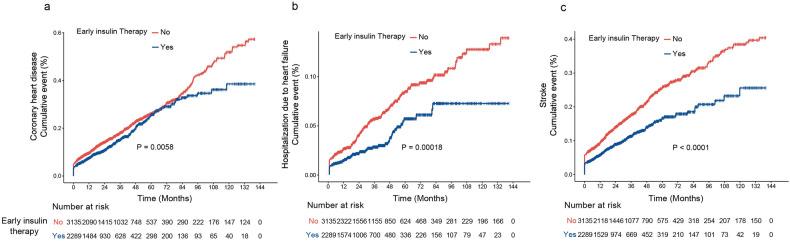
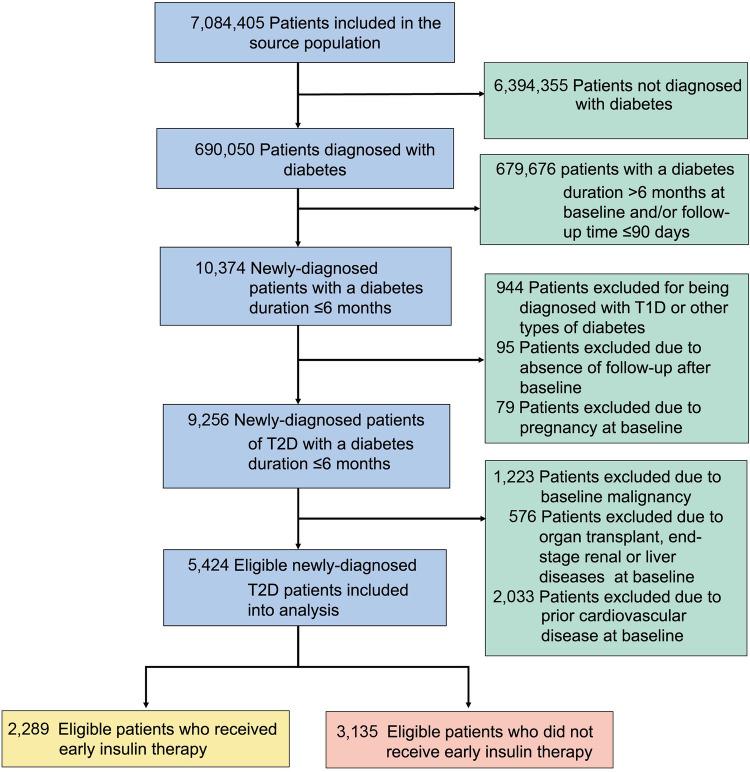
Early insulin therapy is capable to achieve glycemic control and restore β-cell function in newly diagnosed type 2 diabetes (T2D), but its effect on cardiovascular outcomes in these patients remains unclear. In this nationwide real-world study, we analyzed electronic health record data from 19 medical centers across China between 1 January 2000, and 26 May 2022. We included 5424 eligible patients (mean age 56 years, 2176 women/3248 men) who were diagnosed T2D within six months and did not have prior cardiovascular disease. Multivariable Cox regression models were used to estimate the associations of early insulin therapy (defined as the first-line therapy for at least two weeks in newly diagnosed T2D patients) with the incidence of major cardiovascular events including coronary heart disease (CHD), stroke, and hospitalization for heart failure (HF). During 17,158 persons years of observation, we documented 834 incident CHD cases, 719 stroke cases, and 230 hospitalized cases for HF. Newly diagnosed T2D patients who received early insulin therapy, compared with those who did not receive such treatment, had 31% lower risk of incident stroke, and 28% lower risk of hospitalization for HF. No significant difference in the risk of CHD was observed. We found similar results when repeating the aforesaid analysis in a propensity-score matched population of 4578 patients and with inverse probability of treatment weighting models. These findings suggest that early insulin therapy in newly diagnosed T2D may have cardiovascular benefits by reducing the risk of incident stroke and hospitalization for HF.
早期胰岛素治疗能够控制血糖并恢复新诊断的 2 型糖尿病(T2D)患者的β细胞功能,但它对这些患者心血管结局的影响尚不清楚。在这项全国范围的真实世界研究中,我们分析了 2000 年 1 月 1 日至 2022 年 5 月 26 日期间来自中国 19 家医疗中心的电子健康记录数据。我们纳入了 5424 名符合条件的患者(平均年龄 56 岁,2176 名女性/3248 名男性),这些患者在六个月内被诊断为 T2D,且无既往心血管疾病。多变量 Cox 回归模型用于估计早期胰岛素治疗(定义为新诊断的 T2D 患者的一线治疗至少两周)与主要心血管事件(包括冠心病、中风和心力衰竭住院)的发生率之间的关联。在 17158 人年的观察期间,我们记录了 834 例冠心病事件、719 例中风事件和 230 例心力衰竭住院事件。与未接受此类治疗的患者相比,接受早期胰岛素治疗的新诊断 T2D 患者发生中风的风险降低了 31%,心力衰竭住院的风险降低了 28%。未观察到冠心病风险的显著差异。当在 4578 名患者的倾向评分匹配人群和逆概率治疗加权模型中重复上述分析时,我们得到了类似的结果。这些发现表明,早期胰岛素治疗新诊断的 T2D 可能通过降低中风和心力衰竭住院的风险带来心血管获益。
 Zotero 插件