
脑脊液靶向蛋白质组学在阿尔茨海默病连续体中的潜在预后价值。
Potential prognostic value of CSF-targeted proteomics across the Alzheimer's disease continuum.
机构信息
Department of Neurology, The First Affiliated Hospital of Jinan University, No. 613, Huangpu Avenue West, Guangzhou, Guangdong, 510632, P.R. China.
Department of Clinical Research, The First Affiliated Hospital of Jinan University, Guangzhou, China.
出版信息
BMC Geriatr. 2024 Jun 6;24(1):501. doi: 10.1186/s12877-024-05104-z.
BACKGROUND
Core biomarkers for Alzheimer's disease (AD), such as Aβ42 and tau, have demonstrated high prognostic accuracy but do not fully capture the complex pathophysiology of AD. In this study, our objective was to identify novel cerebrospinal fluid (CSF) biomarkers using proteomics across the entire AD continuum to predict conversion to AD and explore their involvement in AD pathogenesis.
METHODS
A cohort of 186 cognitively normal (CN), 127 subjective memory complaint (SMC), 79 early mild cognitive impairment (EMCI), 249 late MCI (LMCI), and 132 AD individuals was analyzed, with a follow-up period of over 3 years for non-AD participants. CSF 65 peptides, as well as hippocampal and entorhinal volumes were analyzed, and cognitive function was evaluated using the 13-item cognitive subscale of the Alzheimer's Disease Assessment Scale (ADAS-Cog 13). Cox proportional hazards models and mediation analysis were performed to investigate associations and causal relationships.
RESULTS
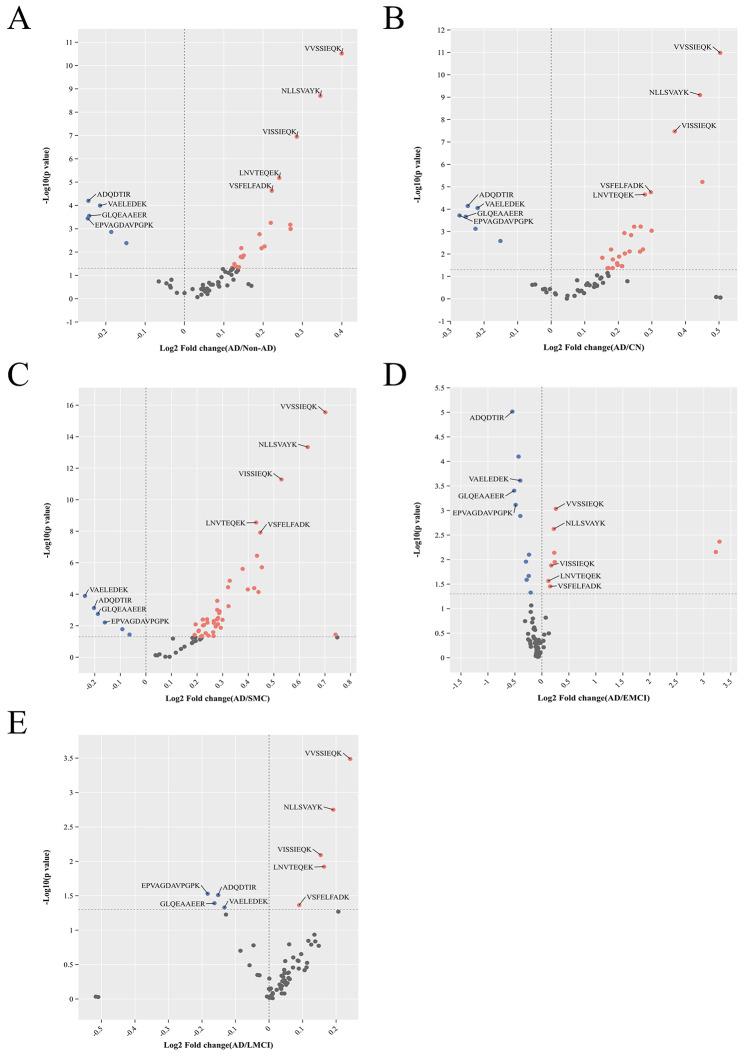
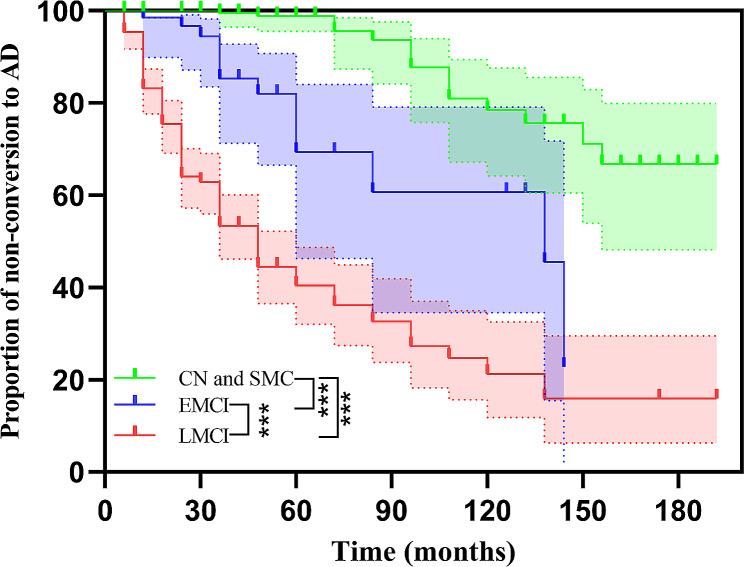
During the follow-up, approximately one-fourth (146/580) of the non-AD participants progressed to AD. After adjusting for baseline diagnosis (CN to LMCI) and other variables, multivariable Cox regression analysis identified three peptides (VAELEDEK, VSFELFADK, and VVSSIEQK) as significant predictors of conversion to AD. Incorporating these three peptides into the initial model significantly improved the C-statistic from 0.82 to 0.85 for predicting AD conversion, surpassing the predictive ability of Aβ42 and P-tau. Moreover, hippocampal and entorhinal volumes mediated 30.3-53.8% of the association between the three peptides and ADAS-Cog 13 scores.
CONCLUSIONS
These findings underscore the potential of these three peptides as robust prognostic biomarker candidates for AD conversion across the entire AD continuum, with a mechanism involving the mediation of hippocampal and entorhinal volumes.
背景
阿尔茨海默病(AD)的核心生物标志物,如 Aβ42 和 tau,已经证明具有较高的预后准确性,但不能完全捕捉 AD 的复杂病理生理学。在这项研究中,我们的目标是使用蛋白质组学在整个 AD 连续体中识别新的脑脊液(CSF)生物标志物,以预测向 AD 的转化,并探讨它们在 AD 发病机制中的作用。
方法
分析了 186 名认知正常(CN)、127 名主观记忆抱怨(SMC)、79 名早期轻度认知障碍(EMCI)、249 名晚期 MCI(LMCI)和 132 名 AD 个体的队列,非 AD 参与者的随访时间超过 3 年。分析了 CSF 65 肽以及海马和内嗅皮质体积,并使用 Alzheimer's Disease Assessment Scale(ADAS-Cog 13)的 13 项认知子量表评估认知功能。使用 Cox 比例风险模型和中介分析来研究关联和因果关系。
结果
在随访期间,约四分之一(146/580)的非 AD 参与者进展为 AD。在调整基线诊断(CN 到 LMCI)和其他变量后,多变量 Cox 回归分析确定了三个肽(VAELEDEK、VSFELFADK 和 VVSSIEQK)作为向 AD 转化的显著预测因子。将这三个肽纳入初始模型可显著提高预测 AD 转化的 C 统计量,从 0.82 提高到 0.85,超过了 Aβ42 和 P-tau 的预测能力。此外,海马和内嗅皮质体积介导了三个肽与 ADAS-Cog 13 评分之间关联的 30.3-53.8%。
结论
这些发现强调了这三个肽作为 AD 连续体中 AD 转化的强大预后生物标志物候选物的潜力,其机制涉及海马和内嗅皮质体积的介导。

 Zotero 插件