
新冠疫情期间儿童封锁的“超补偿”效应:基于身体活动、睡眠和心理变化的分析。
The "supercompensation" effect of children's lockdown during COVID-19: based on the analysis of changes in physical activity, sleep, and psychology.
机构信息
School of Physical Education, Nanchang University, Nanchang, 330031, China.
School of Physical Education, Jiangxi Normal University, Nanchang, 330027, China.
出版信息
BMC Public Health. 2024 Jun 6;24(1):1522. doi: 10.1186/s12889-024-19035-2.
OBJECTIVE
To investigate the "supercompensation" effect of preschoolers during the coronavirus disease 2019 lockdown by comparing the changes in physical activity (PA), psychological, and sleep indicators before and after the lockdown.
METHODS
A total of 127 children (aged 3-6 years) were recruited. Before and after the lockdown, the children's PA levels were measured using the ActiGraph GT3X, and their psychological and sleep indicators were measured using the Strengths and Difficulties Questionnaire (SDQ) and Child Sleep Habit Questionnaire (CSHQ), respectively.
RESULTS
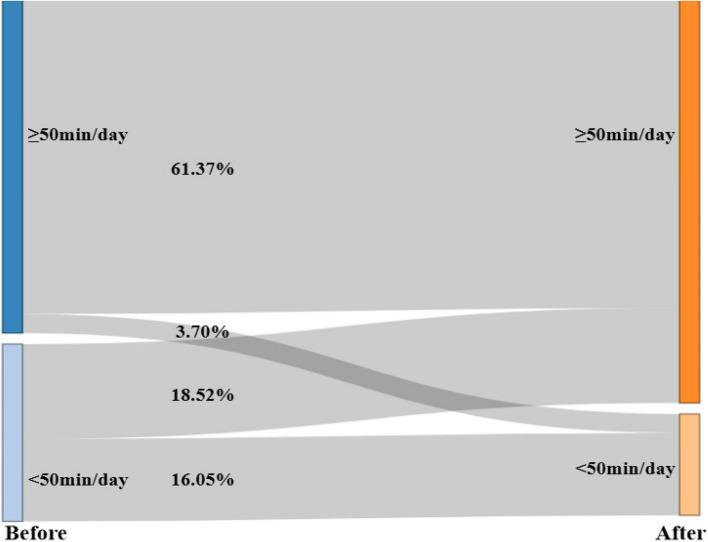
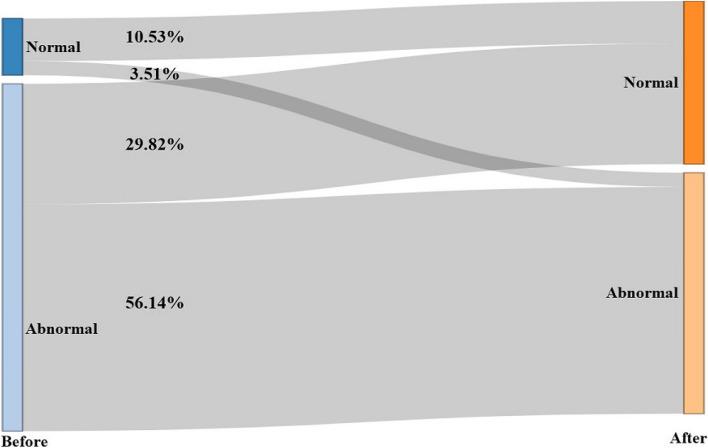
Regarding PA, the children's total physical activity, low-intensity physical activity, and medium-intensity physical activity (MVPA) were higher after the lockdown than before the lockdown, with significant differences in MVPA (p < 0.05). Regarding psychology, the children's SDQ and multidimensional scores were better after the lockdown than before the lockdown, with a significant difference in SDQ scores (p < 0.05). Regarding sleep, the children's CSHQ scores were better after the lockdown than before the lockdown, with a highly significant difference in CSHQ scores (p < 0.01).
CONCLUSION
After lockdown, children's PA, psychological, and sleep effects were "supercompensated." In particular, the PA of preschoolers before, during, and after the lockdown may show a "baseline-inhibition-supercompensation" process.
目的
通过比较新冠疫情封锁前后儿童身体活动(PA)、心理和睡眠指标的变化,探讨学龄前儿童在新冠疫情封锁期间的“超补偿”效应。
方法
共招募了 127 名儿童(3-6 岁)。在封锁前后,使用 ActiGraph GT3X 测量儿童的 PA 水平,使用长处和困难问卷(SDQ)和儿童睡眠习惯问卷(CSHQ)分别测量儿童的心理和睡眠指标。
结果
在 PA 方面,儿童的总身体活动、低强度身体活动和中强度身体活动(MVPA)在封锁后高于封锁前,MVPA 存在显著差异(p<0.05)。在心理方面,儿童的 SDQ 和多维评分在封锁后好于封锁前,SDQ 评分存在显著差异(p<0.05)。在睡眠方面,儿童的 CSHQ 评分在封锁后好于封锁前,CSHQ 评分存在高度显著差异(p<0.01)。
结论
封锁后,儿童的 PA、心理和睡眠效果得到了“超补偿”。特别是,学龄前儿童在封锁前后的 PA 可能表现出“基线抑制-超补偿”过程。


 Zotero 插件