
在CHO细胞中稳定过表达天然和人工miRNA以产生不同岩藻糖基化的抗体。
Stable overexpression of native and artificial miRNAs for the production of differentially fucosylated antibodies in CHO cells.
作者信息
Schlossbauer Patrick, Naumann Lukas, Klingler Florian, Burkhart Madina, Handrick René, Korff Kathrin, Neusüß Christian, Otte Kerstin, Hesse Friedemann
机构信息
Institute for Applied Biotechnology University of Applied Sciences Biberach Biberach Germany.
Department of Chemistry Aalen University Aalen Germany.
出版信息
Eng Life Sci. 2024 Apr 1;24(6):2300234. doi: 10.1002/elsc.202300234. eCollection 2024 Jun.
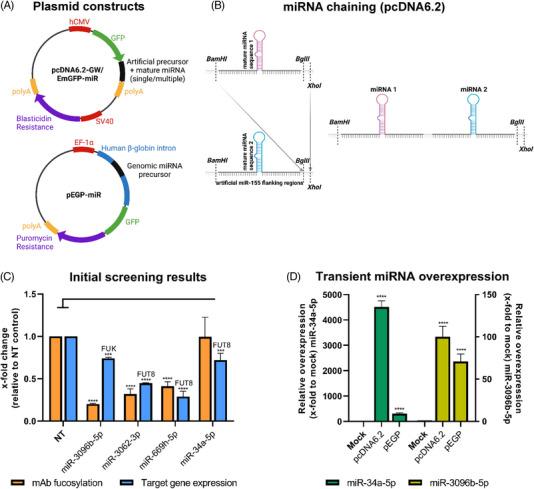
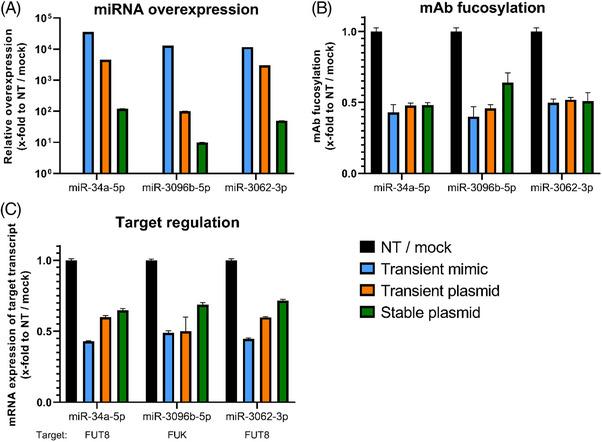
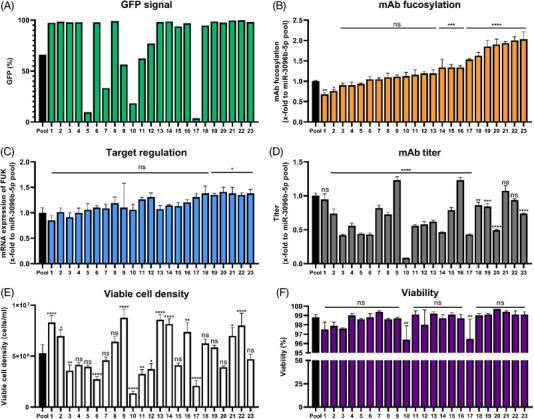
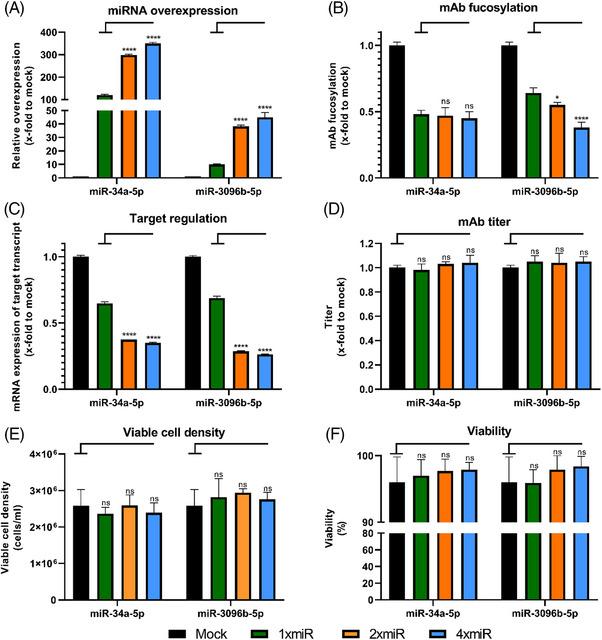
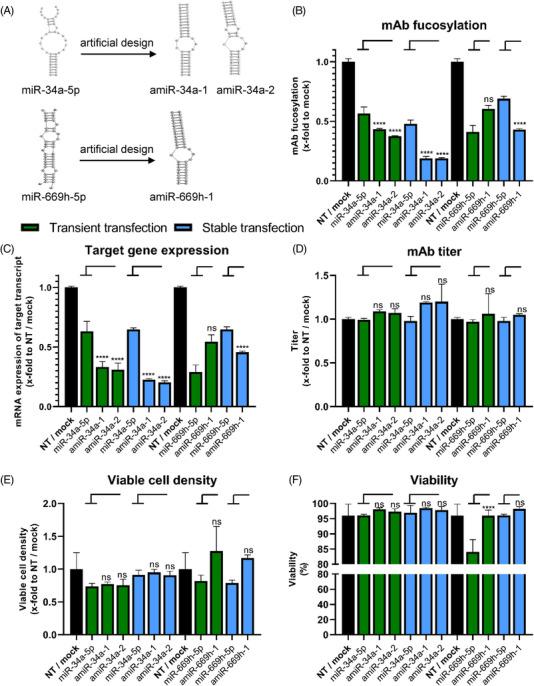
Cell engineering strategies typically rely on energy-consuming overexpression of genes or radical gene-knock out. Both strategies are not particularly convenient for the generation of slightly modulated phenotypes, as needed in biosimilar development of for example differentially fucosylated monoclonal antibodies (mAbs). Recently, transiently transfected small noncoding microRNAs (miRNAs), known to be regulators of entire gene networks, have emerged as potent fucosylation modulators in Chinese hamster ovary (CHO) production cells. Here, we demonstrate the applicability of stable miRNA overexpression in CHO production cells to adjust the fucosylation pattern of mAbs as a model phenotype. For this purpose, we applied a miRNA chaining strategy to achieve adjustability of fucosylation in stable cell pools. In addition, we were able to implement recently developed artificial miRNAs (amiRNAs) based on native miRNA sequences into a stable CHO expression system to even further fine-tune fucosylation regulation. Our results demonstrate the potential of miRNAs as a versatile tool to control mAb fucosylation in CHO production cells without adverse side effects on important process parameters.
细胞工程策略通常依赖于耗能的基因过表达或彻底的基因敲除。这两种策略对于产生微调的表型(如在生物类似药开发中,例如差异岩藻糖基化单克隆抗体(mAb)的开发中所需要的)来说都不是特别方便。最近,已知作为整个基因网络调节因子的瞬时转染小非编码微RNA(miRNA),已成为中国仓鼠卵巢(CHO)生产细胞中有效的岩藻糖基化调节剂。在这里,我们证明了在CHO生产细胞中稳定过表达miRNA以调节mAb的岩藻糖基化模式作为模型表型的适用性。为此,我们应用了一种miRNA串联策略,以实现稳定细胞库中岩藻糖基化的可调节性。此外,我们能够将基于天然miRNA序列的最新开发的人工miRNA(amiRNA)应用于稳定的CHO表达系统,以进一步微调岩藻糖基化调节。我们的结果证明了miRNA作为一种通用工具来控制CHO生产细胞中mAb岩藻糖基化的潜力,而不会对重要的工艺参数产生不利的副作用。

 Zotero 插件