
氟硼代苯丙氨酸正电子发射断层扫描(BPA-PET)在恶性脑肿瘤挽救性硼中子俘获治疗中的预后评估
Prognostic assessment of F-boronophenylalanine positron emission tomography (BPA-PET) in salvage boron neutron capture therapy for malignant brain tumors.
作者信息
Lin Ko-Han, Chen Yi-Wei, Wang Ling-Wei, Wang Yuh-Feng, Hu Lien-Hsin, Ting Chien Hsin, Lee Tse-Hao, Lee Jia-Cheng, Peng Nan-Jing
机构信息
Department of Nuclear Medicine, Taipei Veterans General Hospital, Taipei.
Department of Radiation Oncology, Taipei Veterans General Hospital, Taipei.
出版信息
Quant Imaging Med Surg. 2024 Jun 1;14(6):4177-4188. doi: 10.21037/qims-23-1769. Epub 2024 May 20.
BACKGROUND
Boron neutron capture therapy (BNCT) stands out as a propitious anti-cancer modality. F-boronophenylalanine positron emission tomography (BPA-PET) holds the potential to ascertain the concentration of BPA within the tumor, enabling meticulous treatment planning and outcome evaluation. However, no studies have been conducted on comparing the outcomes of those treated with BNCT to those who did not undergo this therapy. This study endeavors to analyze the correlation between BPA-PET and BNCT in the context of malignant brain tumors, and assess the survival outcomes following BNCT.
METHODS
A cohort study was performed on patients who underwent BPA-PET between February 2017 and April 2022 in our hospital. Patients were stratified into two groups: those subjected to BNCT (Group 1) and those not (Group 2). The tumor to normal tissue (T/N) ratio derived from BPA-PET was set at 2.5. The findings were scrutinized based on clinical follow-up. Student's -test and Chi-squared test were employed to discern differences between the groups. A cumulative survival curve was constructed employing the Kaplan-Meier method. Differences were considered statistically significant at P<0.05.
RESULTS
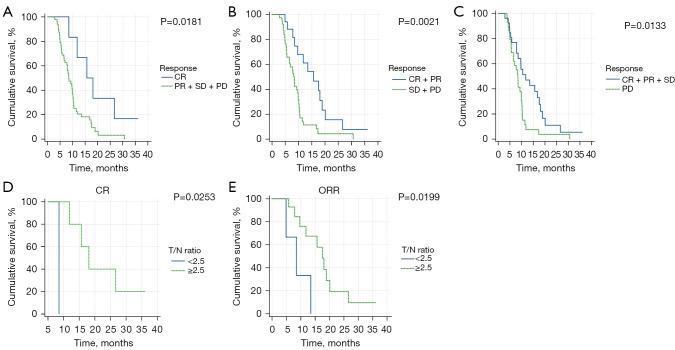
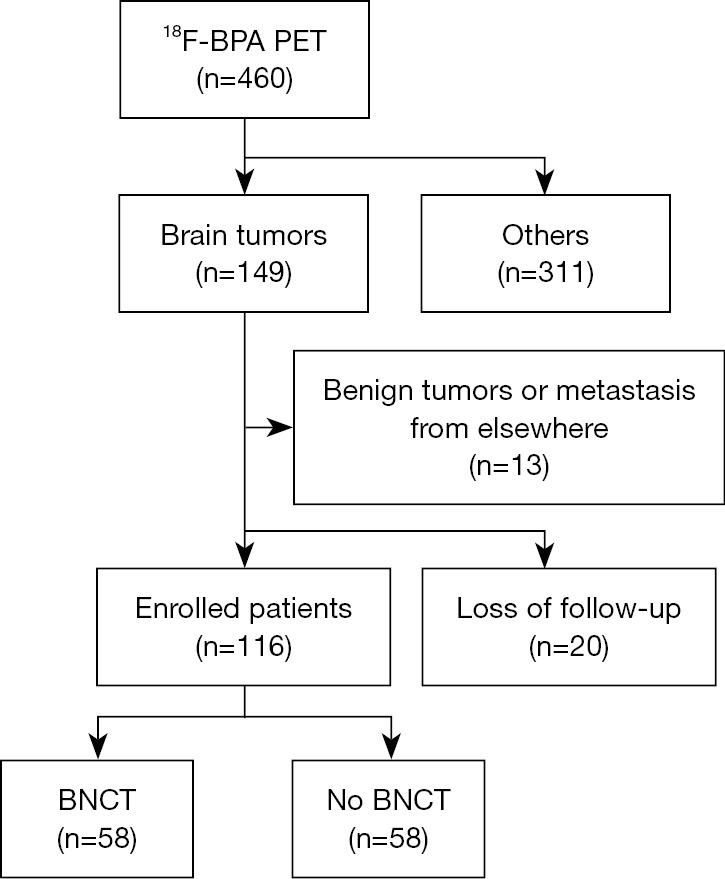
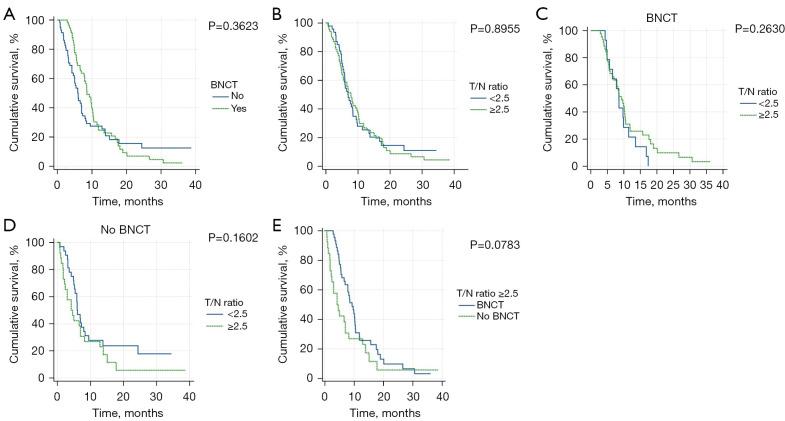
In total, 116 patients with T/N ratios obtained from BPA-PET were enrolled. BNCT was administered to 58 patients, while mortality was observed in 100 patients. The median overall survival (OS) for the two groups was 8.5 and 6.0 months, respectively. The cumulative OS exhibited no significant discrepancy between the two groups, nor in their T/N ratios. Within Group 1, 44 out of 58 (75.9%) patients exhibited T/N ratios exceeding 2.5. Excluding 3 patients who expired within 3 months, 55 out of 58 patients were evaluated for response after BNCT. The objective response rate (ORR) was 30.9%. Patients achieving ORR displayed substantially higher survival rates compared to those without (median OS 13.5 . 8.3 months, P=0.0021), particularly when T/N ratio exceeded 2.5 (median OS 14.8 . 9.0 months, P=0.0199).
CONCLUSIONS
BNCT does not appear indispensable for prolonging the survival of patients afflicted with malignant brain tumors. Nevertheless, it proves advantageous when ORR is attained, a condition closely linked to the values of T/N ratio derived from BPA-PET.
背景
硼中子俘获疗法(BNCT)是一种很有前景的抗癌治疗方式。氟硼代苯丙氨酸正电子发射断层扫描(BPA-PET)能够测定肿瘤内BPA的浓度,有助于进行精确的治疗规划和疗效评估。然而,尚无研究比较接受BNCT治疗的患者与未接受该治疗的患者的治疗效果。本研究旨在分析恶性脑肿瘤患者中BPA-PET与BNCT之间的相关性,并评估BNCT后的生存结局。
方法
对2017年2月至2022年4月在我院接受BPA-PET检查的患者进行队列研究。患者被分为两组:接受BNCT治疗的患者(第1组)和未接受BNCT治疗的患者(第2组)。将BPA-PET得出的肿瘤与正常组织(T/N)比值设定为2.5。根据临床随访结果对研究结果进行分析。采用学生t检验和卡方检验来识别两组之间的差异。采用Kaplan-Meier方法构建累积生存曲线。当P<0.05时,差异被认为具有统计学意义。
结果
共有116例通过BPA-PET获得T/N比值的患者入组。58例患者接受了BNCT治疗,100例患者出现死亡。两组的中位总生存期(OS)分别为8.5个月和6.0个月。两组的累积OS以及T/N比值之间均无显著差异。在第1组中,58例患者中有44例(75.9%)的T/N比值超过2.5。排除3例在3个月内死亡的患者后,58例患者中有55例在BNCT后接受了疗效评估。客观缓解率(ORR)为30.9%。达到ORR的患者的生存率显著高于未达到ORR的患者(中位OS分别为13.5个月和8.3个月,P=0.0021),特别是当T/N比值超过2.5时(中位OS分别为14.8个月和9.0个月,P=0.0199)。
结论
BNCT似乎并非延长恶性脑肿瘤患者生存期所必需的治疗方法。然而,当达到ORR时,BNCT显示出优势,而ORR与BPA-PET得出的T/N比值密切相关。

 Zotero 插件