
新诊断 1 型糖尿病儿童和青少年胰岛素剂量需求的决定因素和特征:来自 INSENODIAB 研究的见解。
Determinants and Characteristics of Insulin Dose Requirements in Children and Adolescents with New-Onset Type 1 Diabetes: Insights from the INSENODIAB Study.
机构信息
Paediatric Endocrinology and Diabetes Unit, Specialized Pediatrics Service, Cliniques universitaires Saint-Luc, Belgium.
PEDI Laboratory, Institut de Recherche Expérimentale et Clinique, UCLouvain, Brussels, Belgium.
出版信息
J Diabetes Res. 2023 Nov 26;2023:5568663. doi: 10.1155/2023/5568663. eCollection 2023.
AIMS
New-onset type 1 diabetes mellitus (T1D) in pediatric patients represents a clinical challenge for initial total daily insulin dosing (TIDD) due to substantial heterogeneity in practice and lack of consensus on the optimal starting dose. Our INSENODIAB (INsulin SEnsitivity in New Onset type 1 DIABetes) study is aimed at (1) exploring the influence of patient-specific characteristics on insulin requirements in pediatric patients with new-onset T1D; (2) constructing a predictive model for the recommended TIDD tailored to individual patient profiles; and (3) assessing potential associations between TIDD and patient outcomes at follow-up intervals of 3 and 12 months.
METHODS
We conducted a comprehensive analysis of medical records for children aged 6 months to 18 years, hospitalized for new-onset T1D from 2013 to 2022. The study initially involved multivariable regression analysis on a retrospective cohort (rINSENODIAB), incorporating baseline variables. Subsequently, we validated the model robustness on a prospective cohort (pINSENODIAB) with a significance threshold of 5%. The model accuracy was assessed by Pearson's correlation.
RESULTS
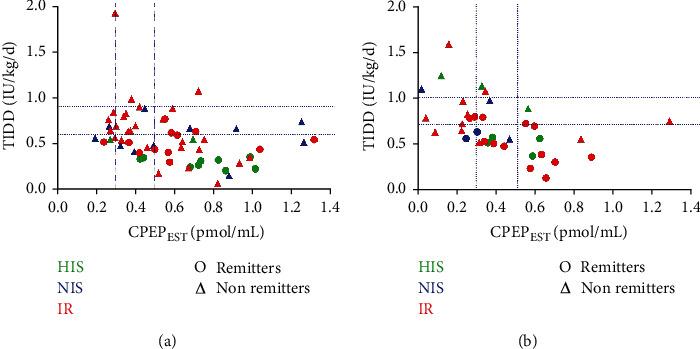
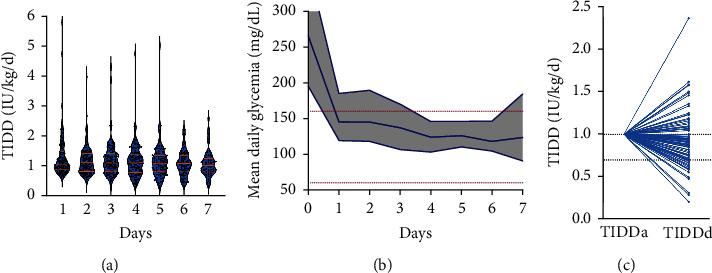
Our study encompassed 103 patients in the retrospective cohort and 80 in the prospective cohort, with median TIDD at diagnosis of 1.1 IU/kg BW/day (IQR 0.5). The predictive model for optimal TIDD was established using baseline characteristics, resulting in the following formula: TIDD (IU/d) = ([0.09 × Age2] + [0.68 × %Weight Loss] + [28.60 × Veinous pH] - [1.03 × Veinous bicarbonates] + [0.81 × Weight] - 194.63). Validation of the model using the pINSENODIAB cohort demonstrated a significant Pearson correlation coefficient of 0.74. Notably, no significant correlation was observed between TIDD at diagnosis and partial remission markers (IDAA1C, C-peptide) at 3- and 12-months postdiagnosis time points.
CONCLUSIONS
In the context of new-onset T1D in pediatric patients, we identified key influencing factors for determining optimal TIDD, including age, percentage of weight loss, weight, veinous pH, and bicarbonates. These findings have paved the way for the development of a dosing algorithm to potentially expedite glycemic control stabilization and facilitate a more individualized approach to treatment regimens.
目的
儿科新发 1 型糖尿病(T1D)患者的初始总日胰岛素剂量(TIDD)存在临床挑战,因为实践中存在很大的异质性,而且对于最佳起始剂量也没有共识。我们的 INSENODIAB(新发 1 型糖尿病胰岛素敏感性)研究旨在:(1)探讨患者特征对新发 T1D 儿科患者胰岛素需求的影响;(2)构建针对个体患者特征的推荐 TIDD 预测模型;(3)评估 TIDD 与随访 3 个月和 12 个月时患者结局之间的潜在关联。
方法
我们对 2013 年至 2022 年期间因新发 T1D 住院的 6 个月至 18 岁儿童的病历进行了全面分析。该研究首先对回顾性队列(rINSENODIAB)进行了多变量回归分析,纳入了基线变量。随后,我们使用前瞻性队列(pINSENODIAB)对模型的稳健性进行了验证,显著性阈值为 5%。模型准确性通过 Pearson 相关系数进行评估。
结果
我们的研究包括回顾性队列中的 103 名患者和前瞻性队列中的 80 名患者,诊断时的中位 TIDD 为 1.1IU/kg BW/day(IQR 0.5)。使用基线特征建立了最佳 TIDD 的预测模型,得出以下公式:TIDD(IU/d)=([0.09×年龄 2] + [0.68×体重丢失%] + [28.60×静脉 pH] - [1.03×静脉碳酸氢盐] + [0.81×体重] - 194.63)。使用 pINSENODIAB 队列验证模型时,Pearson 相关系数显著为 0.74。值得注意的是,诊断时的 TIDD 与诊断后 3 个月和 12 个月的部分缓解标志物(IDAA1C、C 肽)之间没有显著相关性。
结论
在儿科新发 T1D 患者中,我们确定了决定最佳 TIDD 的关键影响因素,包括年龄、体重丢失百分比、体重、静脉 pH 和碳酸氢盐。这些发现为开发一种给药算法奠定了基础,该算法可能有助于加速血糖控制稳定,并促进更个体化的治疗方案。

 Zotero 插件