
便秘与分娩方式的关系:一项基于回顾性问卷调查的研究。
Association of Constipation with Modes of Delivery: A Retrospective Questionnaire-based Study.
机构信息
Department of Surgery, Anorectal Physiology Laboratory, University of Groningen, University Medical Center Groningen, Hanzeplein 1, PO Box 30 001, 9700 RB, Groningen, The Netherlands.
Department of Obstetrics and Gynecology, University of Groningen, University Medical Center Groningen, Groningen, The Netherlands.
出版信息
Int Urogynecol J. 2024 Jul;35(7):1477-1485. doi: 10.1007/s00192-024-05824-1. Epub 2024 Jun 7.
INTRODUCTION AND HYPOTHESIS
Pelvic floor damage can contribute to pelvic floor dysfunction, including constipation. Most studies focus on constipation during pregnancy, whereas information regarding the mode of delivery in relation to constipation is limited. We hypothesise that women with a history of vaginal delivery report constipation more often than women with a history of caesarean section.
METHODS
This was a retrospective cross-sectional multicentre study conducted in the Netherlands. All included patients (n = 2,643) completed the Groningen Defecation and Fecal Continence questionnaire to assess bowel problems of the last 6 months. Parametric tests, Chi-squared, univariable and multivariable regression analyses were performed.
RESULTS
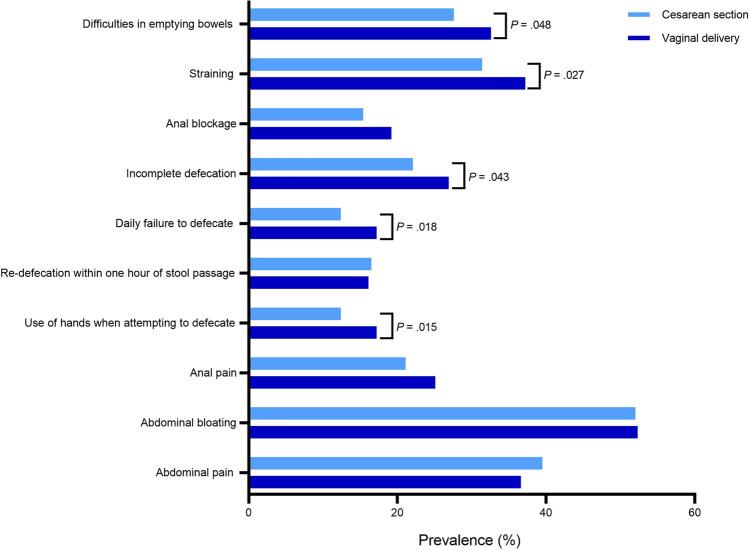
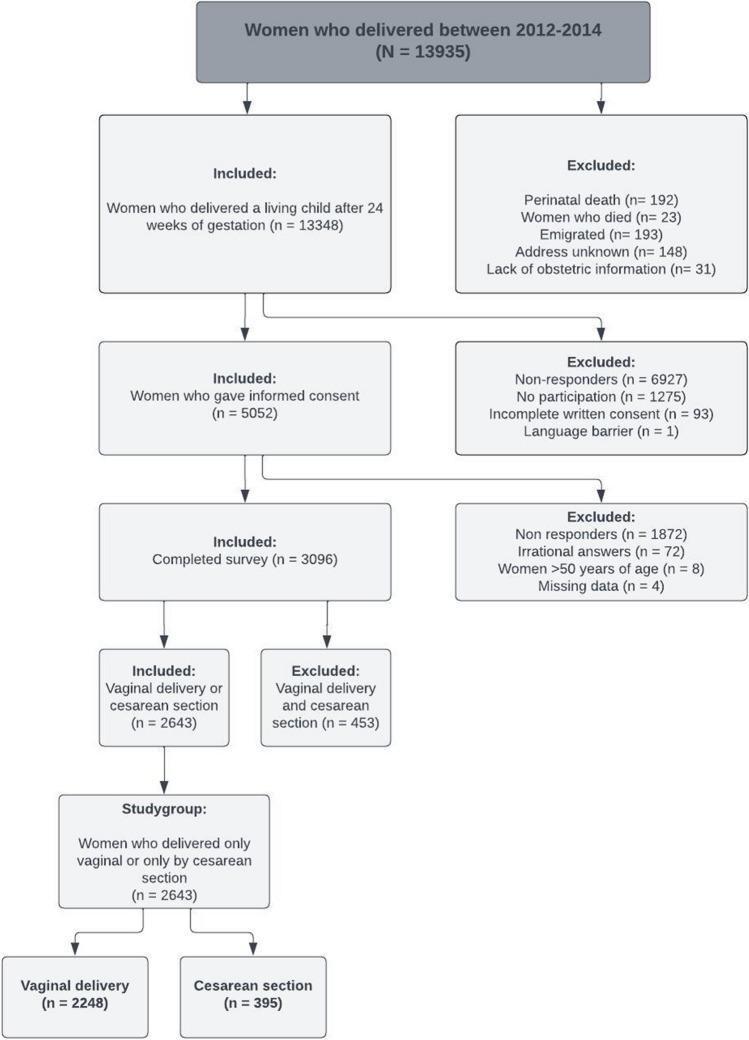
Among 2,643 parous women, 2,248 delivered vaginally (85.1%) and 395 (14.9%) by caesarean section. Altogether, 649 women (24.6%) suffered from constipation. Women in the vaginal delivery group were constipated more often than women in the caesarean section group (25.5% versus 19.0%, p = 0.005). For women who had delivered vaginally, multivariable regression analysis showed an odds ratio for constipation of 1.47 (95% confidence interval, 1.109-1.938, p = 0.007). The odds ratio for constipation in women with a spontaneous perineal tear was 1.4 times higher than in women with an intact perineum (p = 0.030). Furthermore, the vaginal delivery group reported difficulties regarding bowel emptying (p = 0.048), straining (p = 0.027), incomplete defecation (p = 0.043), not able to defecate daily (p = 0.018), manually assisted defecation (p = 0.015) and had higher Renzi scores (p = 0.043) more often.
CONCLUSIONS
Women in the vaginal delivery group have higher prevalences and odds ratios for constipation. Furthermore, a perineal tear during vaginal delivery increases the odds ratio for constipation.
引言与假设
盆底损伤可导致盆底功能障碍,包括便秘。大多数研究都集中在妊娠期间的便秘上,而关于分娩方式与便秘关系的信息有限。我们假设阴道分娩史的女性比剖宫产史的女性更常报告便秘。
方法
这是一项在荷兰进行的回顾性横断面多中心研究。所有纳入的患者(n=2643)都完成了格罗宁根排便和粪便控制问卷,以评估过去 6 个月的肠道问题。进行了参数检验、卡方检验、单变量和多变量回归分析。
结果
在 2643 名经产妇中,2248 人经阴道分娩(85.1%),395 人(14.9%)行剖宫产。共有 649 名女性(24.6%)患有便秘。阴道分娩组的女性比剖宫产组的女性更常便秘(25.5%比 19.0%,p=0.005)。对于经阴道分娩的女性,多变量回归分析显示便秘的优势比为 1.47(95%置信区间,1.109-1.938,p=0.007)。自然会阴撕裂的女性便秘的优势比是会阴完整的女性的 1.4 倍(p=0.030)。此外,阴道分娩组报告在排空肠道(p=0.048)、用力(p=0.027)、不完全排便(p=0.043)、不能每日排便(p=0.018)、手动辅助排便(p=0.015)和 Renzi 评分更高(p=0.043)方面存在更多困难。
结论
阴道分娩组的女性便秘的患病率和优势比更高。此外,阴道分娩时会阴撕裂会增加便秘的优势比。
 Zotero 插件