
多方位电子健康记录干预措施前后的肺癌筛查:一项非随机对照试验。
Lung Cancer Screening Before and After a Multifaceted Electronic Health Record Intervention: A Nonrandomized Controlled Trial.
机构信息
Department of Biomedical Informatics, University of Utah, Salt Lake City.
Study Design and Biostatistics Center, University of Utah, Salt Lake City.
出版信息
JAMA Netw Open. 2024 Jun 3;7(6):e2415383. doi: 10.1001/jamanetworkopen.2024.15383.
IMPORTANCE
Lung cancer is the deadliest cancer in the US. Early-stage lung cancer detection with lung cancer screening (LCS) through low-dose computed tomography (LDCT) improves outcomes.
OBJECTIVE
To assess the association of a multifaceted clinical decision support intervention with rates of identification and completion of recommended LCS-related services.
DESIGN, SETTING, AND PARTICIPANTS: This nonrandomized controlled trial used an interrupted time series design, including 3 study periods from August 24, 2019, to April 27, 2022: baseline (12 months), period 1 (11 months), and period 2 (9 months). Outcome changes were reported as shifts in the outcome level at the beginning of each period and changes in monthly trend (ie, slope). The study was conducted at primary care and pulmonary clinics at a health care system headquartered in Salt Lake City, Utah, among patients aged 55 to 80 years who had smoked 30 pack-years or more and were current smokers or had quit smoking in the past 15 years. Data were analyzed from September 2023 through February 2024.
INTERVENTIONS
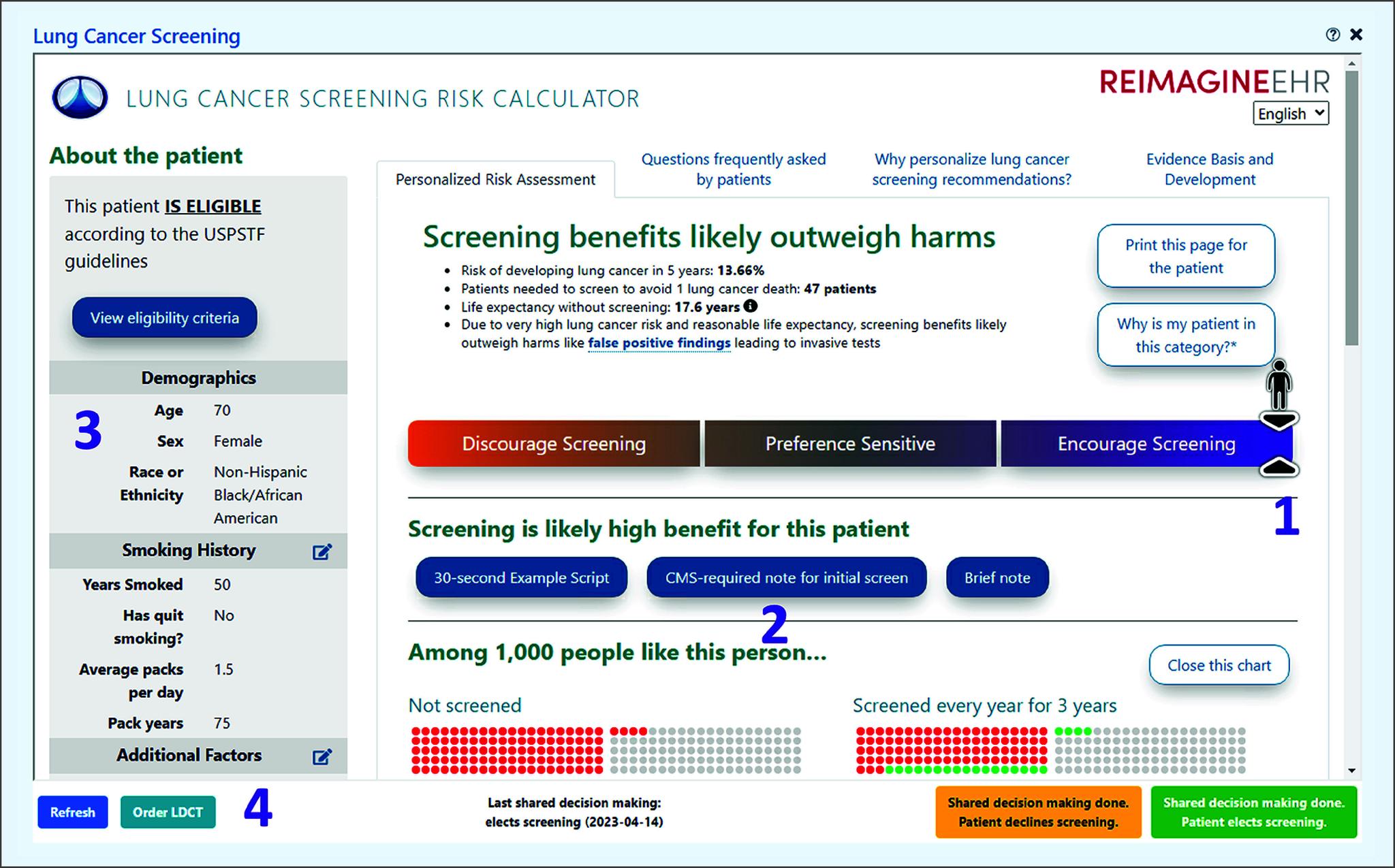
Interventions in period 1 included clinician-facing preventive care reminders, an electronic health record-integrated shared decision-making tool, and narrative LCS guidance provided in the LDCT ordering screen. Interventions in period 2 included the same clinician-facing interventions and patient-facing reminders for LCS discussion and LCS.
MAIN OUTCOME AND MEASURE
The primary outcome was LCS care gap closure, defined as the identification and completion of recommended care services. LCS care gap closure could be achieved through LDCT completion, other chest CT completion, or LCS shared decision-making.
RESULTS
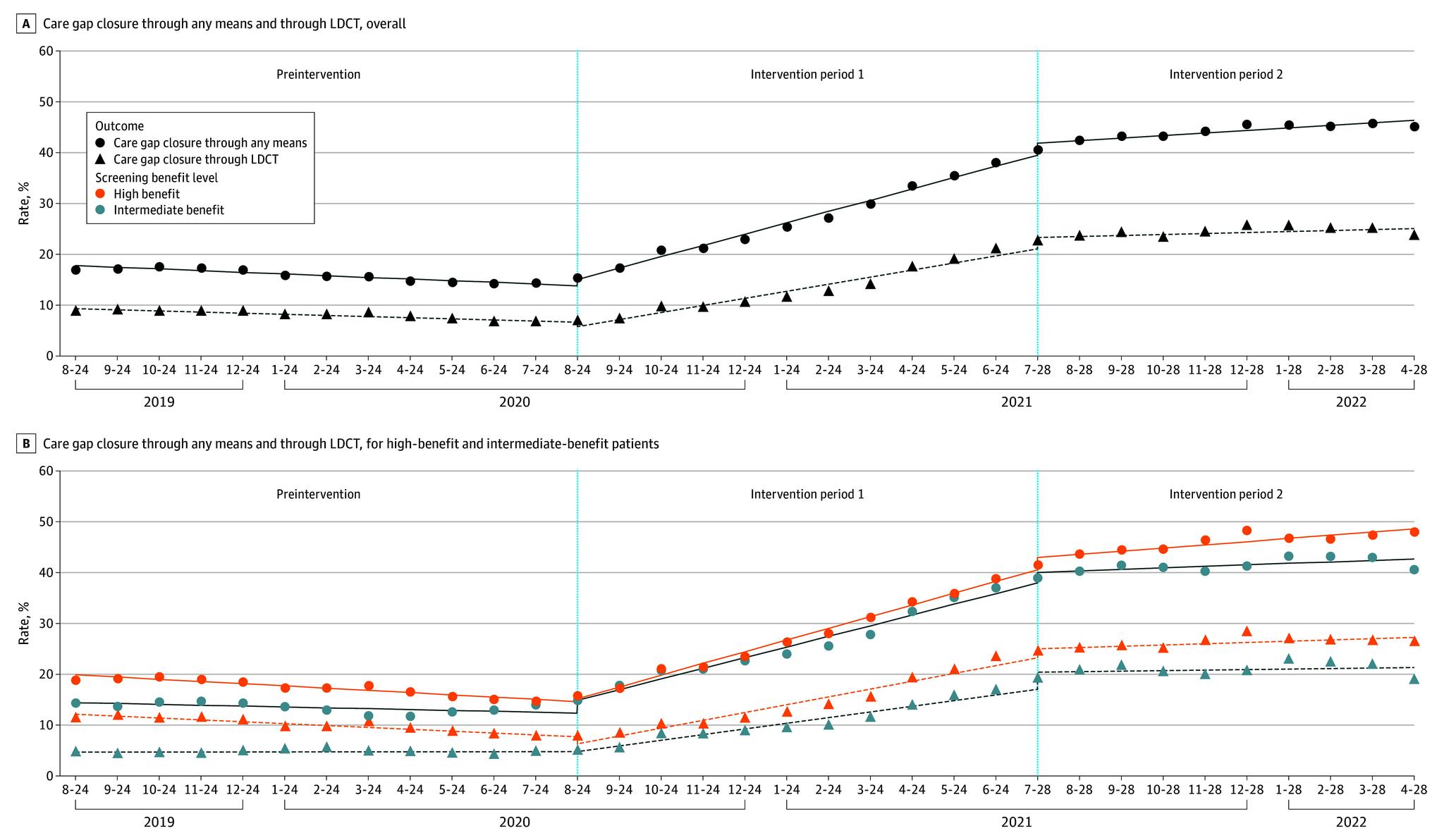
The study included 1865 patients (median [IQR] age, 64 [60-70] years; 759 female [40.7%]). The clinician-facing intervention (period 1) was not associated with changes in level but was associated with an increase in slope of 2.6 percentage points (95% CI, 2.4-2.7 percentage points) per month in care gap closure through any means and 1.6 percentage points (95% CI, 1.4-1.8 percentage points) per month in closure through LDCT. In period 2, introduction of patient-facing reminders was associated with an immediate increase in care gap closure (2.3 percentage points; 95% CI, 1.0-3.6 percentage points) and closure through LDCT (2.4 percentage points; 95% CI, 0.9-3.9 percentage points) but was not associated with an increase in slope. The overall care gap closure rate was 175 of 1104 patients (15.9%) at the end of the baseline period vs 588 of 1255 patients (46.9%) at the end of period 2.
CONCLUSIONS AND RELEVANCE
In this study, a multifaceted intervention was associated with an improvement in LCS care gap closure.
TRIAL REGISTRATION
ClinicalTrials.gov Identifier: NCT04498052.
重要性
肺癌是美国最致命的癌症。通过低剂量计算机断层扫描 (LDCT) 进行肺癌筛查 (LCS) 可早期发现肺癌,从而改善预后。
目的
评估多方面临床决策支持干预措施与建议的 LCS 相关服务的识别和完成率之间的关联。
设计、设置和参与者:这是一项非随机对照试验,采用了中断时间序列设计,包括 2019 年 8 月 24 日至 2022 年 4 月 27 日的 3 个研究期间:基线期(12 个月)、第 1 期(11 个月)和第 2 期(9 个月)。结果变化报告为每个期间开始时结果水平的变化以及每月趋势(即斜率)的变化。该研究在犹他州盐湖城总部的医疗保健系统的初级保健和肺科诊所进行,参与者为年龄在 55 至 80 岁之间、吸烟 30 包年或以上、目前吸烟或在过去 15 年内戒烟的患者。数据于 2023 年 9 月至 2024 年 2 月进行分析。
干预措施
第 1 期的干预措施包括面向临床医生的预防性护理提醒、与电子健康记录集成的共享决策工具以及在 LDCT 订购屏幕中提供的叙述性 LCS 指导。第 2 期的干预措施包括相同的面向临床医生的干预措施和面向患者的 LCS 讨论和 LCS 提醒。
主要结果和测量
主要结果是 LCS 护理差距的闭合,定义为建议护理服务的识别和完成。通过 LDCT 完成、其他胸部 CT 完成或 LCS 共享决策,可以实现 LCS 护理差距的闭合。
结果
研究纳入了 1865 名患者(中位数[IQR]年龄,64[60-70]岁;759 名女性[40.7%])。面向临床医生的干预措施(第 1 期)与水平的变化无关,但与任何方式的护理差距闭合斜率每月增加 2.6 个百分点(95%CI,2.4-2.7 个百分点)和 LDCT 闭合斜率每月增加 1.6 个百分点(95%CI,1.4-1.8 个百分点)相关。在第 2 期,引入患者面对的提醒措施与护理差距的立即闭合(2.3 个百分点;95%CI,1.0-3.6 个百分点)和 LDCT 闭合(2.4 个百分点;95%CI,0.9-3.9 个百分点)相关,但与斜率的增加无关。在基线期结束时,1104 名患者中有 175 名(15.9%)完成了护理差距,而在第 2 期结束时,1255 名患者中有 588 名(46.9%)完成了护理差距。
结论和相关性
在这项研究中,多方面的干预措施与 LCS 护理差距的改善相关。
试验注册
ClinicalTrials.gov 标识符:NCT04498052。
 Zotero 插件