
通过紧凑型点扩散函数工程实现深度增强的高通量显微镜技术。
Depth-enhanced high-throughput microscopy by compact PSF engineering.
作者信息
Opatovski Nadav, Nehme Elias, Zoref Noam, Barzilai Ilana, Orange Kedem Reut, Ferdman Boris, Keselman Paul, Alalouf Onit, Shechtman Yoav
机构信息
Russell Berrie Nanotechnology Institute, Technion - Israel Institute of Technology, Haifa, Israel.
Department of Biomedical Engineering, Technion - Israel Institute of Technology, Haifa, Israel.
出版信息
Nat Commun. 2024 Jun 7;15(1):4861. doi: 10.1038/s41467-024-48502-y.
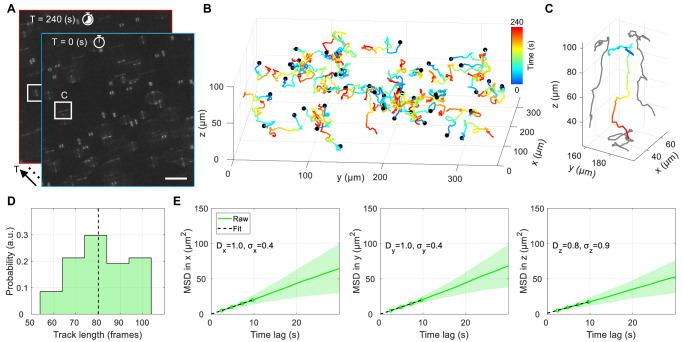
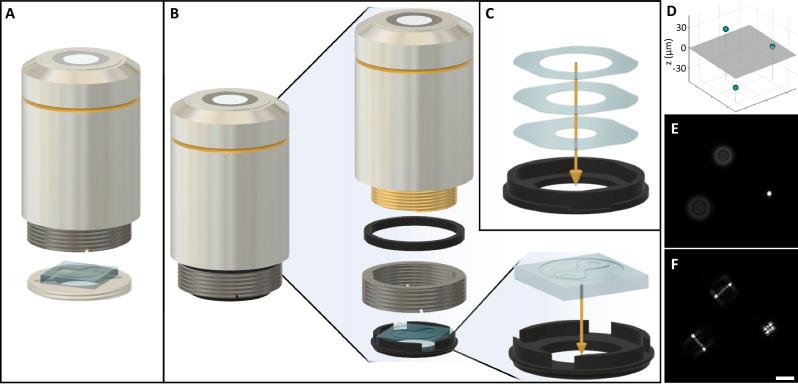
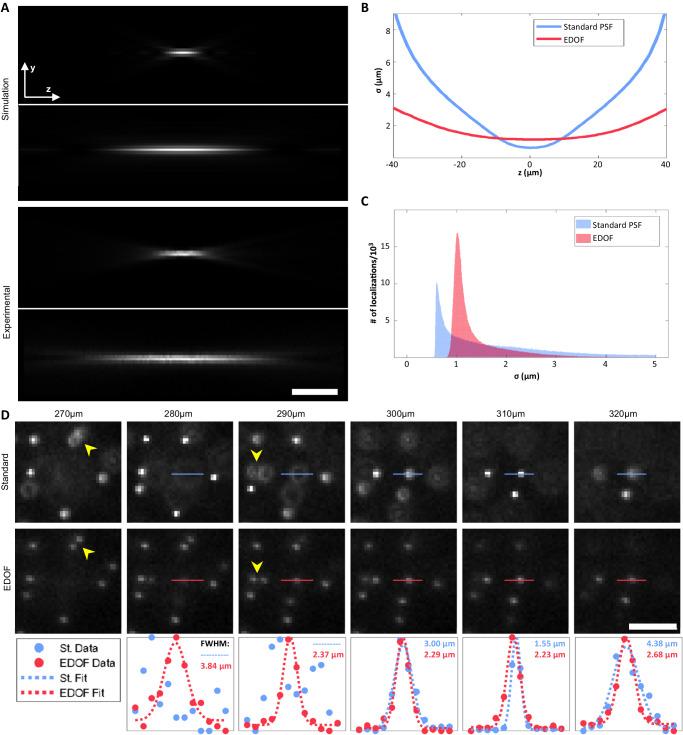
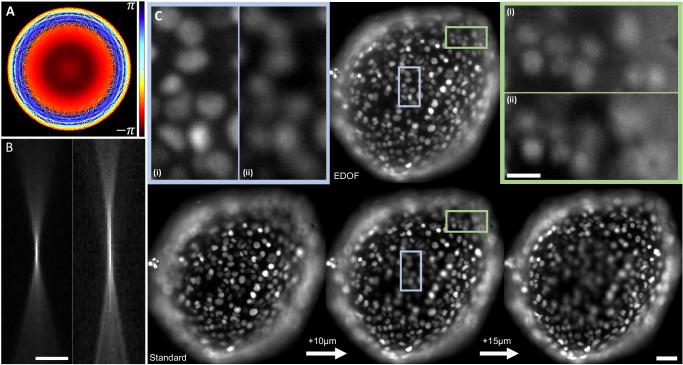
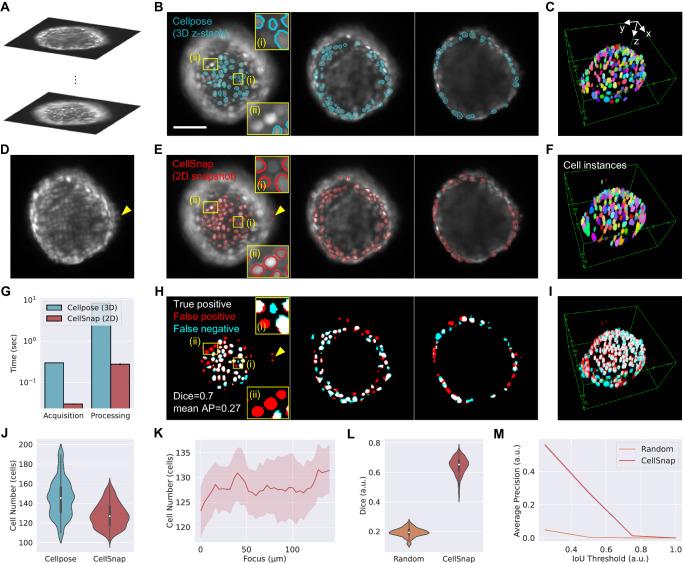
High-throughput microscopy is vital for screening applications, where three-dimensional (3D) cellular models play a key role. However, due to defocus susceptibility, current 3D high-throughput microscopes require axial scanning, which lowers throughput and increases photobleaching and photodamage. Point spread function (PSF) engineering is an optical method that enables various 3D imaging capabilities, yet it has not been implemented in high-throughput microscopy due to the cumbersome optical extension it typically requires. Here we demonstrate compact PSF engineering in the objective lens, which allows us to enhance the imaging depth of field and, combined with deep learning, recover 3D information using single snapshots. Beyond the applications shown here, this work showcases the usefulness of high-throughput microscopy in obtaining training data for deep learning-based algorithms, applicable to a variety of microscopy modalities.
高通量显微镜对于筛选应用至关重要,其中三维(3D)细胞模型发挥着关键作用。然而,由于对焦易感性,当前的3D高通量显微镜需要进行轴向扫描,这会降低通量并增加光漂白和光损伤。点扩散函数(PSF)工程是一种光学方法,可实现各种3D成像功能,但由于通常需要繁琐的光学扩展,它尚未在高通量显微镜中得到应用。在这里,我们展示了在物镜中进行紧凑的PSF工程,这使我们能够增强成像景深,并结合深度学习,使用单张快照恢复3D信息。除了此处展示的应用之外,这项工作还展示了高通量显微镜在获取基于深度学习算法的训练数据方面的有用性,适用于各种显微镜模式。

 Zotero 插件