
为未来的大流行做准备:在整个 COVID-19 大流行期间,衰弱与住院老年人的死亡率相关,一项荷兰多中心队列研究。
Preparing for future pandemics: frailty associates with mortality in hospitalised older people during the entire COVID-19 pandemic, a Dutch multicentre cohort study.
机构信息
Department of Internal Medicine, Section of Geriatrics and Gerontology, Leiden University Medical Center, Albinusdreef 2, 2333ZA, Leiden, The Netherlands.
LUMC Center of Medicine for Older People, Leiden University Medical Center, Leiden, The Netherlands.
出版信息
Eur Geriatr Med. 2024 Aug;15(4):951-959. doi: 10.1007/s41999-024-01001-1. Epub 2024 Jun 7.
PURPOSE
Viral mutations and improved prevention or treatment options may have changed the association of frailty with mortality throughout the COVID-19 pandemic. We investigated how associations of frailty with in-hospital mortality changed throughout the pandemic in older people hospitalised for COVID-19.
METHODS
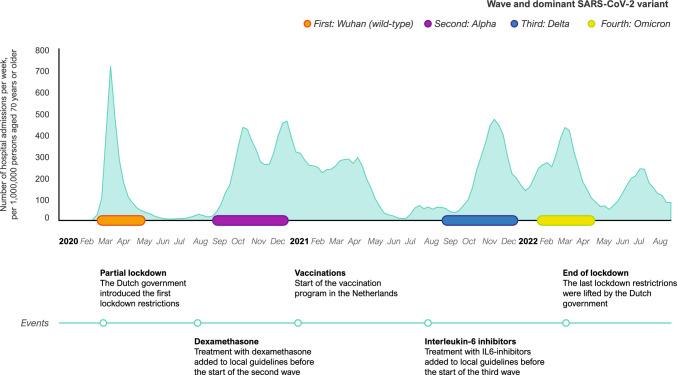
The COVID-OLD study included COVID-19 patients aged ≥ 70 years hospitalised during the first (early 2020), second (late 2020), third (late 2021) or fourth wave (early 2022). Based on the clinical frailty scale, patients were categorised as fit (1-3), pre-frail (4-5) or frail (6-9). Associations of frailty with in-hospital mortality were assessed with pairwise comparisons with fit as reference category and modelled using binary logistic regression adjusted for age and sex.
RESULTS
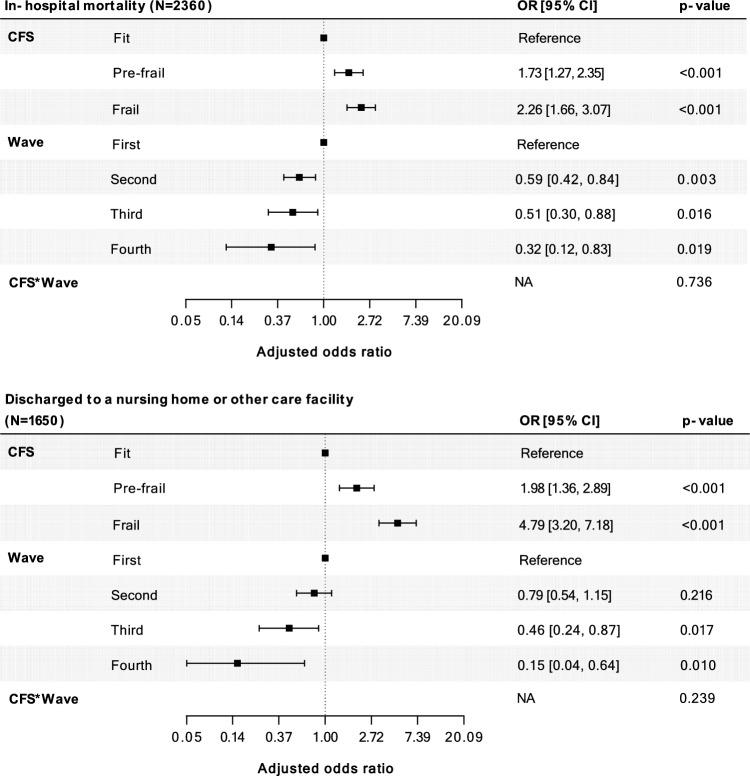
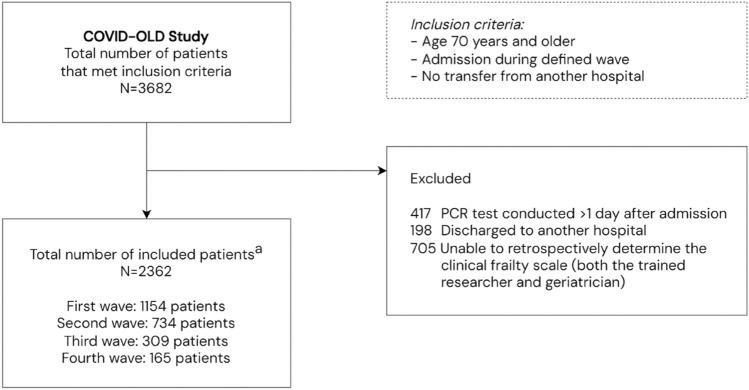
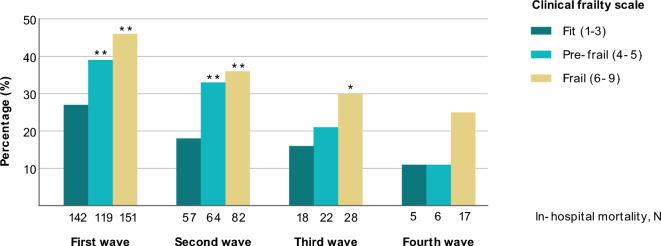
This study included 2362 patients (mean age 79.7 years, 60% men). In the first wave, in-hospital mortality was 46% in patients with frailty and 27% in fit patients. In-hospital mortality decreased in each subsequent wave to 25% in patients with frailty and 11% in fit patients in the fourth wave. After adjustments, an overall higher risk of in-hospital mortality was found in frail (OR 2.26, 95% CI: 1.66-3.07) and pre-frail (OR 1.73, 95% CI: 1.27-2.35) patients compared to fit patients, which did not change over time (p for interaction = 0.74).
CONCLUSIONS
Frailty remained associated with a higher risk of in-hospital mortality throughout the entire COVID-19 pandemic, although overall in-hospital mortality rates decreased. Frailty therefore remains a relevant risk factor in all stages of a pandemic and is important to consider in prevention and treatment guidelines for future pandemics.
目的
病毒突变以及预防或治疗选择的改进可能改变了整个 COVID-19 大流行期间衰弱与死亡率的关联。我们研究了 COVID-19 大流行期间,年龄较大的 COVID-19 住院患者中,衰弱与院内死亡率的关联如何随时间发生变化。
方法
COVID-OLD 研究纳入了 2020 年初(第一波)、2020 年末(第二波)、2021 年末(第三波)和 2022 年初(第四波)期间住院的≥70 岁 COVID-19 患者。基于临床衰弱量表,患者分为健康(1-3 分)、衰弱前期(4-5 分)或衰弱(6-9 分)。以健康患者为参考类别,通过两两比较评估衰弱与院内死亡率的关联,并采用二元逻辑回归模型进行调整,以校正年龄和性别。
结果
本研究纳入了 2362 例患者(平均年龄 79.7 岁,60%为男性)。在第一波中,衰弱患者的院内死亡率为 46%,健康患者的院内死亡率为 27%。在随后的每一波中,衰弱患者的院内死亡率逐渐下降,至第四波时为 25%,健康患者的院内死亡率为 11%。校正后,衰弱(比值比 2.26,95%置信区间:1.66-3.07)和衰弱前期(比值比 1.73,95%置信区间:1.27-2.35)患者的院内死亡风险总体高于健康患者,且这种关联随时间没有变化(交互检验 P=0.74)。
结论
尽管总体院内死亡率下降,但整个 COVID-19 大流行期间,衰弱仍然与更高的院内死亡风险相关。因此,衰弱仍然是大流行所有阶段的一个相关风险因素,对于未来大流行的预防和治疗指南非常重要。
 Zotero 插件