
用于解决拟南芥叶和种子离子组预测中数据不足问题的具有生物学意义的基因组解释模型。
Biologically meaningful genome interpretation models to address data underdetermination for the leaf and seed ionome prediction in Arabidopsis thaliana.
机构信息
ESAT-STADIUS, KU Leuven, 3001, Leuven, Belgium.
Université Paris-Saclay, INRAE, AgroParisTech, Institute Jean-Pierre Bourgin for Plant Sciences (IJPB), 78000, Versailles, France.
出版信息
Sci Rep. 2024 Jun 8;14(1):13188. doi: 10.1038/s41598-024-63855-6.
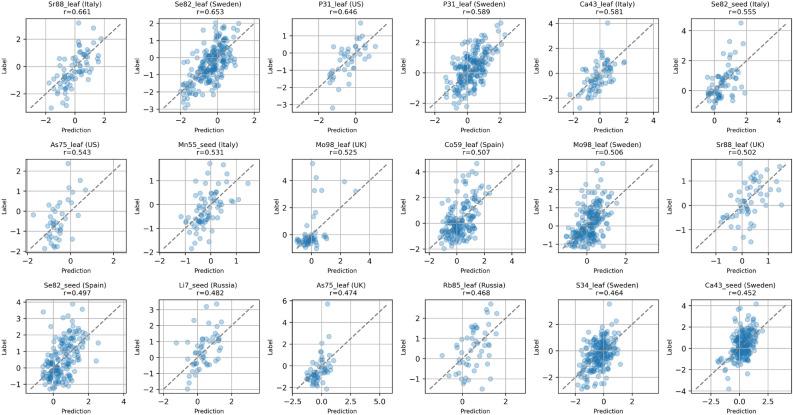
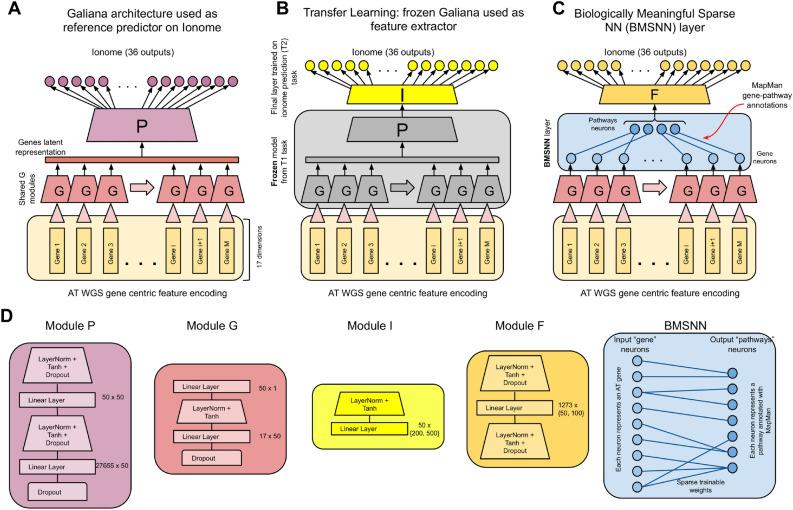
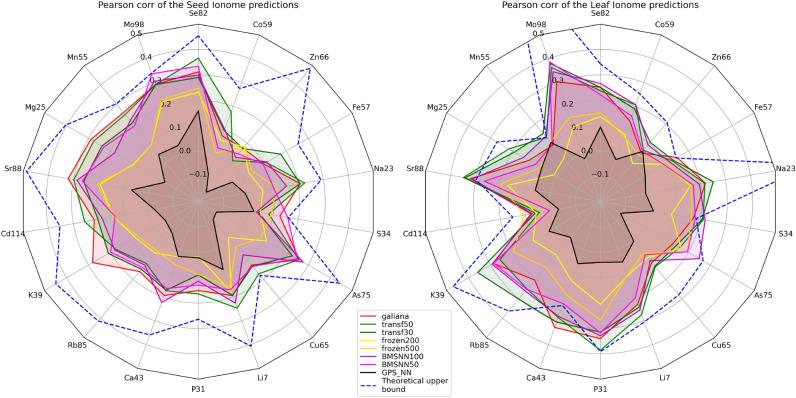
Genome interpretation (GI) encompasses the computational attempts to model the relationship between genotype and phenotype with the goal of understanding how the first leads to the second. While traditional approaches have focused on sub-problems such as predicting the effect of single nucleotide variants or finding genetic associations, recent advances in neural networks (NNs) have made it possible to develop end-to-end GI models that take genomic data as input and predict phenotypes as output. However, technical and modeling issues still need to be fixed for these models to be effective, including the widespread underdetermination of genomic datasets, making them unsuitable for training large, overfitting-prone, NNs. Here we propose novel GI models to address this issue, exploring the use of two types of transfer learning approaches and proposing a novel Biologically Meaningful Sparse NN layer specifically designed for end-to-end GI. Our models predict the leaf and seed ionome in A.thaliana, obtaining comparable results to our previous over-parameterized model while reducing the number of parameters by 8.8 folds. We also investigate how the effect of population stratification influences the evaluation of the performances, highlighting how it leads to (1) an instance of the Simpson's Paradox, and (2) model generalization limitations.
基因组解释(GI)涵盖了尝试建立基因型和表型之间关系的计算模型,目的是了解前者如何导致后者。虽然传统方法侧重于预测单核苷酸变异的影响或寻找遗传关联等子问题,但神经网络(NN)的最新进展使得开发端到端 GI 模型成为可能,这些模型将基因组数据作为输入,并预测表型作为输出。然而,这些模型要想有效,仍需要解决技术和建模问题,包括基因组数据集普遍存在的欠定问题,这使得它们不适合训练大型、容易过拟合的 NN。在这里,我们提出了新的 GI 模型来解决这个问题,探索了两种类型的迁移学习方法的应用,并提出了一种专门用于端到端 GI 的新型生物学意义稀疏 NN 层。我们的模型预测拟南芥的叶和种子离子组,获得了与我们之前的过参数化模型相当的结果,同时将参数数量减少了 8.8 倍。我们还研究了群体分层如何影响性能评估,突出表明它如何导致(1)辛普森悖论的实例,以及(2)模型泛化限制。
 Zotero 插件