
中年学术医学教师的倦怠。
Burnout Among Mid-Career Academic Medical Faculty.
机构信息
Department of Radiation Oncology, University of Michigan, Ann Arbor.
Department of Internal Medicine, University of Michigan, Ann Arbor.
出版信息
JAMA Netw Open. 2024 Jun 3;7(6):e2415593. doi: 10.1001/jamanetworkopen.2024.15593.
IMPORTANCE
Studies reveal that most physicians report symptoms of burnout. Less is known about burnout in mid-career medical faculty specifically.
OBJECTIVE
To characterize burnout and its risk factors, particularly differences by gender, among mid-career medical faculty.
DESIGN, SETTING, AND PARTICIPANTS: Between August 2021 and August 2022, a survey was sent to 1430 individuals who received new National Institutes of Health K08 and K23 career development awards from 2006 to 2009. Data were analyzed between June and October 2023.
MAIN OUTCOMES AND MEASURES
Personal and work-related burnout as evaluated using the Copenhagen Burnout Inventory (CBI). The CBI score ranges from 0 to 100, with a score of 50 or higher indicating a high degree of burnout. Multivariable models were used to investigate associations between burnout and participant characteristics, including race and ethnicity, sexual orientation and gender identity, academic rank, work climate, experiences of workplace sexual harassment, sleep hours, work and domestic caregiving time, and time allocation changes in work and domestic work hours compared with before the COVID-19 pandemic. Work climate was evaluated by a general climate elements scale assessing elements such as friendliness, respect, and collegiality, and a diversity, equity, and inclusion climate elements scale assessing elements such as homogeneity, sexism, and homophobia; higher scores indicated a more favorable view of the climate.
RESULTS
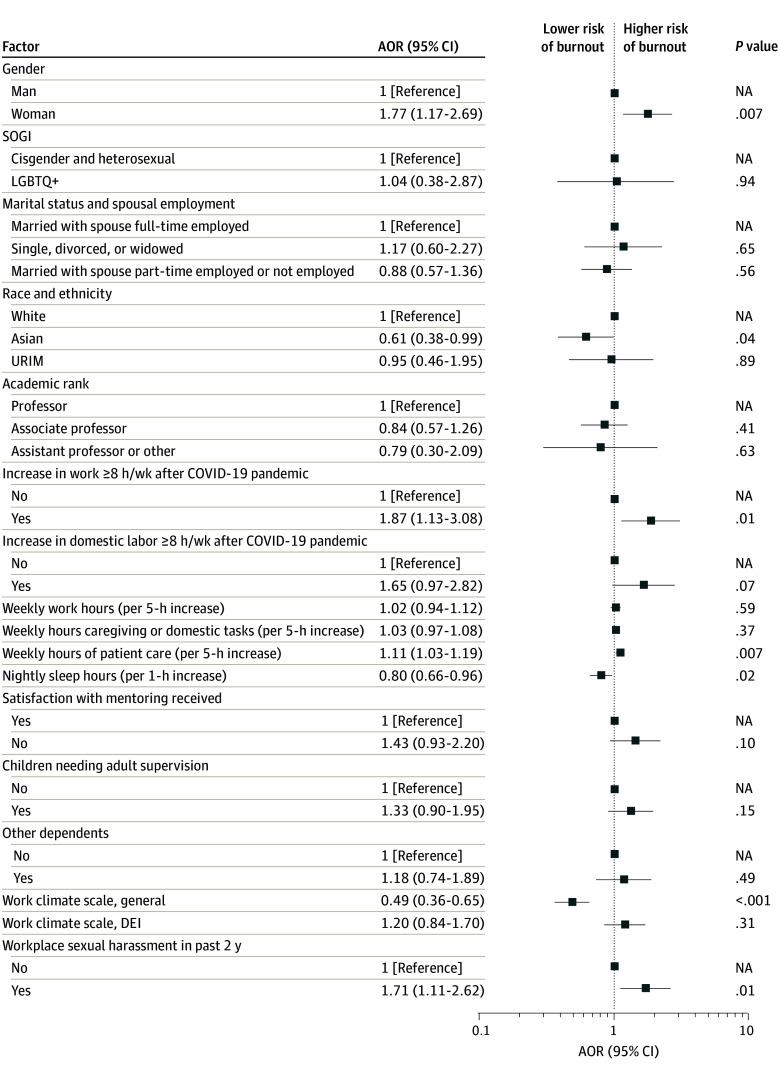
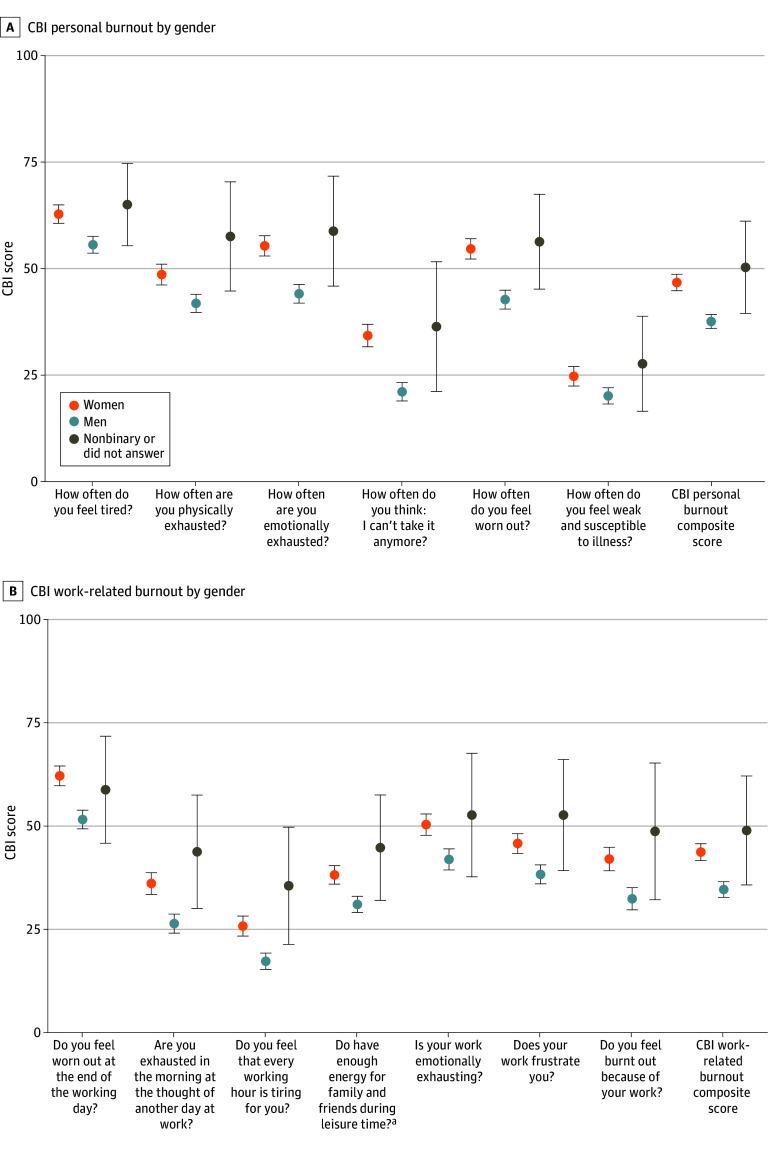
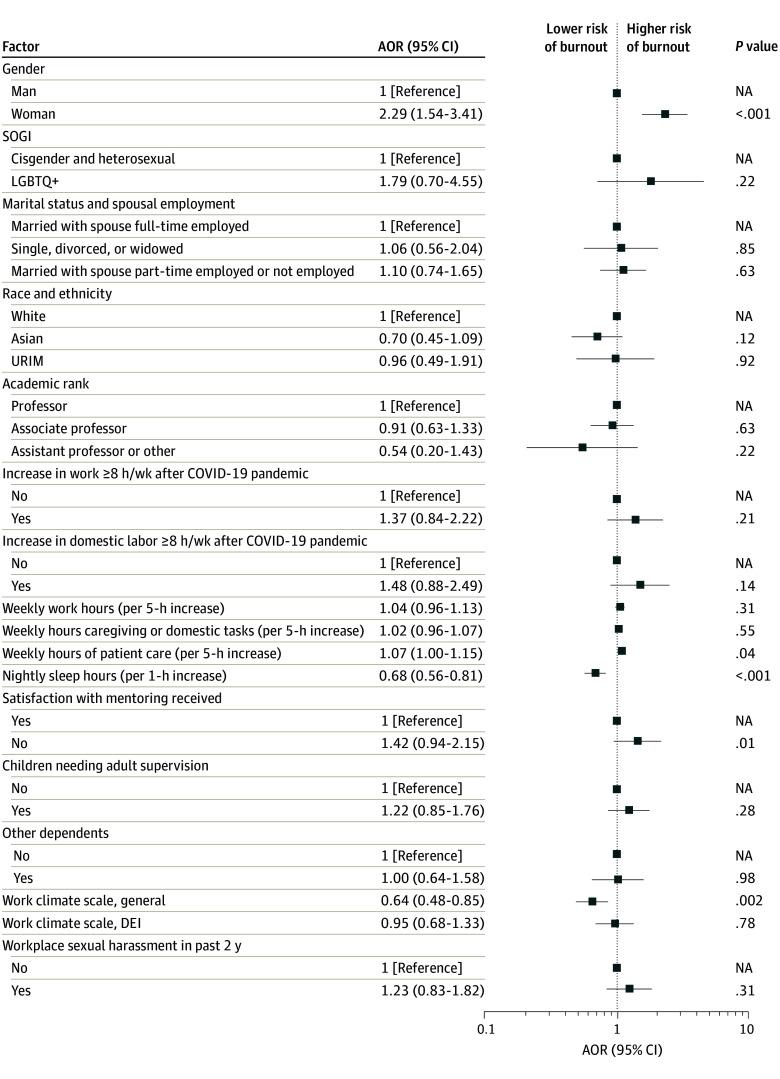
In all, 1430 surveys were sent, 926 candidates responded (65% response rate), and the analytic cohort was limited to the 841 respondents who were still in academic medicine (50.7% men). Burnout was significantly more common for women than men (mean [SD] CBI personal scores, 46.6 [19.4] vs 37.5 [17.2]; P < .001; mean [SD] CBI work-related scores, 43.7 [20.4] vs 34.6 [19.7]; P < .001). In multivariable models, personal burnout was significantly more likely for women (adjusted odds ratio [AOR], 2.29 [95% CI, 1.54-3.41]; P < .001) and with more weekly hours of patient care (AOR, 1.07 [95% CI, 1.00-1.15] for each 5-hour increase; P = .04). Personal burnout was less likely with more nightly sleep hours (AOR, 0.68 [95% CI, 0.56-0.81] for each 1-hour increase; P < .001) and with an improved general work climate rating (AOR, 0.64 [95% CI, 0.48-0.85] for each 1-point increase in general work climate scale score; P = .002). Work-related burnout was also significantly more likely for women than men (AOR, 1.77 [95% CI, 1.17-2.69]; P = .007). Greater work-related burnout was associated with an increase of 8 or more work hours per week compared with before the COVID-19 pandemic (AOR, 1.87 [95% CI, 1.13-3.08]; P = .01), more weekly hours of patient care (AOR, 1.11 [95% CI, 1.03-1.19] for each 5-hour increase; P = .007), and a workplace sexual harassment experience in the past 2 years (AOR, 1.71 [95% CI, 1.11-2.62]; P = .01). Work-related burnout was significantly less likely with more nightly sleep hours (AOR, 0.80 [95% CI, 0.66-0.96] for each 1-hour increase; P = .02) and with an improved general work climate rating (AOR, 0.49; [95% CI, 0.36-0.65] for each 1-point increase in general work climate scale score; P < .001).
CONCLUSIONS AND RELEVANCE
This survey study of K grant awardees revealed substantial rates of burnout among mid-career medical faculty, and burnout rates differed by gender. Evidence-based interventions are needed to realize the benefits of workforce diversity and vitality.
重要性
研究表明,大多数医生都有倦怠感。关于中年医学教师的倦怠感,人们了解得较少。
目的
描述中年医学教师的倦怠感及其风险因素,特别是按性别划分的差异。
设计、地点和参与者:在 2021 年 8 月至 2022 年 8 月期间,向 2006 年至 2009 年获得美国国立卫生研究院 K08 和 K23 职业发展奖的 1430 名个人发送了一项调查。数据分析于 2023 年 6 月至 10 月进行。
主要结果和措施
使用哥本哈根倦怠量表(CBI)评估个人和与工作相关的倦怠感。CBI 得分范围从 0 到 100,得分 50 或以上表示高度倦怠。使用多变量模型调查了倦怠感与参与者特征之间的关联,包括种族和民族、性取向和性别认同、学术等级、工作氛围、工作场所性骚扰经历、睡眠小时数、工作和家庭照顾时间,以及与 COVID-19 大流行前相比,工作和家庭工作时间的分配变化。工作氛围通过一般气候元素量表评估,该量表评估了友好、尊重和同事关系等元素,以及多样性、公平性和包容性气候元素量表,评估了同质化、性别歧视和恐同症等元素;较高的分数表示对气候的看法更为有利。
结果
共发送了 1430 份调查,926 名候选人做出了回应(回应率为 65%),分析队列仅限于仍在学术医学领域的 841 名应答者(50.7%为男性)。女性的倦怠感明显高于男性(平均[标准差]CBI 个人得分,46.6[19.4]与 37.5[17.2];P<0.001;平均[标准差]CBI 与工作相关的得分,43.7[20.4]与 34.6[19.7];P<0.001)。在多变量模型中,女性(调整后的优势比[95%置信区间],2.29[1.54-3.41];P<0.001)和每周患者护理时间增加(每增加 5 小时,AOR 为 1.07[95%CI,1.00-1.15];P=0.04)的可能性更大。每晚睡眠时间增加(AOR,每增加 1 小时,0.68[95%CI,0.56-0.81];P<0.001)和一般工作氛围评分提高(AOR,每提高 1 分,0.64[95%CI,0.48-0.85];P=0.002)的个人倦怠感降低。女性的工作相关倦怠感也明显高于男性(AOR,1.77[95%CI,1.17-2.69];P=0.007)。与 COVID-19 大流行前相比,每周工作时间增加 8 小时或以上(AOR,1.87[95%CI,1.13-3.08];P=0.01)、每周患者护理时间增加(AOR,每增加 5 小时,1.11[95%CI,1.03-1.19];P=0.007)和过去 2 年工作场所性骚扰经历(AOR,1.71[95%CI,1.11-2.62];P=0.01)与更高的工作相关倦怠感相关。每晚睡眠时间增加(AOR,每增加 1 小时,0.80[95%CI,0.66-0.96];P=0.02)和一般工作氛围评分提高(AOR,每提高 1 分,0.49[95%CI,0.36-0.65];P<0.001)与工作相关的倦怠感降低相关。
结论和相关性
这项 K 赠款获得者的调查研究显示,中年医学教师中存在大量的倦怠感,而且倦怠感因性别而异。需要采取循证干预措施,以实现劳动力多样性和活力的好处。
 Zotero 插件