
水杨酸和茉莉酸介导的两个弹裂碎米荠种群对镍的不同植物修复命运
Salicylic acid and jasmonic acid-mediated different fate of nickel phytoremediation in two populations of Alyssum inflatum Nyár.
机构信息
Pharmaceutical Sciences Research Center, Health Institute, Kermanshah University of Medical Sciences, Kermanshah, Iran.
Laboratory of Plant Physiology, Department of Biology, School of Science, Razi University, Kermanshah, Iran.
出版信息
Sci Rep. 2024 Jun 10;14(1):13259. doi: 10.1038/s41598-024-64336-6.
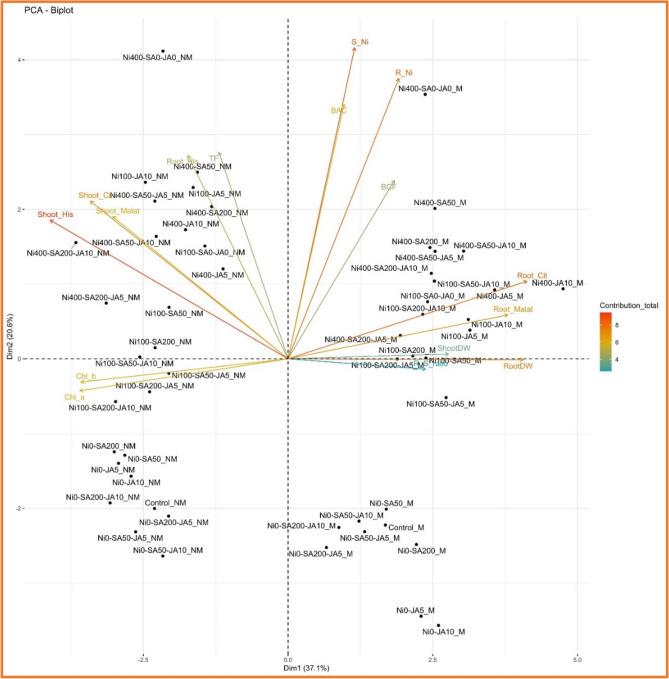
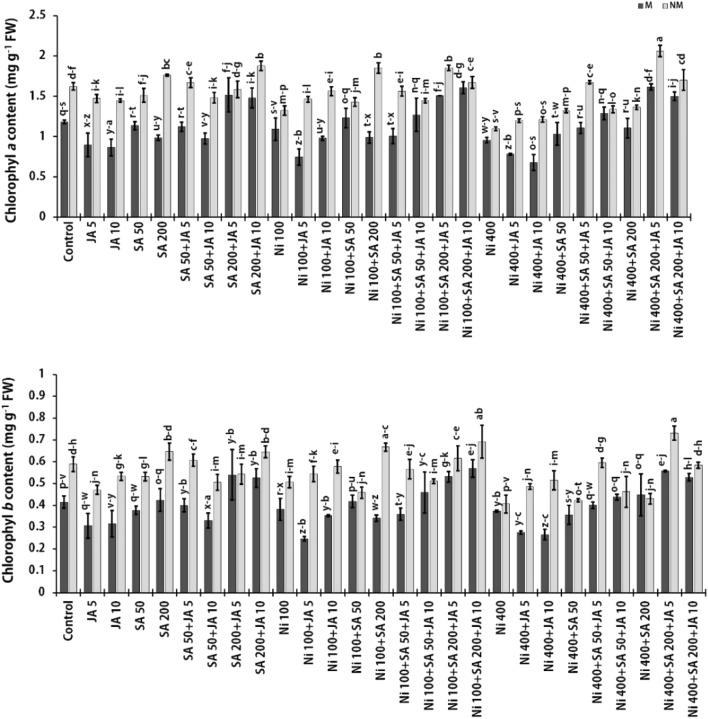
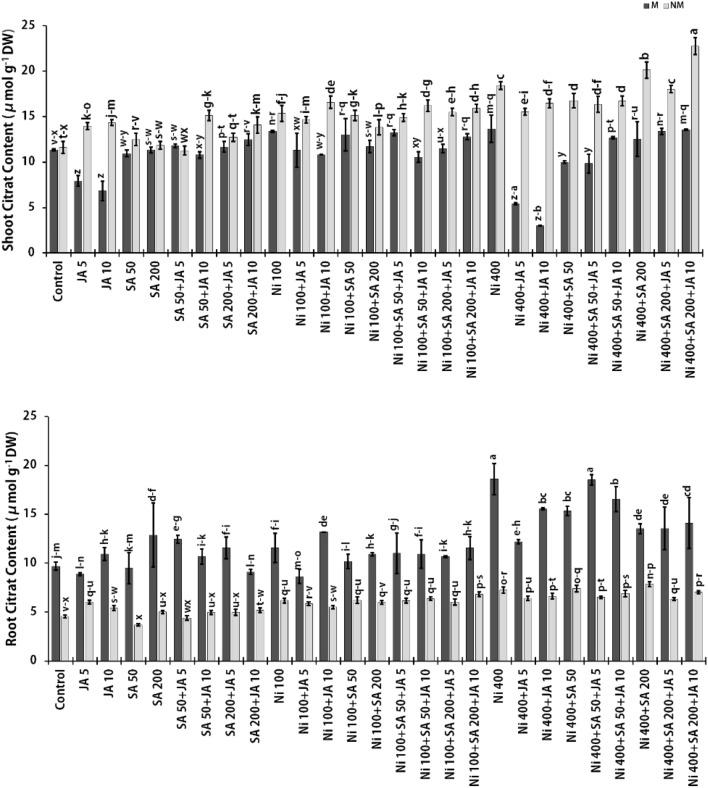
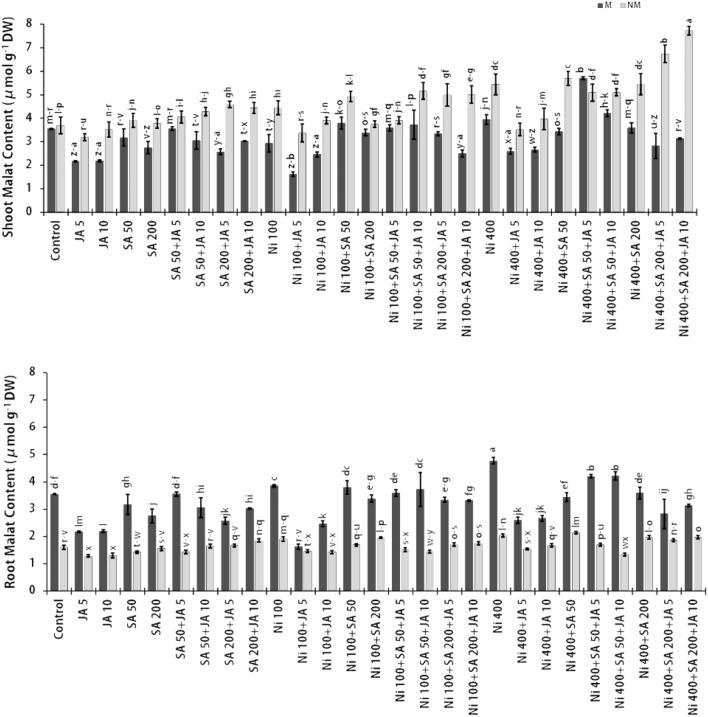
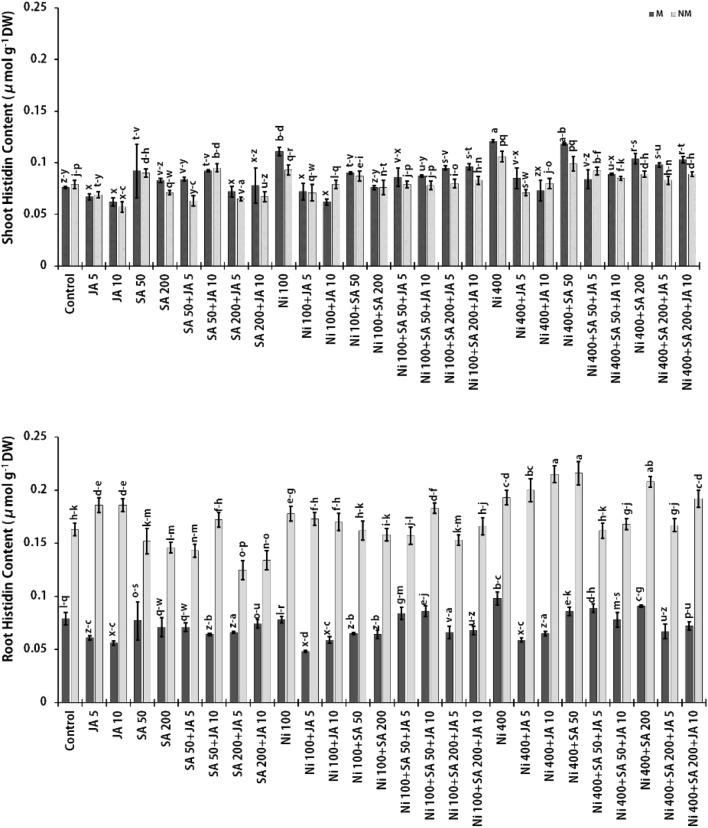
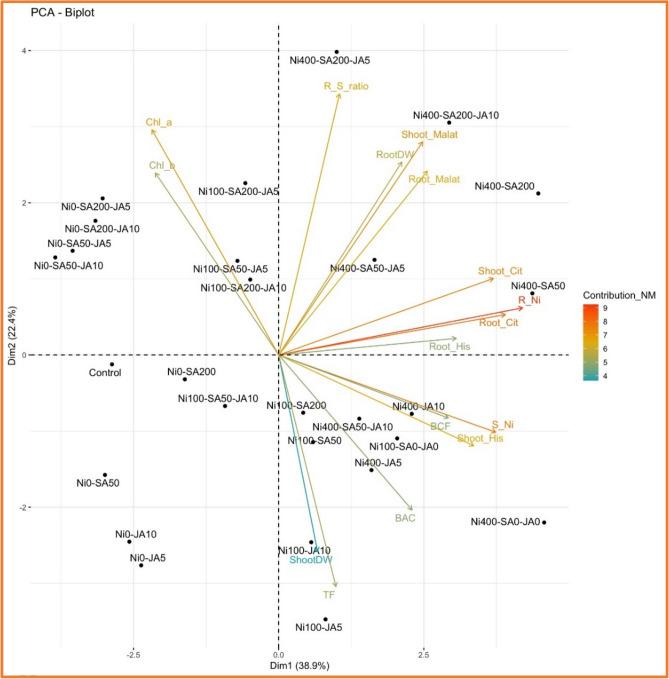
This study investigates Ni phytoremediation and accumulation potential in the presence of salicylic acid (SA) (0, 50 and 200 μM) and jasmonic acid (JA) (0, 5 and 10 μM) in two populations of Alyssum inflatum under various nickel (Ni) doses (0, 100 and 400 μM). By measuring Ni levels in the shoots and roots, values of bioaccumulation coefficient (BAC), biological concentration factor (BCF) and translocation factor (TF) were calculated to quantify Ni accumulation and translocation between plant organs. Additionally, the amounts of histidine (His), citric acid (CA) and malic acid (MA) were explored. The results showed that plant dry weight (DW) [in shoot (29.8%, 8.74%) and in root (21.6%, 24.4%)] and chlorophyll [a (17.1%, 32.5%), b (10.1%, 30.9%)] declined in M and NM populations respectively, when exposed to Ni (400 μM). Conversely, the levels of MA [in shoot (37.0%, 32.0%) and in root (25.5%, 21.2%)], CA [in shoot (17.0%, 10.0%) and in root (47.9%, 37.2%)] and His [in shoot (by 1.59- and 1.34-fold) and in root (by 1.24- and 1.18-fold)] increased. Also, in the presence 400 μM Ni, the highest accumulation of Ni was observed in shoots of M (1392 μg/g DW) and NM (1382 μg/g DW). However, the application of SA and JA (especially in Ni 400 μM + SA 200 μM + JA 5 and 10 μM treatments) mitigated the harmful impact of Ni on physiological parameters. Also, a decreasing trend was observed in the contents of MA, CA, and His. The reduction of these compounds as important chelators of Ni caused a decrease in root-to-shoot Ni transfer and reducing accumulation in the shoots of both populations. The values of phytoremediation indices in both populations exposed to Ni (400 μM) were above one. In presence of the SA and JA, these indices showed a decreasing trend, although the values remained above one (BAC, BCF and TF > 1). Overall, the results indicated that SA and JA can reduce phytoremediation potential of the two populations through different mechanisms.
这项研究调查了水杨酸(SA)(0、50 和 200 μM)和茉莉酸(JA)(0、5 和 10 μM)存在下两种 Alyssum inflatum 种群对镍(Ni)的植物修复和积累潜力。通过测量植物地上部和地下部的 Ni 含量,计算生物积累系数(BAC)、生物浓缩因子(BCF)和转运因子(TF),以量化 Ni 在植物器官之间的积累和转运。此外,还探索了组氨酸(His)、柠檬酸(CA)和苹果酸(MA)的含量。结果表明,在 M 和 NM 种群中,当暴露于 Ni(400 μM)时,植物干重(地上部(29.8%、8.74%)和地下部(21.6%、24.4%))和叶绿素[a(17.1%、32.5%)、b(10.1%、30.9%)]下降。相反,MA 的含量[地上部(37.0%、32.0%)和地下部(25.5%、21.2%)]、CA 的含量[地上部(17.0%、10.0%)和地下部(47.9%、37.2%)]和 His 的含量[地上部(增加 1.59-和 1.34 倍)和地下部(增加 1.24-和 1.18 倍)]增加。此外,在 400 μM Ni 存在下,M(1392μg/g DW)和 NM(1382μg/g DW)地上部中 Ni 的积累量最高。然而,SA 和 JA 的应用(特别是在 Ni 400 μM+SA 200 μM+JA 5 和 10 μM 处理下)减轻了 Ni 对生理参数的有害影响。此外,MA、CA 和 His 的含量呈下降趋势。这些化合物作为 Ni 的重要螯合剂的减少导致 Ni 从根部向地上部的转移减少,从而降低了两个种群地上部的积累。暴露于 Ni(400 μM)的两个种群的植物修复指数均高于 1。在 SA 和 JA 的存在下,这些指数呈下降趋势,尽管仍高于 1(BAC、BCF 和 TF>1)。总的来说,结果表明,SA 和 JA 可以通过不同的机制降低两个种群的植物修复潜力。

 Zotero 插件