
基于改良髓芯减压的不同联合疗法治疗早期非创伤性股骨头坏死的疗效比较:一项回顾性临床研究
Comparison of the Efficacy of Different Combined Therapies Based on Modified Core Decompression for the Treatment of Early-stage Nontraumatic Osteonecrosis of the Femoral Head: A Retrospective Clinical Study.
作者信息
Sun Shuo, Li Donghai, Wang Qin, Kang Pengde
机构信息
Department of Orthopedics, Orthopedic Research Institute, West China Hospital, Sichuan University, Chengdu, China.
出版信息
Orthop Surg. 2024 Aug;16(8):1912-1919. doi: 10.1111/os.14128. Epub 2024 Jun 10.
OBJECTIVE
Osteonecrosis of the femoral head (ONFH) is a severe orthopedic disease, which may cause severe hip dysfunction in later stage. Therefore, it is necessary to treat nontraumatic ONFH during the early stages. The aim of this study was to evaluate the clinical efficacy and survival rates of different combined therapies based on modified core decompression (CD) for early-stage nontraumatic ONFH.
METHODS
This retrospective cohort study assessed 397 hips with ONFH who underwent different combined therapies based on modified CD in our institution between January 2010 and December 2017. Patients were classified into six groups based on treatment modalities, and were followed up at 1 year and 5 years postoperatively. Clinical outcomes, including Harris hip score (HHS) and Western Ontario and McMaster Universities osteoarthritis index (WOMAC), were compared to evaluate the hip function and quick rehabilitation effect. Radiographic progression of ONFH and the incidence of total hip arthroplasty were analyzed to evaluate the survival rate of ONFH postoperatively. Statistical analyses were mainly performed with Kruskal-Wallis test, chi-square test and Kaplan-Meier method.
RESULTS
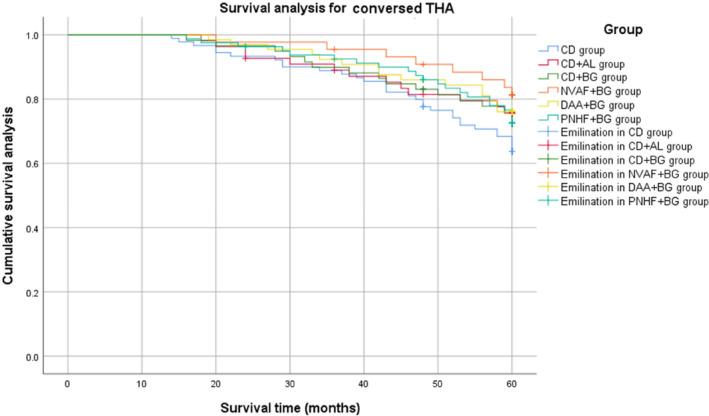
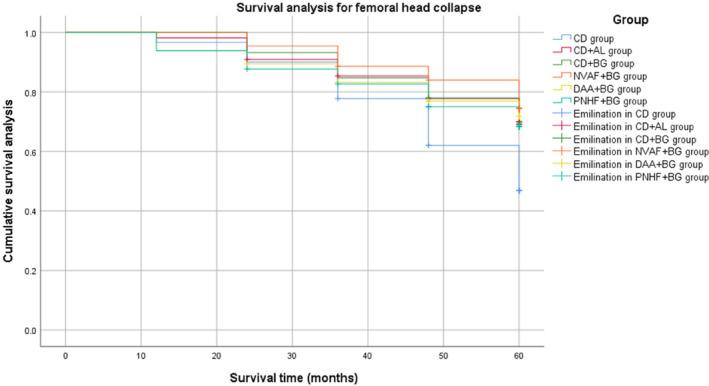
HHS increased significantly in all groups but showed no significant differences among the six groups in the first years. The nonvascularized allogeneic fibula with bone grafting (NVAF + BG) and percutaneous femoral neck-head fenestration with bone grafting via the direct anterior approach (DAA + BG) groups had significantly higher HHS (p = 0.010; p = 0.025) and WOMAC function score (p < 0.001; p = 0.012) than the CD group 5 years postoperatively. Compared with the CD group, all the other groups showed statistically significant differences in radiographic progression (p < 0.001) and a higher survival rate with no significant difference (p = 0.569).
CONCLUSION
Our study demonstrates the potential use of NVAF + BG and DAA + BG, may serve as a promising combined therapy for the treatment of early-stage nontraumatic ONFH.
目的
股骨头坏死(ONFH)是一种严重的骨科疾病,后期可能导致严重的髋关节功能障碍。因此,有必要在早期治疗非创伤性ONFH。本研究的目的是评估基于改良髓芯减压术(CD)的不同联合治疗方法对早期非创伤性ONFH的临床疗效和生存率。
方法
这项回顾性队列研究评估了2010年1月至2017年12月期间在本机构接受基于改良CD的不同联合治疗的397例ONFH髋关节患者。根据治疗方式将患者分为六组,并在术后1年和5年进行随访。比较包括Harris髋关节评分(HHS)和西安大略和麦克马斯特大学骨关节炎指数(WOMAC)在内的临床结果,以评估髋关节功能和快速康复效果。分析ONFH的影像学进展和全髋关节置换术的发生率,以评估术后ONFH的生存率。主要采用Kruskal-Wallis检验、卡方检验和Kaplan-Meier方法进行统计分析。
结果
所有组的HHS均显著增加,但在第一年六组之间无显著差异。术后5年,非血管化同种异体腓骨植骨(NVAF+BG)组和经直接前路经皮股骨颈-股骨头开窗植骨(DAA+BG)组的HHS(p=0.010;p=0.025)和WOMAC功能评分(p<0.001;p=0.012)显著高于CD组。与CD组相比,所有其他组在影像学进展方面均有统计学显著差异(p<0.001),生存率更高,但无显著差异(p=0.569)。
结论
我们的研究表明NVAF+BG和DAA+BG可能具有潜在应用价值,可能是治疗早期非创伤性ONFH的一种有前景的联合治疗方法。
 Zotero 插件