
中枢神经系统桥接放疗在 CAR T 细胞治疗侵袭性 B 细胞淋巴瘤前实现快速细胞减灭。
CNS bridging radiotherapy achieves rapid cytoreduction before CAR T-cell therapy for aggressive B-cell lymphomas.
机构信息
Department of Radiation Oncology, Memorial Sloan Kettering Cancer Center, New York, NY.
Department of Radiology, Memorial Sloan Kettering Cancer Center, New York, NY.
出版信息
Blood Adv. 2024 Oct 8;8(19):5192-5199. doi: 10.1182/bloodadvances.2024013393.
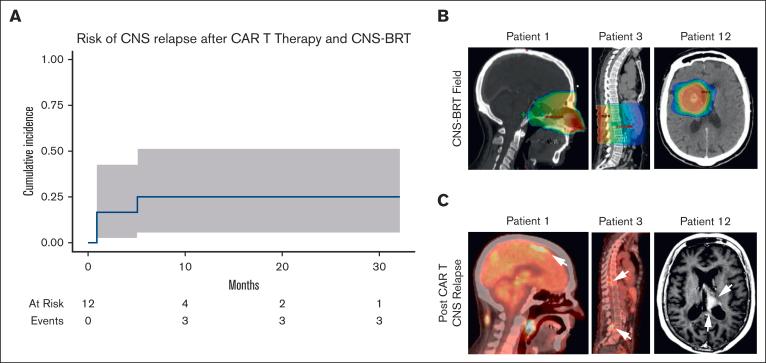
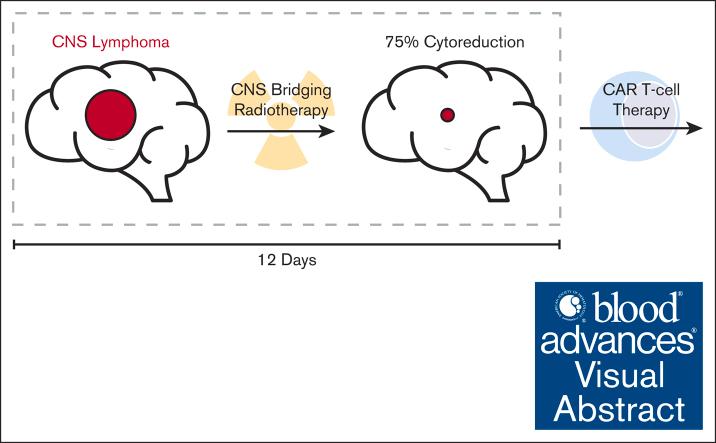
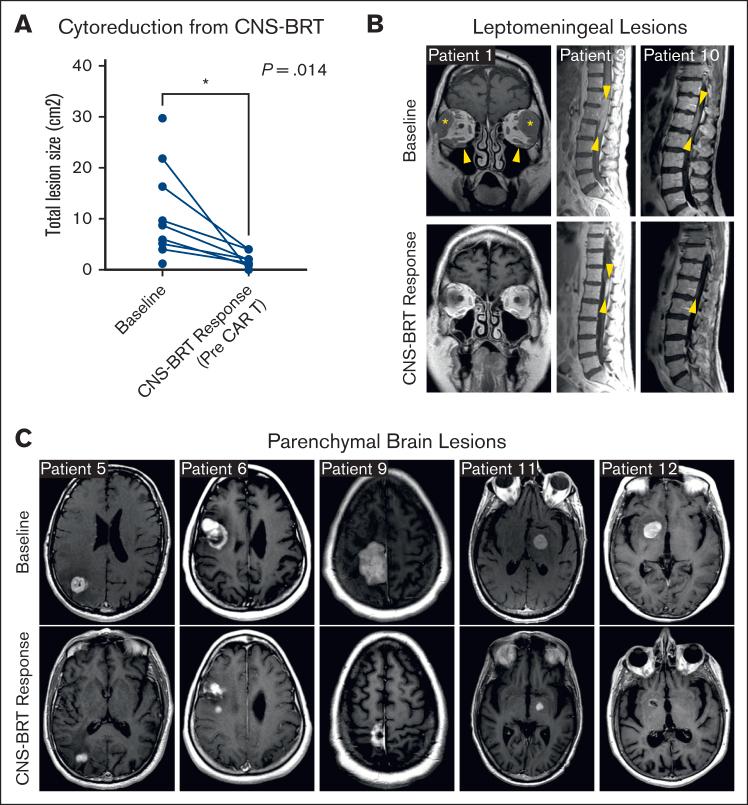
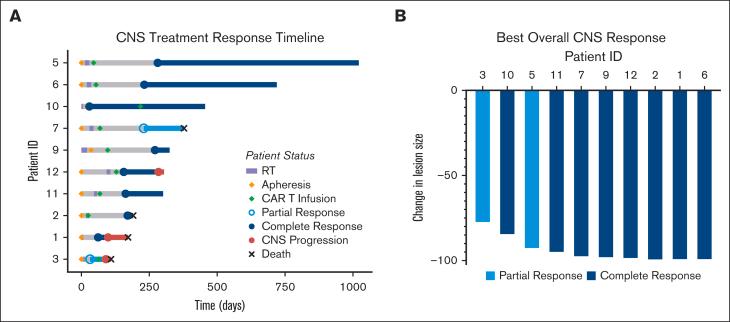
Chimeric antigen receptor (CAR) T-cell therapy (CART) for central nervous system lymphoma (CNSL) is a promising strategy, yet responses are frequently not durable. Bridging radiotherapy (BRT) is used for extracranial lymphoma in which it can improve CART outcomes through cytoreduction of high-risk lesions. We hypothesized that BRT would achieve similar, significant cytoreduction before CART for CNSL (CNS-BRT). We identified patients with CNSL with non-Hodgkin B-cell lymphoma who received CNS-BRT before commercial CART. Cytoreduction from CNS-BRT was calculated as change in lesion size before CART. Twelve patients received CNS-BRT, and the median follow-up among survivors is 11.8 months (interquartile range, 8.5-21.9). Ten patients had CNSL (9 secondary, 1 primary) and 2 patients had epidural disease (evaluable for toxicity). All 10 patients with CNSL had progressive disease at the time of CNS-BRT. Of 12 patients, 1 experienced grade ≥3 cytokine release syndrome, and 3 of 12 patients experienced grade ≥3 immune effector cell-associated neurotoxicity syndrome. CNS-BRT achieved a 74.0% (95% confidence interval, 62.0-86.0) mean reduction in lesion size from baseline (P = .014) at a median of 12 days from BRT completion and before CART infusion. Best CNS response included 8 complete responses, 1 partial response, and 1 progressive disease. Three patients experienced CNS relapse outside the BRT field. Preliminary data suggest CNS-BRT achieves rapid cytoreduction and is associated with a favorable CNS response and safety profile. These data support further study of BRT as a bridging modality for CNSL CART.
嵌合抗原受体 (CAR) T 细胞疗法 (CART) 治疗中枢神经系统淋巴瘤 (CNSL) 是一种很有前途的策略,但反应往往不能持久。桥接放疗 (BRT) 用于治疗颅外淋巴瘤,它可以通过减少高危病变来改善 CART 治疗效果。我们假设 BRT 在 CNSL 的 CART 之前可以达到类似的、显著的肿瘤缩小效果 (CNS-BRT)。我们确定了接受过 CNS-BRT 治疗的非霍奇金 B 细胞淋巴瘤患者,并在商业 CART 之前进行了 CNS-BRT。CNS-BRT 的肿瘤缩小量通过 CART 前病变大小的变化来计算。12 名患者接受了 CNS-BRT,幸存者的中位随访时间为 11.8 个月(四分位距,8.5-21.9)。10 名患者患有 CNSL(9 例继发性,1 例原发性),2 名患者患有硬膜外疾病(可评估毒性)。所有 10 名患有 CNSL 的患者在进行 CNS-BRT 时均患有进展性疾病。12 名患者中,1 名患者出现 3 级及以上细胞因子释放综合征,12 名患者中有 3 名出现 3 级及以上免疫效应细胞相关神经毒性综合征。CNS-BRT 使基线病变大小平均缩小了 74.0%(95%置信区间,62.0-86.0)(P=0.014),中位时间为 BRT 完成后 12 天,在进行 CART 输注之前。最佳 CNS 反应包括 8 例完全缓解,1 例部分缓解,1 例进展性疾病。3 名患者在 BRT 照射野外出现 CNS 复发。初步数据表明,CNS-BRT 可迅速减少肿瘤体积,且与良好的 CNS 反应和安全性相关。这些数据支持进一步研究 BRT 作为 CNSL CART 的桥接方式。
 Zotero 插件