
成人菌血症诊断中寒战作为一种诊断征象的效用:系统评价和荟萃分析。
Utility of shaking chills as a diagnostic sign for bacteremia in adults: a systematic review and meta-analysis.
机构信息
Department of General Internal Medicine, Fukushima Medical University, Fukushima City, 1 Hikarigaoka, Fukushima, 960-1295, Japan.
Department of Clinical Epidemiology, Graduate School of Medicine, Fukushima Medical University, Fukushima, Japan.
出版信息
BMC Med. 2024 Jun 11;22(1):240. doi: 10.1186/s12916-024-03467-z.
BACKGROUND
Accurate prediction of bacteremia is essential for guiding blood culture collection and optimal antibiotic treatment. Shaking chills, defined as a subjective chill sensation with objective body shivering, have been suggested as a potential predictor of bacteremia; however, conflicting findings exist. To address the evidence gap, we conducted a systematic review and meta-analysis of studies to assess the diagnostic accuracy of shaking chills for predicting bacteremia among adult patients.
METHODS
We included studies reporting the diagnostic accuracy of shaking chills or chills for bacteremia. Adult patients with suspected bacteremia who underwent at least one set of blood cultures were included. Our main analysis focused on studies that assessed shaking chills. We searched these studies through CENTRAL, MEDLINE, Embase, the World Health Organization ICTRP Search Portal, and ClinicalTrials.gov. Study selection, data extraction, evaluation for risk of bias, and applicability using the QUADAS-2 tool were conducted by two independent investigators. We estimated a summary receiver operating characteristic curve and a summary point of sensitivity and specificity of the index tests, using a hierarchical model and the bivariate model, respectively.
RESULTS
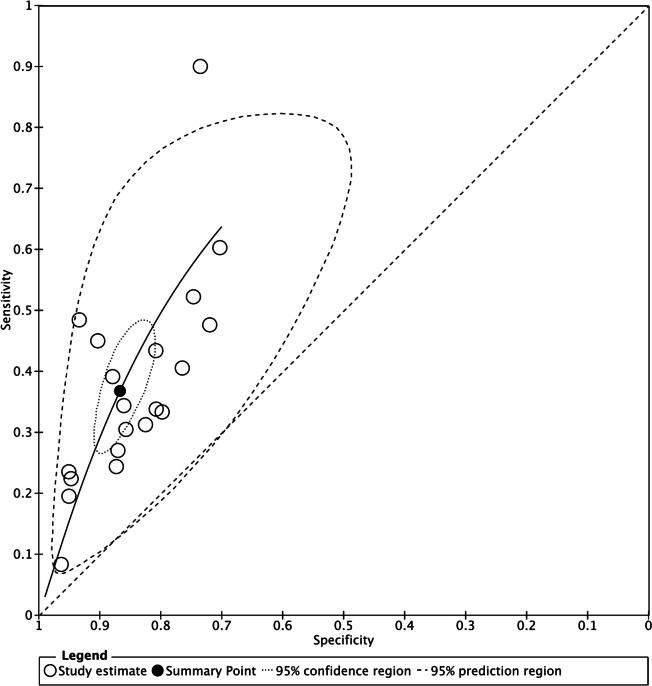
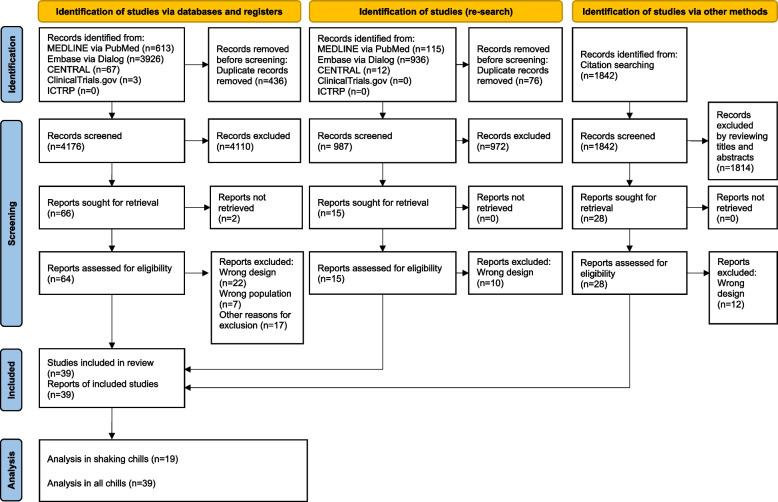
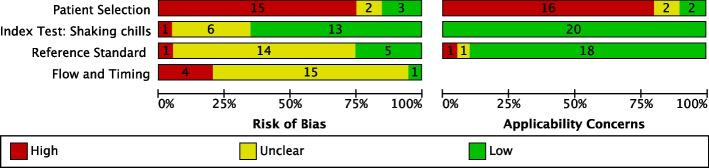
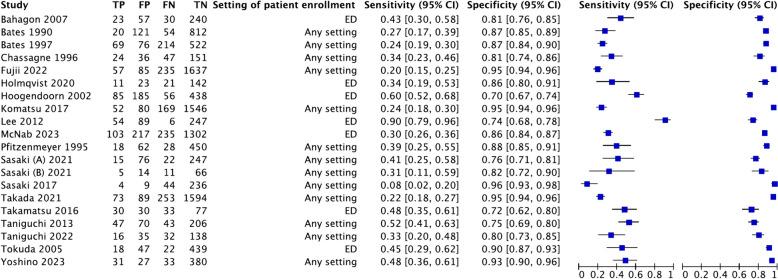
We identified 19 studies with a total of 14,641 patients in which the accuracy of shaking chills was evaluated. The pooled sensitivity and specificity of shaking chills were 0.37 (95% confidence interval [CI], 0.29 to 0.45) and 0.87 (95% CI, 0.83 to 0.90), respectively. Most studies had a low risk of bias in the index test domain and a high risk of bias and a high applicability concern in the patient-selection domain.
CONCLUSIONS
Shaking chills are a highly specific but less sensitive predictor of bacteremia. Blood cultures and early initiation of antibiotics should be considered for patients with an episode of shaking chills; however, the absence of shaking chills must not lead to exclusion of bacteremia and early antibiotic treatment.
背景
准确预测菌血症对于指导血培养采集和优化抗生素治疗至关重要。颤抖性寒战,即伴有身体颤抖的主观寒战感觉,被认为是菌血症的潜在预测指标;然而,目前存在相互矛盾的研究结果。为了解决证据差距,我们对评估成人患者颤抖性寒战预测菌血症的诊断准确性的研究进行了系统评价和荟萃分析。
方法
我们纳入了报告颤抖性寒战或寒战对菌血症的诊断准确性的研究。纳入了接受至少一组血培养且疑似菌血症的成年患者。我们的主要分析集中在评估颤抖性寒战的研究上。我们通过 CENTRAL、MEDLINE、Embase、世界卫生组织 ICTRP 搜索门户和 ClinicalTrials.gov 进行了研究检索。两位独立的研究者进行了研究选择、数据提取、偏倚风险评估和应用 QUADAS-2 工具评估。我们使用分层模型和双变量模型分别估计了指数试验的汇总受试者工作特征曲线和汇总敏感度和特异度。
结果
我们确定了 19 项研究,共纳入了 14641 名患者,评估了颤抖性寒战的准确性。颤抖性寒战的汇总敏感度和特异度分别为 0.37(95%置信区间 [CI],0.29 至 0.45)和 0.87(95% CI,0.83 至 0.90)。大多数研究在指数试验域中具有低偏倚风险,而在患者选择域中具有高偏倚风险和高适用性关注。
结论
颤抖性寒战是菌血症的高度特异性但敏感性较低的预测指标。对于出现颤抖性寒战的患者,应考虑进行血培养和早期开始使用抗生素;然而,没有出现颤抖性寒战绝不能排除菌血症和早期使用抗生素治疗。

 Zotero 插件