
钠-葡萄糖共转运蛋白 2 抑制剂在台湾 2 型糖尿病患者中的应用与视网膜静脉闭塞的发生。
Use of Sodium-Glucose Co-Transporter 2 Inhibitors in Patients With Type 2 Diabetes and the Incidence of Retinal Vein Occlusion in Taiwan.
机构信息
Department of Ophthalmology, Hualien Tzu Chi Hospital, Buddhist Tzu Chi Medical Foundation, Hualien, Taiwan.
Health Information Center, Tzu Chi University, Hualien, Taiwan.
出版信息
Invest Ophthalmol Vis Sci. 2024 Jun 3;65(6):19. doi: 10.1167/iovs.65.6.19.
PURPOSE
The purpose of this study was to evaluate the risk of newly diagnosed retinal vein occlusion (RVO) in patients with type 2 diabetes (T2D) using sodium-glucose cotransporter-2 inhibitors (SGLT-2i) compared to dipeptidyl peptidase-4 inhibitors (DPP-4i).
METHODS
Claims data from the National Health Insurance Research Database of Taiwan were used in this nationwide retrospective cohort study. A target trial emulation framework was applied. Patients with T2D with no prior diagnosis of RVO who had newly commenced treatment with SGLT-2i or DPP-4i between May 1, 2016, and December 31, 2020, were included. Potential systematic differences in baseline characteristics between the paired groups were controlled using stabilized inverse probability of treatment weighting. The outcome of interest was incident RVO. The hazard ratio (HR) for SGLT-2i compared with that of DPP-4i was estimated using a Cox regression model.
RESULTS
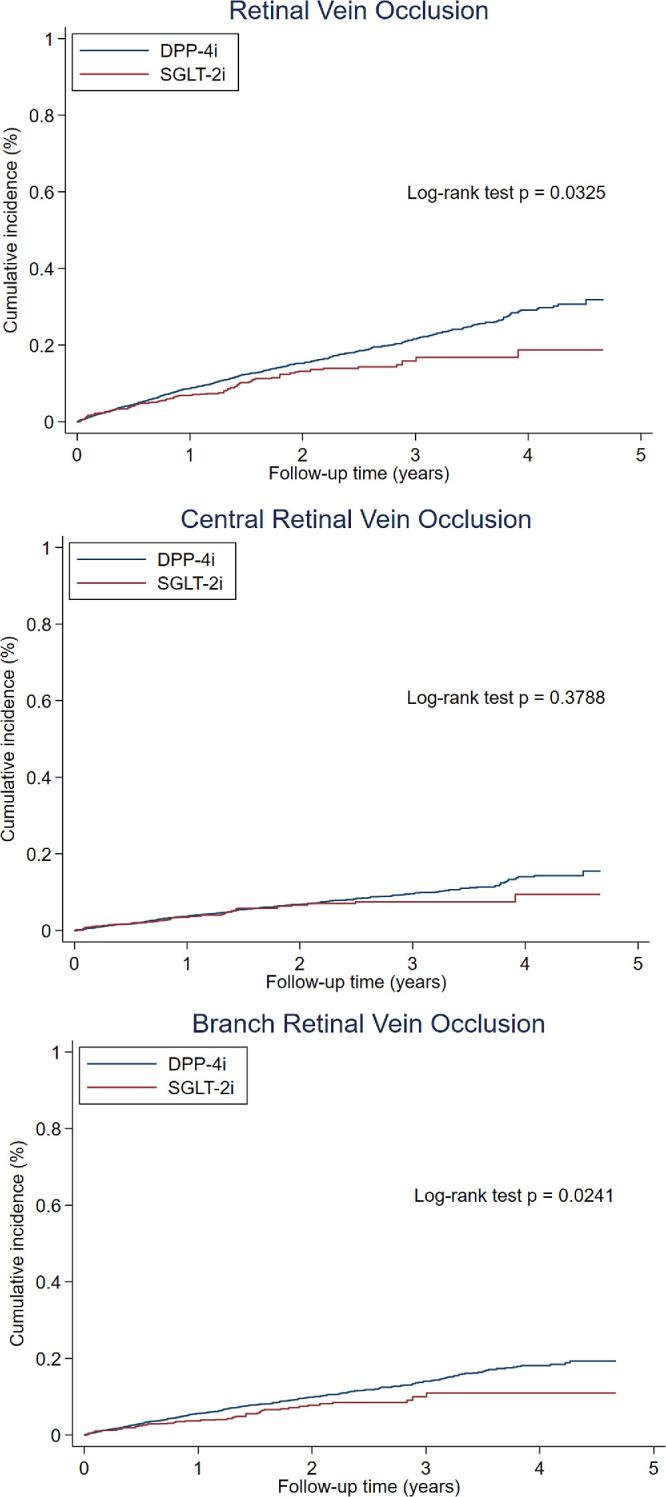
Data from 123,567 and 578,665 patients receiving SGLT-2i and DPP-4i, respectively, were analyzed. The incidence of RVO was lower in patients newly receiving SGLT-2i (0.59 events per 1000 person-years) compared to those receiving DPP-4i (0.77 events per 1000 person-years) over a mean follow-up of 1.61 years. SGLT-2i users had a significantly lower risk of developing RVO compared with DPP-4i users (HR = 0.76, 95% confidence interval [CI] = 0.59-0.98). In the individual outcome analysis, SGLT-2i use was significantly associated with a lower risk of branch RVO (HR = 0.71, 95% CI = 0.52-0.96), but not central RVO (HR = 0.84, 95% CI = 0.57-1.24).
CONCLUSIONS
The risk of developing RVO was lower in patients with T2D receiving SGLT-2i compared with that in those receiving DPP-4i.
目的
本研究旨在评估与二肽基肽酶-4 抑制剂(DPP-4i)相比,钠-葡萄糖协同转运蛋白 2 抑制剂(SGLT-2i)治疗 2 型糖尿病(T2D)患者新发视网膜静脉闭塞(RVO)的风险。
方法
本全国性回顾性队列研究使用了来自台湾全民健康保险研究数据库的索赔数据。应用了目标试验模拟框架。纳入 2016 年 5 月 1 日至 2020 年 12 月 31 日期间新开始接受 SGLT-2i 或 DPP-4i 治疗且无 RVO 既往诊断的 T2D 患者。使用稳定的逆概率治疗加权来控制配对组之间基线特征的潜在系统差异。感兴趣的结局是新发 RVO。使用 Cox 回归模型估计 SGLT-2i 与 DPP-4i 相比的风险比(HR)。
结果
分析了分别接受 SGLT-2i 和 DPP-4i 的 123567 例和 578665 例患者的数据。在平均 1.61 年的随访中,新接受 SGLT-2i 治疗的患者(0.59 例/1000 人年)的 RVO 发生率低于新接受 DPP-4i 治疗的患者(0.77 例/1000 人年)。与 DPP-4i 相比,SGLT-2i 使用者发生 RVO 的风险显著降低(HR=0.76,95%置信区间[CI]:0.59-0.98)。在个别结局分析中,SGLT-2i 治疗与分支 RVO 风险降低显著相关(HR=0.71,95%CI:0.52-0.96),但与中央 RVO 无关(HR=0.84,95%CI:0.57-1.24)。
结论
与 DPP-4i 相比,T2D 患者接受 SGLT-2i 治疗时发生 RVO 的风险较低。

 Zotero 插件