
钠-葡萄糖共转运蛋白 2 抑制剂与系统性红斑狼疮患者肾炎。
Sodium-Glucose Cotransporter-2 Inhibitors and Nephritis Among Patients With Systemic Lupus Erythematosus.
机构信息
Dr Yen's Clinic, Taoyuan, Taiwan.
Center for Health Data Science, Department of Medical Research, Chung Shan Medical University Hospital, Taichung, Taiwan.
出版信息
JAMA Netw Open. 2024 Jun 3;7(6):e2416578. doi: 10.1001/jamanetworkopen.2024.16578.
IMPORTANCE
Lupus nephritis is a major complication of systemic lupus erythematosus (SLE). Randomized clinical trials have shown nephroprotective and cardioprotective effects of sodium-glucose cotransporter-2 inhibitors (SGLT2is).
OBJECTIVE
To investigate whether the use of SGLT2is is associated with the onset and progression of lupus nephritis and other kidney and cardiac outcomes in patients with SLE and type 2 diabetes.
DESIGN, SETTING, AND PARTICIPANTS: This multicenter cohort study used the US Collaborative Network of the TriNetX clinical data platform to identify patients with SLE and type 2 diabetes from January 1, 2015, to December 31, 2022. Data collection and analysis were conducted in September 2023.
EXPOSURES
Individuals were categorized into 2 groups by SGLT2i use or nonuse with 1:1 propensity score matching.
MAIN OUTCOMES AND MEASURES
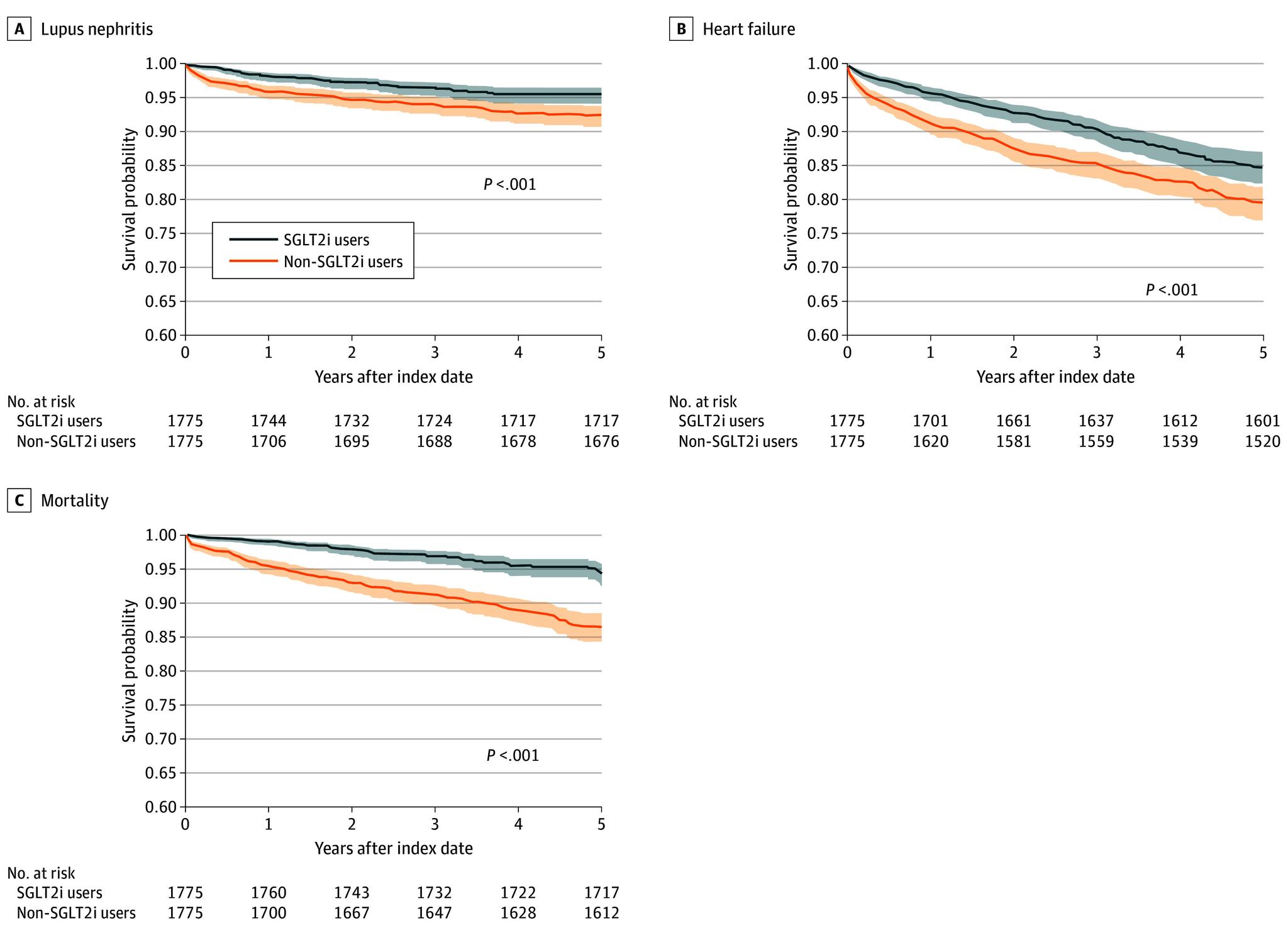
The Kaplan-Meier method and Cox proportional hazards regression models were used to calculate the 5-year adjusted hazard ratios (AHRs) of lupus nephritis, dialysis, kidney transplant, heart failure, and mortality for the 2 groups.
RESULTS
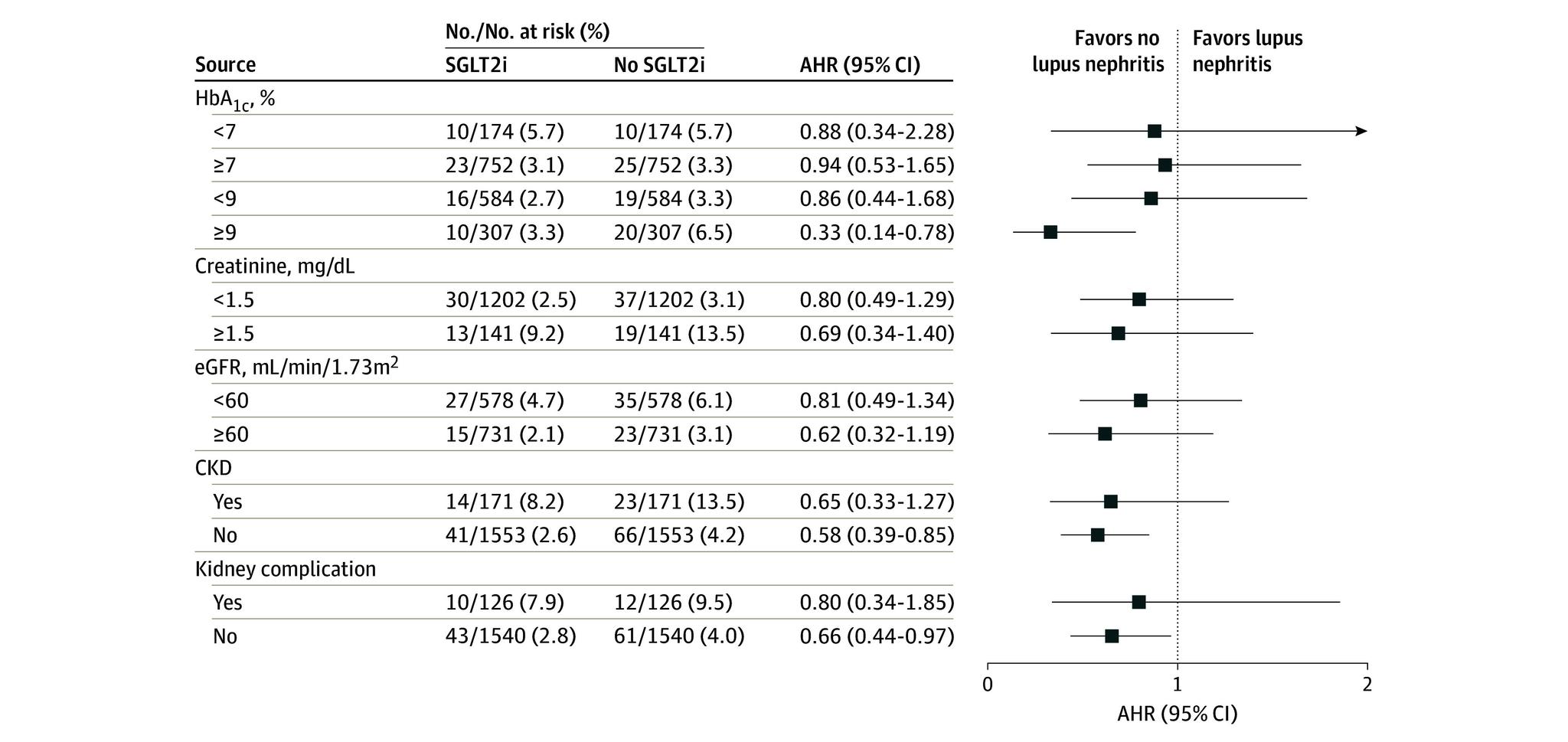
From 31 790 eligible participants, 1775 matched pairs of SGLT2i users and nonusers (N = 3550) were selected based on propensity scores. The mean (SD) age of matched participants was 56.8 (11.6) years, and 3012 (84.8%) were women. SGLT2i users had a significantly lower risk of lupus nephritis (AHR, 0.55; 95% CI, 0.40-0.77), dialysis (AHR, 0.29; 95% CI, 0.17-0.48), kidney transplant (AHR, 0.14; 95% CI, 0.03-0.62), heart failure (AHR, 0.65; 95% CI, 0.53-0.78), and all-cause mortality (AHR, 0.35; 95% CI, 0.26-0.47) than SGLT2i nonusers.
CONCLUSIONS AND RELEVANCE
In this cohort study of patients with SLE and type 2 diabetes, SGLT2i users had a significantly lower risk of lupus nephritis, dialysis, kidney transplant, heart failure, and all-cause mortality than nonusers. The findings suggest that SGLT2is may provide some nephroprotective and cardioprotective benefits.
重要性
狼疮肾炎是系统性红斑狼疮(SLE)的主要并发症。随机临床试验表明,钠-葡萄糖共转运蛋白 2 抑制剂(SGLT2i)具有肾保护和心脏保护作用。
目的
研究 SGLT2i 的使用是否与 SLE 合并 2 型糖尿病患者的狼疮肾炎和其他肾脏及心脏结局的发生和进展相关。
设计、地点和参与者:这项多中心队列研究使用美国 TriNetX 临床数据平台的合作网络,从 2015 年 1 月 1 日至 2022 年 12 月 31 日,在全美范围内确定了 SLE 和 2 型糖尿病患者。数据收集和分析于 2023 年 9 月进行。
暴露
根据 SGLT2i 的使用或不使用情况,将个体分为两组,并进行 1:1 倾向评分匹配。
主要结局和测量
采用 Kaplan-Meier 法和 Cox 比例风险回归模型计算两组患者狼疮肾炎、透析、肾移植、心力衰竭和死亡率的 5 年调整后的风险比(AHR)。
结果
在 31790 名合格参与者中,根据倾向得分,共纳入了 1775 对 SGLT2i 使用和未使用者(N=3550)进行匹配。匹配参与者的平均(SD)年龄为 56.8(11.6)岁,其中 3012 名(84.8%)为女性。SGLT2i 使用者狼疮肾炎(AHR,0.55;95%CI,0.40-0.77)、透析(AHR,0.29;95%CI,0.17-0.48)、肾移植(AHR,0.14;95%CI,0.03-0.62)、心力衰竭(AHR,0.65;95%CI,0.53-0.78)和全因死亡率(AHR,0.35;95%CI,0.26-0.47)的风险显著低于 SGLT2i 未使用者。
结论和相关性
在这项 SLE 合并 2 型糖尿病患者的队列研究中,SGLT2i 使用者发生狼疮肾炎、透析、肾移植、心力衰竭和全因死亡率的风险显著低于未使用者。这些发现表明,SGLT2i 可能具有一定的肾脏保护和心脏保护作用。

 Zotero 插件