
在巴基斯坦,因胆囊疾病而行胆囊切除术的患者中伤寒带菌者的频率及相关因素:一项横断面研究。
The frequency and associated factors of typhoid carriage in patients undergoing cholecystectomy for gallbladder disease in Pakistan: A cross-sectional study.
机构信息
Department of Pediatrics and Child Health, Aga Khan University, Karachi, Sindh, Pakistan.
Division of Infectious Diseases, Massachusetts General Hospital, Boston, Massachusetts, United States of America.
出版信息
PLoS Negl Trop Dis. 2024 Jun 12;18(6):e0011775. doi: 10.1371/journal.pntd.0011775. eCollection 2024 Jun.
BACKGROUND
Enteric fever is caused by Salmonella enterica serovars Typhi (S. Typhi) and Paratyphi A, B, and C. It continues to be a significant cause of morbidity and mortality worldwide. In highly endemic areas, children are disproportionately affected, and antimicrobial resistance reduces therapeutic options. It is estimated that 2-5% of enteric fever patients develop chronic asymptomatic infection. These carriers may act as reservoirs of infection; therefore, the prospective identification and treatment of carriers are critical for long-term disease control. We aimed to find the frequency of Salmonella Typhi carriers in patients undergoing cholecystectomy. We also compared the detection limit of culturing versus qPCR in detecting S. Typhi, performed a geospatial analysis of the carriers identified using this study, and evaluated the accuracy of anti-Vi and anti-YncE in identifying chronic typhoid carriage.
METHODS
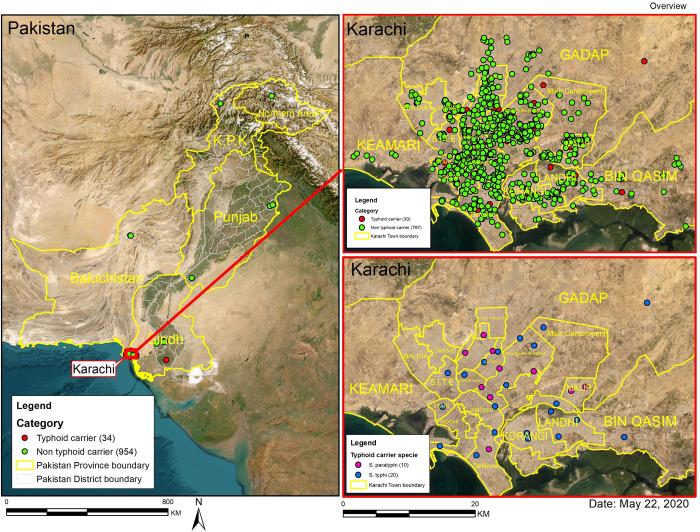
We performed a cross-sectional study in two centers in Pakistan. Gallbladder specimens were subjected to quantitative PCR (qPCR) and serum samples were analyzed for IgG against YncE and Vi by ELISA. We also mapped the residential location of those with a positive qPCR result.
FINDINGS
Out of 988 participants, 3.4% had qPCR-positive gallbladder samples (23 S. Typhi and 11 S. Paratyphi). Gallstones were more likely to be qPCR positive than bile and gallbladder tissue. Anti-Vi and YncE were significantly correlated (r = 0.78 p<0.0001) and elevated among carriers as compared to qPCR negative controls, except for anti-Vi response in Paratyphi A. But the discriminatory values of these antigens in identifying carriers from qPCR negative controls were low.
CONCLUSION
The high prevalence of typhoid carriers observed in this study suggests that further studies are required to gain information that will help in controlling future typhoid outbreaks in a superior manner than they are currently being managed.
背景
肠热病是由伤寒沙门氏菌血清型 Typhi(S. Typhi)和 Paratyphi A、B、C 引起的。它仍然是全球发病率和死亡率的重要原因。在高度流行地区,儿童受影响不成比例,抗菌药物耐药性降低了治疗选择。据估计,2-5%的肠热病患者会发展为无症状慢性感染。这些携带者可能成为感染的储源;因此,前瞻性识别和治疗携带者对于长期疾病控制至关重要。我们旨在确定接受胆囊切除术的患者中伤寒沙门氏菌携带者的频率。我们还比较了培养和 qPCR 在检测 S. Typhi 方面的检测限,使用本研究对鉴定的携带者进行了地理空间分析,并评估了抗 Vi 和抗 YncE 在鉴定慢性伤寒带菌方面的准确性。
方法
我们在巴基斯坦的两个中心进行了一项横断面研究。胆囊标本进行定量 PCR(qPCR),血清样本通过 ELISA 分析针对 YncE 和 Vi 的 IgG。我们还绘制了 qPCR 阳性结果的居住地点。
发现
在 988 名参与者中,有 3.4%的 qPCR 阳性胆囊样本(23 株伤寒沙门氏菌和 11 株副伤寒沙门氏菌)。与胆汁和胆囊组织相比,胆结石更有可能 qPCR 阳性。抗 Vi 和 YncE 与携带状态显著相关(r = 0.78,p<0.0001),并且与 qPCR 阴性对照相比,携带者中升高,除了副伤寒 A 中的抗 Vi 反应。但是,这些抗原在从 qPCR 阴性对照中识别携带者方面的鉴别值较低。
结论
本研究观察到的伤寒携带者高患病率表明,需要进一步研究以获取信息,以帮助以比目前更好的方式控制未来的伤寒爆发。




 Zotero 插件