
通过氧化还原的视角看治疗诱导的衰老。
Therapy-induced senescence through the redox lens.
机构信息
Healthy Longevity Translational Research Program, Yong Loo Lin School of Medicine, National University of Singapore, Singapore; Centre for Healthy Longevity, National University Health System, Singapore; Department of Physiology, Yong Loo Lin School of Medicine, National University of Singapore, Singapore.
Healthy Longevity Translational Research Program, Yong Loo Lin School of Medicine, National University of Singapore, Singapore; Centre for Healthy Longevity, National University Health System, Singapore; Department of Physiology, Yong Loo Lin School of Medicine, National University of Singapore, Singapore; Department of Biochemistry, Yong Loo Lin School of Medicine, National University of Singapore, Singapore.
出版信息
Redox Biol. 2024 Aug;74:103228. doi: 10.1016/j.redox.2024.103228. Epub 2024 Jun 6.
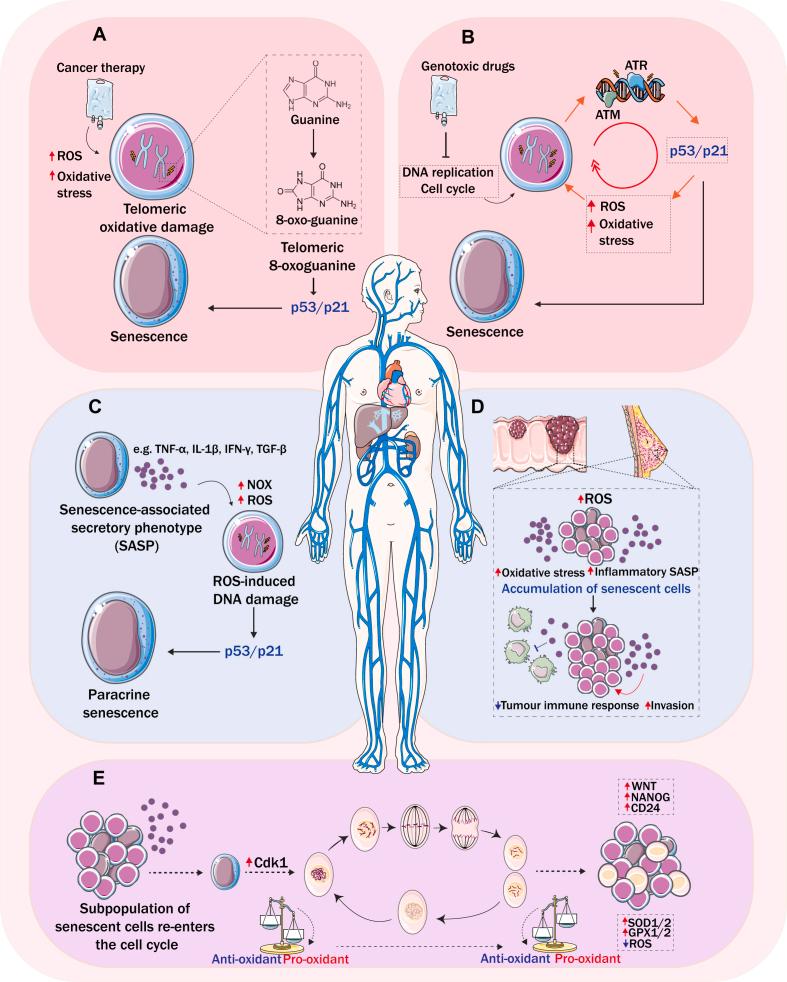
Therapy-induced senescent tumor cells have emerged as significant drivers of tumor recurrence and disease relapse. Interestingly, reactive oxygen species (ROS) production and its associated redox signaling networks are intertwined with initiation and establishment of therapy-induced senescence. Therapy-induced senescent cells influence neighboring cells and the tumor microenvironment via their bioactive secretome known as the senescence-associated secretory phenotype (SASP). The intracellular effects of ROS are dose and context-dependent. Under normal physiological conditions, ROS is involved in various signalling pathways and cellular processes important for maintenance of cellular homeostasis, such as redox balance, stress response, inflammatory signalling, cell proliferation and cell death among others. However excess ROS accompanied by a pro-oxidant microenvironment can engender oxidative DNA damage, triggering cellular senescence. In this review, we discuss the role of ROS and the redox state dynamics in fine-tuning homeostatic processes that drive therapy-induced cell fate towards senescence establishment, as well as their influence in stimulating inflammatory signalling and SASP production. We also offer insights into interventional strategies, specifically senotherapeutics, that could potentially leverage on modulation of redox and antioxidant pathways. Lastly, we evaluate possible implications of redox rewiring during escape from therapy-induced senescence, an emerging area of research. We envision that examining therapy-induced senescence through the redox lens, integrated with time-resolved single-cell RNA sequencing combined with spatiotemporal multi-omics, could further enhance our understanding of its functional heterogeneity. This could aid identification of targetable signalling nodes to reduce disease relapse, as well as inform strategies for development of broad-spectrum senotherapeutics. Overall, our review aims to delineate redox-driven mechanisms which contribute to the biology of therapy-induced senescence and beyond, while highlighting implications for tumor initiation and recurrence.
治疗诱导的衰老肿瘤细胞已成为肿瘤复发和疾病复发的重要驱动因素。有趣的是,活性氧(ROS)的产生及其相关的氧化还原信号网络与治疗诱导的衰老的起始和建立交织在一起。治疗诱导的衰老细胞通过其称为衰老相关分泌表型(SASP)的生物活性分泌组影响邻近细胞和肿瘤微环境。ROS 的细胞内效应取决于剂量和上下文。在正常生理条件下,ROS 参与各种信号通路和细胞过程,这些过程对于维持细胞内稳态很重要,例如氧化还原平衡、应激反应、炎症信号、细胞增殖和细胞死亡等。然而,过量的 ROS 伴随着促氧化剂微环境会导致氧化 DNA 损伤,从而引发细胞衰老。在这篇综述中,我们讨论了 ROS 和氧化还原状态动态在微调稳态过程中的作用,这些过程促使治疗诱导的细胞命运向衰老建立方向发展,以及它们在刺激炎症信号和 SASP 产生方面的影响。我们还提供了关于干预策略的见解,特别是衰老治疗学,它可以潜在地利用氧化还原和抗氧化途径的调节。最后,我们评估了在逃避治疗诱导的衰老过程中重新布线氧化还原的可能影响,这是一个新兴的研究领域。我们设想,通过与时间分辨的单细胞 RNA 测序相结合的时空多组学,从氧化还原角度检查治疗诱导的衰老,可以进一步增强我们对其功能异质性的理解。这有助于识别可靶向的信号节点,以减少疾病复发,并为广谱衰老治疗学的发展提供信息。总的来说,我们的综述旨在描绘促进治疗诱导的衰老生物学的氧化还原驱动机制,同时强调其对肿瘤起始和复发的影响。

 Zotero 插件