
通过智能数据驱动的心电图非线性多波段分析评估对咖啡因的反应模式。
Evaluation of the responsiveness pattern to caffeine through a smart data-driven ECG non-linear multi-band analysis.
作者信息
Domingues Rita, Batista Patrícia, Pintado Manuela, Oliveira-Silva Patrícia, Rodrigues Pedro Miguel
机构信息
Universidade Católica Portuguesa, CBQF - Centro de Biotecnologia e Química Fina - Laboratório Associado, Escola Superior de Biotecnologia, Rua Diogo Botelho 1327, 4169-005, Porto, Portugal.
Universidade Católica Portuguesa, Faculty of Education and Psychology, Research Centre for Human Development, Human Neurobehavioral Laboratory, Rua de Diogo Botelho 1327, 4169-005, Porto, Portugal.
出版信息
Heliyon. 2024 May 23;10(11):e31721. doi: 10.1016/j.heliyon.2024.e31721. eCollection 2024 Jun 15.
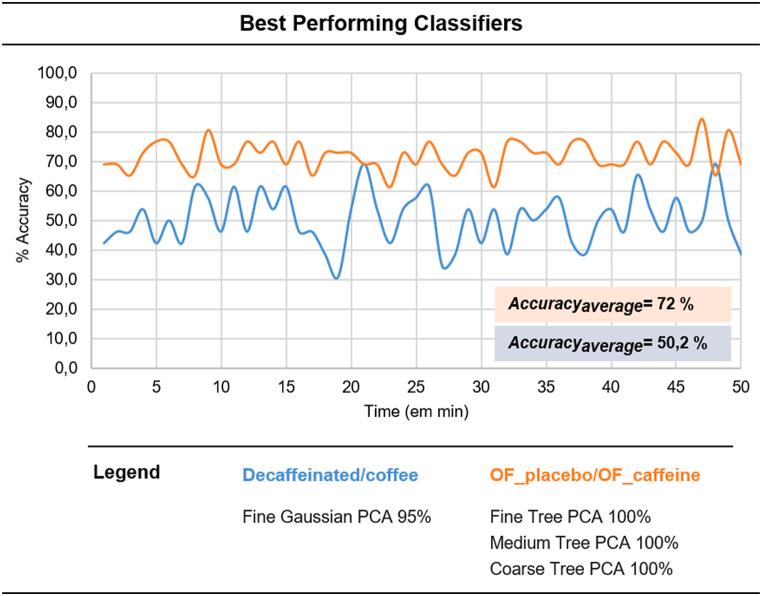
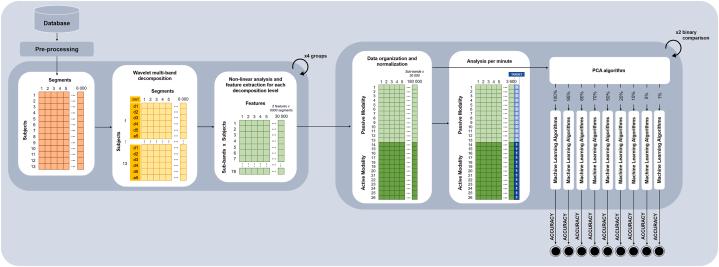
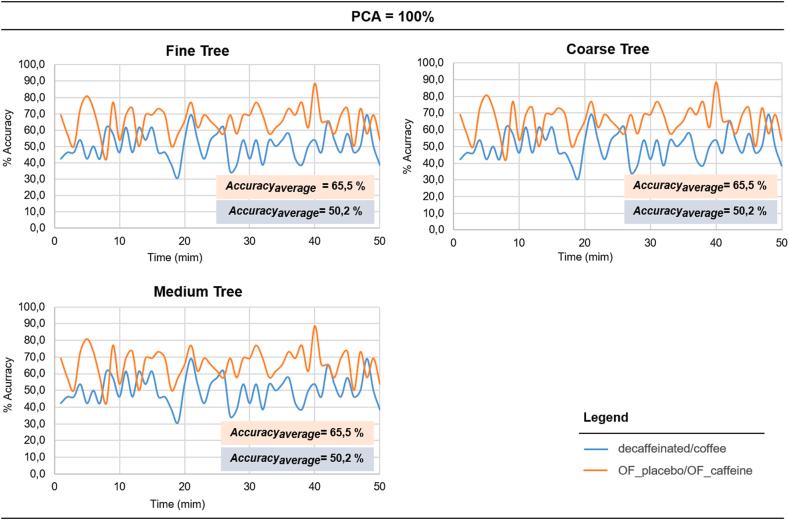
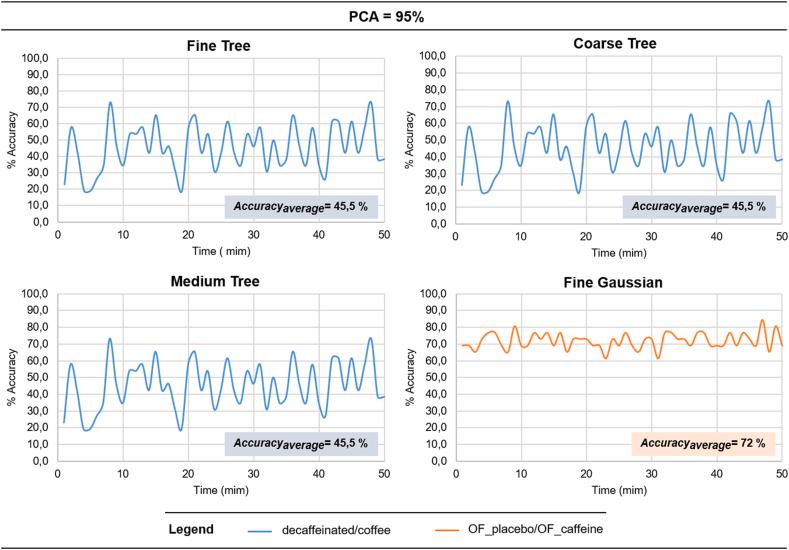
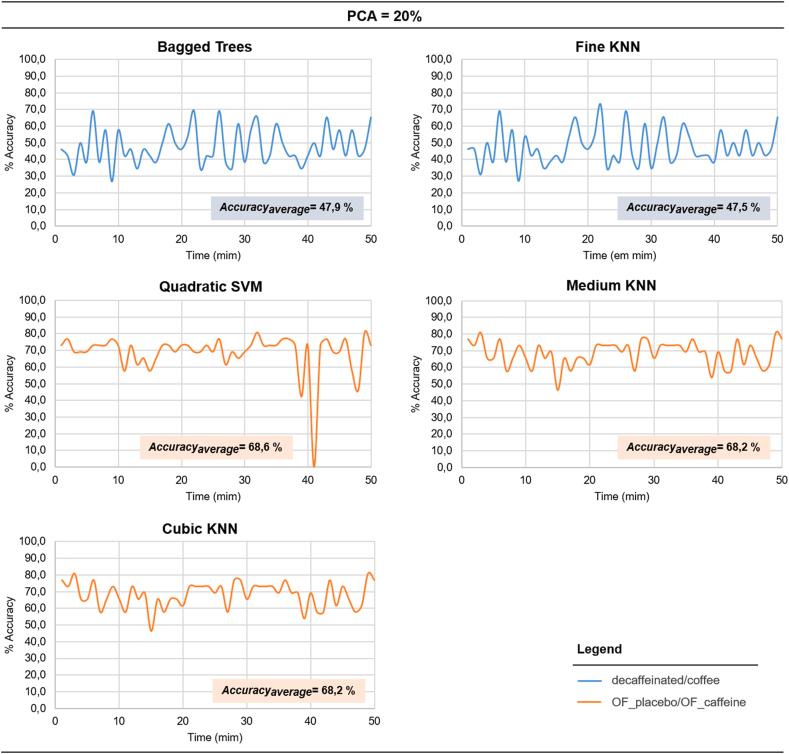
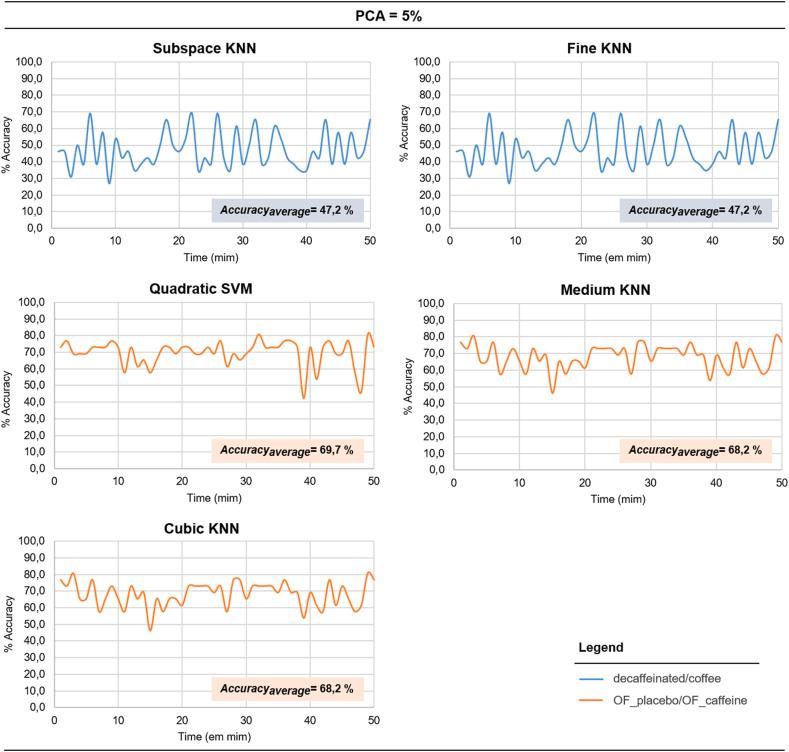
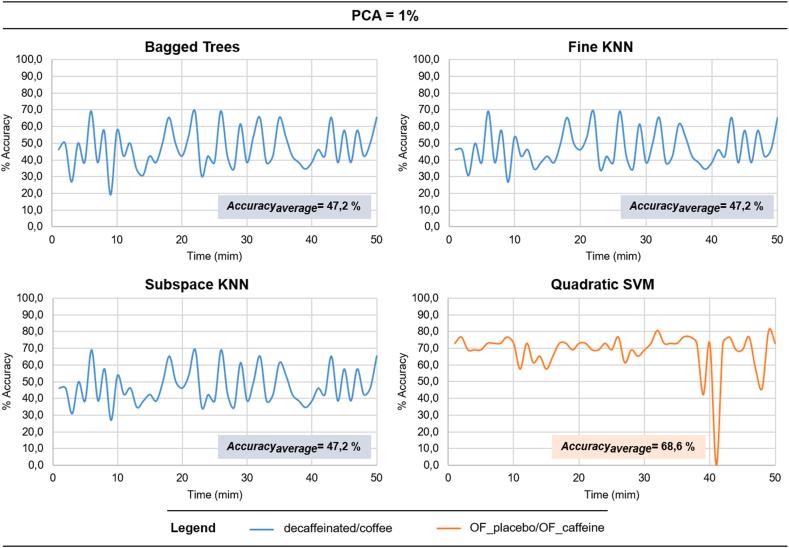
This study aimed to explore more efficient ways of administering caffeine to the body by investigating the impact of caffeine on the modulation of the nervous system's activity through the analysis of electrocardiographic signals (ECG). An ECG non-linear multi-band analysis using Discrete Wavelet Transform (DWT) was employed to extract various features from healthy individuals exposed to different caffeine consumption methods: expresso coffee (EC), decaffeinated coffee (ED), Caffeine Oral Films (OF_caffeine), and placebo OF (OF_placebo). Non-linear feature distributions representing every ECG minute time series have been selected by PCA with different variance percentages to serve as inputs for 23 machine learning models in a leave-one-out cross-validation process for analyzing the behavior differences between ED/EC and OF_placebo/OF_caffeine groups, respectively, over time. The study generated 50-point accuracy curves per model, representing the discrimination power between groups throughout the 50 min. The best model accuracies for ED/EC varied between 30 and 70 %, (using the decision tree classifier) and OF_placebo/OF_caffeine ranged from 62 to 84 % (using Fine Gaussian). Notably, caffeine delivery through OFs demonstrated effective capacity compared to its placebo counterpart, as evidenced by significant differences in accuracy curves between OF_placebo/OF_caffeine. Caffeine delivery via OFs also exhibited rapid dissolution efficiency and controlled release rate over time, distinguishing it from EC. The study supports the potential of caffeine delivery through Caffeine OFs as a superior technology compared to traditional methods by means of ECG analysis. It highlights the efficiency of OFs in controlling the release of caffeine and underscores their promise for future caffeine delivery systems.
本研究旨在通过分析心电图信号(ECG)来研究咖啡因对神经系统活动调节的影响,从而探索更有效的咖啡因给药方式。采用离散小波变换(DWT)进行心电图非线性多波段分析,从接触不同咖啡因摄入方式的健康个体中提取各种特征:浓缩咖啡(EC)、脱咖啡因咖啡(ED)、咖啡因口腔膜(OF_咖啡因)和安慰剂口腔膜(OF_安慰剂)。通过主成分分析(PCA)选择代表每个心电图分钟时间序列的非线性特征分布,并采用不同的方差百分比作为23个机器学习模型的输入,在留一法交叉验证过程中分别分析ED/EC组与OF_安慰剂/OF_咖啡因组随时间的行为差异。该研究为每个模型生成了50个时间点的准确率曲线,代表了50分钟内两组之间的区分能力。ED/EC组的最佳模型准确率在30%至70%之间(使用决策树分类器),OF_安慰剂/OF_咖啡因组的准确率在62%至84%之间(使用精细高斯模型)。值得注意的是,与安慰剂相比,通过口腔膜递送咖啡因显示出有效的能力,OF_安慰剂/OF_咖啡因组的准确率曲线存在显著差异证明了这一点。通过口腔膜递送咖啡因还表现出快速溶解效率和随时间的控释率,这与浓缩咖啡不同。该研究通过心电图分析支持了与传统方法相比,通过咖啡因口腔膜递送咖啡因作为一种优越技术的潜力。它突出了口腔膜在控制咖啡因释放方面的效率,并强调了它们在未来咖啡因递送系统中的前景。




 Zotero 插件