
从外耳道炎分离菌株的表型和基因型特征:携带PVL的CC30-t019-SCC IV作为主要基因型的出现。
Phenotypic and genotypic characterization of strains isolated from otitis externa: Emergence of CC30- t019-SCC IV carrying PVL as major genotype.
作者信息
Rahmani Zahra, Hosseini Sareh Sadat, Bagheri Parmida, Dadashi Masoud, Haghighi Mehrdad, Goudarzi Mehdi
机构信息
Department of Otorhinolaryngology, Loghman Hospital, Shahid-Beheshti University of Medical Sciences, Tehran, Iran.
Department of Microbiology, School of Medicine, Shahid Beheshti University of Medical Sciences, Tehran, Iran.
出版信息
Heliyon. 2024 May 28;10(11):e32002. doi: 10.1016/j.heliyon.2024.e32002. eCollection 2024 Jun 15.
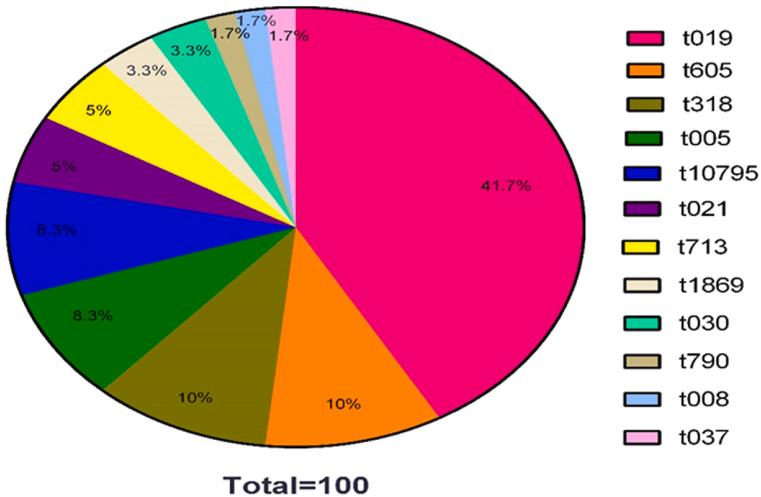
The increasing emergence of as the primary causative agent of otitis externa has been noted; however, detailed information regarding the molecular characteristics of these strains in Iran remains scarce. The current study aims to investigate both genotypic and phenotypic attributes of strains implicated in ear infections. In the present work, we analyzed 60 strains isolated from cases of otitis externa over a period of 45 months. The resistance patterns were determined using disk diffusion and microbroth dilution methods. All isolates were confirmed by the polymerase chain reaction assay, and their biofilm production was assessed by a microtiter plate assay. Molecular characterization of the isolates was performed using the staphylococcal cassette chromosome multilocus sequence typing, and staphylococcus protein A typing methods. Overall, the results indicated that 44 out of 60 isolates (73.3 %) were methicillin-resistant . Resistance to mupirocin and vancomycin was observed in 13.3 % and 1.7 % of the tested isolates, respectively. Furthermore, out of the 60 isolates, 56 strains (93.4 %) were classified as positive biofilm strains at different levels. Twelve distinct clonal lineages were identified. The vast majority of isolates belonged to CC30/ST30-MRSA IV/t019 (41.7 %). Among the 31 strong biofilm producers, the majority (64.5 %) belonged to CC30/ST30-MRSA IV/t019 clone. Biofilm negative isolates belonged to CC22/ST22 (2 isolates), CC8/ST585 (one isolate), and CC8/ST8 (one isolate). Our result revealed that about three-quarters of PVL-positive strains belonged to CC30/ST30. Our data confirmed the presence of MSSA strains among CC30/ST30 and CC22/ST22 isolates. The mupirocin resistant isolates (n = 8) belonged to CC8/ST585-MRSA III/t713 (37.5 %), CC8/ST239-MRSA III/t030 (25 %), CC8/ST8-MRSA IV/t008 (12.5 %), CC8/ST239-MRSA III/t037 (12.5 %), and CC22/ST22-MRSA IV/t790 (12.5 %) lineages. The VRSA strain belonged to the CC8/ST8-MRSA IV/t008 lineage, carrying the determinant. iMLS phenotypes (n = 14) were distributed across different lineages, including CC30/ST30-MRSA IV/t019 (21.5 %), CC30/ST30-MSSA/t021 (21.5 %), CC22/ST22-MSSA/t005 (14.3 %), CC8/ST239-MRSA III/t030 (14.3 %), CC22/ST22-MSSA/t1869 (7.1 %), CC22/ST22-MRSA IV/t790 (7.1 %), CC8/ST239-MRSA III/t037 (7.1 %), and CC1/ST772-MRSA IV/t10795 (7.1 %). These findings highlight significant genotypic diversity and high biofilm formation among our isolates. The frequent occurrence of the CC/ST30 clone in strains isolated from otitis externa reflects the emergence of these lineages as a predominant clone in Iran, posing a significant public health concern.
已注意到金黄色葡萄球菌作为外耳道炎主要病原体的出现日益增多;然而,关于伊朗这些菌株分子特征的详细信息仍然匮乏。本研究旨在调查与耳部感染相关的金黄色葡萄球菌菌株的基因型和表型特征。在本研究中,我们分析了在45个月期间从外耳道炎病例中分离出的60株金黄色葡萄球菌菌株。采用纸片扩散法和微量肉汤稀释法测定耐药模式。所有分离株均通过聚合酶链反应检测得以确认,并用微量滴定板法评估其生物膜形成情况。使用葡萄球菌盒式染色体多位点序列分型和葡萄球菌蛋白A分型方法对分离株进行分子特征分析。总体而言,结果表明60株金黄色葡萄球菌分离株中有44株(73.3%)对甲氧西林耐药。分别在13.3%和1.7%的受试分离株中观察到对莫匹罗星和万古霉素的耐药性。此外,在60株分离株中,56株(93.4%)在不同水平上被分类为生物膜阳性菌株。鉴定出12个不同的克隆谱系。绝大多数金黄色葡萄球菌分离株属于CC30/ST30-MRSA IV/t019(41.7%)。在31株强生物膜产生菌中,大多数(64.5%)属于CC30/ST30-MRSA IV/t019克隆。生物膜阴性分离株属于CC22/ST22(2株)、CC8/ST585(1株)和CC8/ST8(1株)。我们的结果显示,约四分之三的PVL阳性菌株属于CC30/ST30。我们的数据证实了CC30/ST30和CC22/ST22分离株中存在MSSA菌株。对莫匹罗星耐药的分离株(n = 8)属于CC8/ST585-MRSA III/t713(37.5%)、CC8/ST239-MRSA III/t030(25%)、CC8/ST8-MRSA IV/t008(12.5%)、CC8/ST23-9MRSA III/t037(12.5%)和CC22/ST22-MRSA IV/t790(12.5%)谱系。VRSA菌株属于CC8/ST8-MRSA IV/t008谱系,携带vanA决定簇。iMLS表型(n = 14)分布在不同谱系中,包括CC30/ST30-MRSA IV/t019(21.5%)、CC30/ST30-MSSA/t021(21.5%)、CC22/ST-MSSA/t005(14.3%)、CC8/ST239-MRSA III/t030(14.3%)、CC22/ST22-MSSA/t1869(7.1%)、CC22/ST22-MRSA IV/t790(7.1%)、CC8/ST239-MRSA III/t037(7.1%)和CC1/ST772-MRSA IV/t10795(7.1%)。这些发现突出了我们分离株中显著的基因型多样性和高生物膜形成能力。从外耳道炎分离出的金黄色葡萄球菌菌株中CC/ST30克隆的频繁出现反映了这些谱系在伊朗作为主要克隆的出现,这对公共卫生构成了重大关注。
 Zotero 插件