
对有感染新冠病毒严重后果风险的美国成年人中导致新冠病毒检测犹豫因素的横断面调查。
Cross-Sectional Survey of Factors Contributing to COVID-19 Testing Hesitancy Among US Adults at Risk of Severe Outcomes from COVID-19.
作者信息
Assaf Annlouise R, Sidhu Gurinder S, Soni Apurv, Cappelleri Joseph C, Draica Florin, Herbert Carly, Arham Iqra, Bader Mehnaz, Jimenez Camille, Bois Michael, Silvester Eliza, Meservey Jessica, Eng Valerie, Nelson Megan, Cai Yong, Nangarlia Aakansha, Tian Zhiyi, Liu Yanping, Watt Stephen
机构信息
Global Medical Patient Impact Assessment, Worldwide Medical and Safety, Pfizer Inc, Groton, CT, USA.
Brown University School of Public Health, Providence, RI, USA.
出版信息
Infect Dis Ther. 2024 Jul;13(7):1683-1701. doi: 10.1007/s40121-024-01001-5. Epub 2024 Jun 13.
INTRODUCTION
The United States Centers for Disease Control and Prevention (CDC) advises testing individuals for COVID-19 after exposure or if they display symptoms. However, a deeper understanding of demographic factors associated with testing hesitancy is necessary.
METHODS
A US nationwide cross-sectional survey of adults with risk factors for developing severe COVID-19 ("high-risk" individuals) was conducted from August 18-September 5, 2023. Objectives included characterizing demographics and attitudes associated with COVID-19 testing. Inverse propensity weighting was used to weight the data to accurately reflect the high-risk adult US population as reflected in IQVIA medical claims data. We describe here the weighted results modeled to characterize demographic factors driving hesitancy.
RESULTS
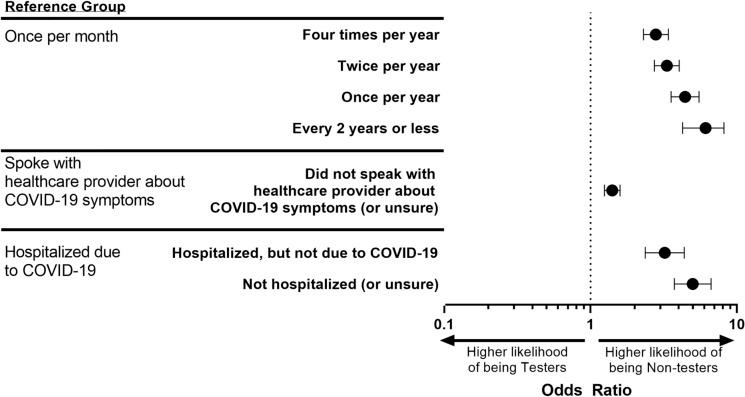
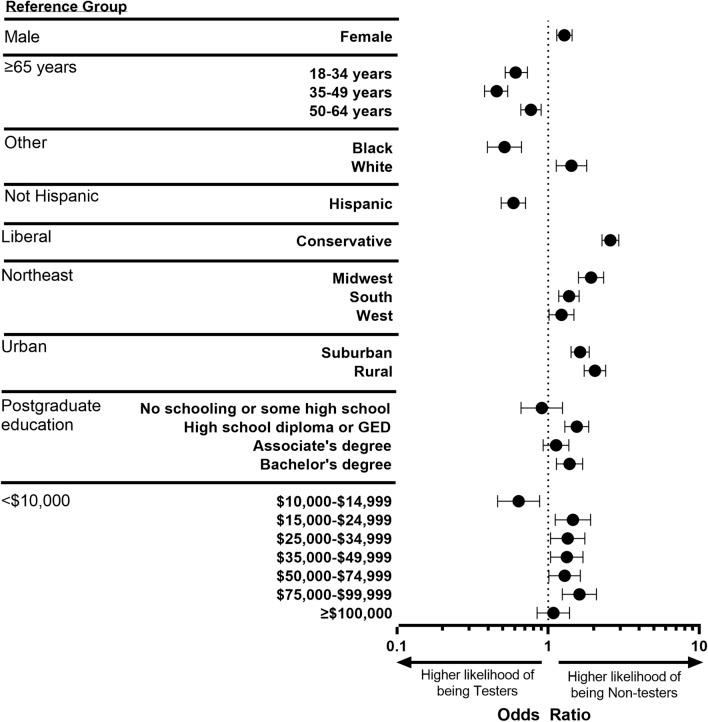
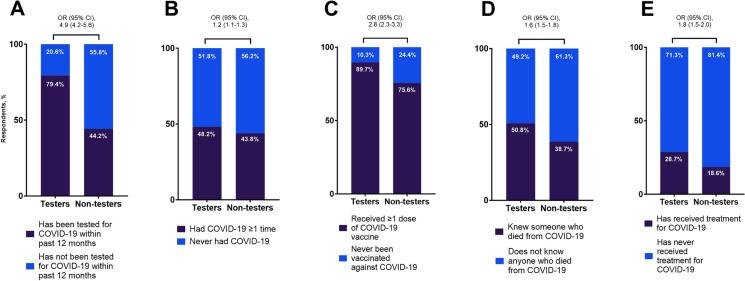
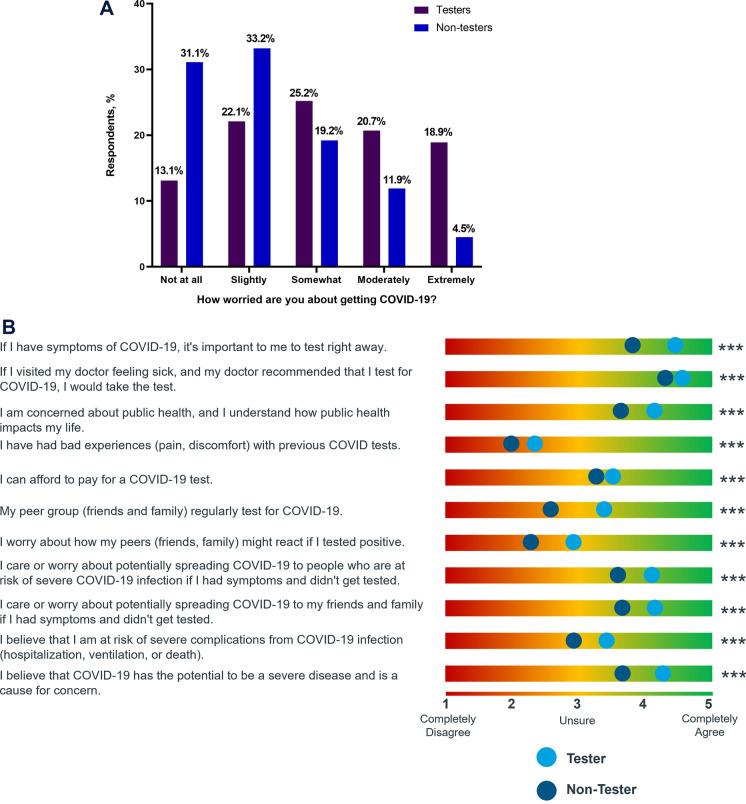
In the weighted sample of 5019 respondents at high risk for severe COVID-19, 58.2% were female, 37.8% were ≥ 65 years old, 77.1% were White, and 13.9% had a postgraduate degree. Overall, 67% were Non-testers (who indicated that they were unlikely or unsure of their likelihood of being tested within the next 6 months); these respondents were significantly more likely than Testers (who indicated a higher probability of testing within 6 months) to be female (60.2 vs. 54.1%; odds ratio [OR] [95% confidence interval (CI)], 1.3 [1.1‒1.4]), aged ≥ 65 years old (41.5 vs. 30.3%; OR [95% CI] compared with ages 18‒34 years, 0.6 [0.5‒0.7]), White (82.1 vs. 66.8%; OR [95% CI], 1.4 [1.1‒1.8]), and to identify as politically conservative (40.9 vs. 18.1%; OR [95% CI], 2.6 [2.3‒2.9]). In contrast, Testers were significantly more likely than Non-testers to have previous experience with COVID-19 testing, infection, or vaccination; greater knowledge regarding COVID-19 and testing; greater healthcare engagement; and concerns about COVID-19.
CONCLUSIONS
Older, female, White, rural-dwelling, and politically conservative high-risk adults are the most likely individuals to experience COVID-19 testing hesitancy. Understanding these demographic factors will help guide strategies to improve US testing rates.
引言
美国疾病控制与预防中心(CDC)建议在个体接触新冠病毒后或出现症状时对其进行新冠病毒检测。然而,有必要更深入地了解与检测犹豫相关的人口统计学因素。
方法
于2023年8月18日至9月5日在美国全国范围内对有发展为重症新冠病毒感染风险因素的成年人(“高危”个体)进行了一项横断面调查。目标包括描述与新冠病毒检测相关的人口统计学特征和态度。采用逆倾向加权法对数据进行加权,以准确反映IQVIA医疗理赔数据中所体现的美国高危成年人群体。我们在此描述为刻画导致检测犹豫的人口统计学因素而建立模型的加权结果。
结果
在5019名重症新冠病毒感染高危受访者的加权样本中,58.2%为女性,37.8%年龄≥65岁,77.1%为白人,13.9%拥有研究生学位。总体而言,67%为非检测者(表示他们在未来6个月内不太可能或不确定自己接受检测的可能性);这些受访者比检测者(表示在6个月内接受检测的可能性更高)更有可能为女性(60.2%对54.1%;优势比[OR][95%置信区间(CI)],1.3[1.1‒1.4])、年龄≥65岁(41.5%对30.3%;与18‒34岁年龄组相比的OR[95%CI],0.6[0.5‒0.7])、白人(82.1%对66.8%;OR[95%CI],1.4[1.1‒1.8]),以及自我认同为政治保守派(40.9%对18.1%;OR[95%CI],2.6[2.3‒2.9])。相比之下,检测者比非检测者更有可能有过新冠病毒检测、感染或接种疫苗的经历;对新冠病毒和检测有更多了解;有更高的医疗保健参与度;以及对新冠病毒更担忧。
结论
年龄较大、女性、白人、居住在农村且政治上保守的高危成年人是最有可能出现新冠病毒检测犹豫的人群。了解这些人口统计学因素将有助于指导提高美国检测率的策略。

 Zotero 插件