
内脏脂肪蓄积指标与不孕的关系:基于美国女性的横断面研究。
Association between indicators of visceral lipid accumulation and infertility: a cross-sectional study based on U.S. women.
机构信息
Department of Obstetrics and Gynecology, Guangdong Provincial Key Laboratory of Major Obstetric Diseases, Guangdong Provincial Clinical Research Center for Obstetrics and Gynecology, Guangdong-Hong Kong-Macao Greater Bay Area Higher Education Joint Laboratory of Maternal-Fetal Medicine, The Third Affiliated Hospital of Guangzhou Medical University, Guangzhou, Guangdong, China.
出版信息
Lipids Health Dis. 2024 Jun 13;23(1):186. doi: 10.1186/s12944-024-02178-x.
BACKGROUND
Evidence on the association between visceral lipid accumulation and infertility remains limited and controversial. Therefore, the current investigation is the first investigation to unveil this correlation by utilizing novel indicators of visceral lipid accumulation.
METHODS
The present study utilized the NHANES 2013-2020 dataset. Researchers utilized multiple logistic regression, smoothed curve fitting, and subgroup analysis to investigate the associations of waist circumference (WC), metabolic score for visceral fat (METS-VF), lipid accumulation product (LAP), visceral adiposity index (VAI) with infertility. Additionally, the eXtreme Gradient Boosting (XGBoost) algorithm model was utilized to evaluate the relative importance of the factors.
RESULTS
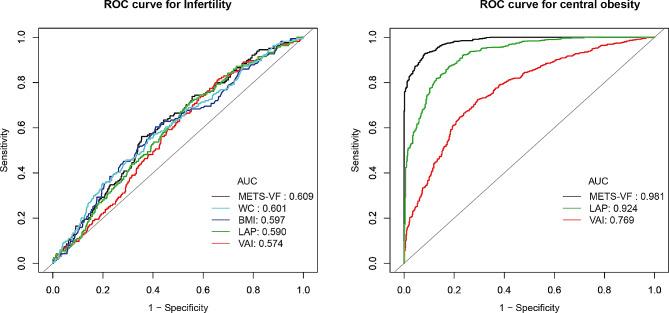
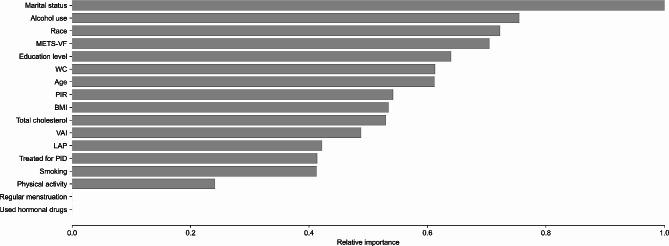
After adjusting for potential factors that could influence the results, researchers discovered that all these four indicators of visceral lipid accumulation exhibited strong positive correlations with the probability of infertility. The subgroup analysis demonstrated that the correlations remained consistent in the majority of subgroups (P for interaction > 0.05). The results of XGBoost algorithm model indicate that METS-VF is the most meaningful factor in infertility. The ROC curve research revealed that while METS-VF had the greatest AUC values, there was no variation in the AUC value of different markers of visceral fat accumulation (P > 0.05).
CONCLUSIONS
The present investigation discovered that increased WC, METS-VF, LAP, and VAI were associated with a heightened prevalence of infertility.
背景
内脏脂肪堆积与不孕之间的关联证据仍然有限且存在争议。因此,目前的研究首次利用内脏脂肪堆积的新指标揭示了这种相关性。
方法
本研究利用了 NHANES 2013-2020 数据集。研究人员采用多因素逻辑回归、平滑曲线拟合和亚组分析来探讨腰围(WC)、代谢性内脏脂肪评分(METS-VF)、脂积指数(LAP)和内脏脂肪指数(VAI)与不孕之间的关联。此外,还利用极端梯度提升(XGBoost)算法模型来评估这些因素的相对重要性。
结果
在调整了可能影响结果的潜在因素后,研究人员发现,这四个内脏脂肪堆积指标均与不孕的概率呈强正相关。亚组分析表明,在大多数亚组中,这种相关性仍然一致(P 交互>0.05)。XGBoost 算法模型的结果表明,METS-VF 是不孕的最有意义的因素。ROC 曲线研究表明,虽然 METS-VF 的 AUC 值最大,但不同内脏脂肪堆积标志物的 AUC 值没有变化(P>0.05)。
结论
本研究发现,WC、METS-VF、LAP 和 VAI 的增加与不孕的患病率升高有关。

 Zotero 插件