
烟草幼苗的冷胁迫响应:转录组、蛋白质组和磷酸化蛋白质组分析的见解
Chilling stress response in tobacco seedlings: insights from transcriptome, proteome, and phosphoproteome analyses.
作者信息
Shao Xiuhong, Zhang Zhenchen, Yang Faheng, Yu Yongchao, Guo Junjie, Li Jiqin, Xu Tingyu, Pan Xiaoying
机构信息
Guangdong Key Laboratory for Crops Genetic Improvement, Crops Research Institute, Guangdong Academy of Agricultural Sciences (GAAS), Guangdong Provincial Engineering & Technology Research Center for Tobacco Breeding and Comprehensive Utilization, Guangzhou, China.
China National Tobacco Corporation, Guangdong Company, Guangzhou, China.
出版信息
Front Plant Sci. 2024 May 28;15:1390993. doi: 10.3389/fpls.2024.1390993. eCollection 2024.
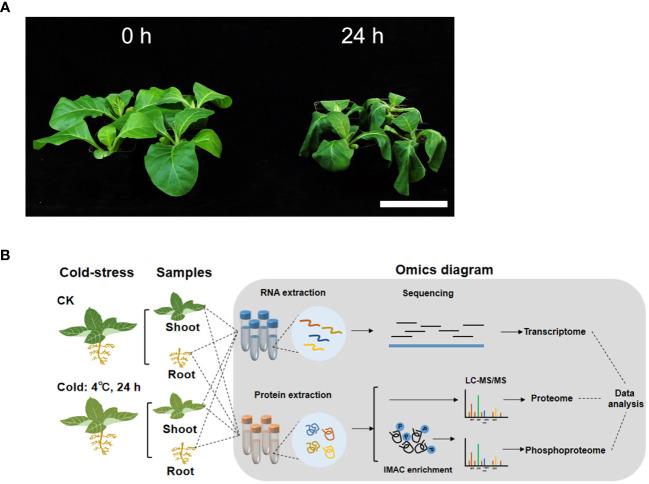
Tobacco ( L.) is an important industrial crop, which is sensitive to chilling stress. Tobacco seedlings that have been subjected to chilling stress readily flower early, which seriously affects the yield and quality of their leaves. Currently, there has been progress in elucidating the molecular mechanisms by which tobacco responds to chilling stress. However, little is known about the phosphorylation that is mediated by chilling. In this study, the transcriptome, proteome and phosphoproteome were analyzed to elucidate the mechanisms of the responses of tobacco shoot and root to chilling stress (4 °C for 24 h). A total of 6,113 differentially expressed genes (DEGs), 153 differentially expressed proteins (DEPs) and 345 differential phosphopeptides were identified in the shoot, and the corresponding numbers in the root were 6,394, 212 and 404, respectively. This study showed that the tobacco seedlings to 24 h of chilling stress primarily responded to this phenomenon by altering their levels of phosphopeptide abundance. Kyoto Encyclopedia of Genes and Genomes analyses revealed that starch and sucrose metabolism and endocytosis were the common pathways in the shoot and root at these levels. In addition, the differential phosphopeptide corresponding proteins were also significantly enriched in the pathways of photosynthesis-antenna proteins and carbon fixation in photosynthetic organisms in the shoot and arginine and proline metabolism, peroxisome and RNA transport in the root. These results suggest that phosphoproteins in these pathways play important roles in the response to chilling stress. Moreover, kinases and transcription factors (TFs) that respond to chilling at the levels of phosphorylation are also crucial for resistance to chilling in tobacco seedlings. The phosphorylation or dephosphorylation of kinases, such as CDPKs and RLKs; and TFs, including VIP1-like, ABI5-like protein 2, TCP7-like, WRKY 6-like, MYC2-like and CAMTA7 among others, may play essential roles in the transduction of tobacco chilling signal and the transcriptional regulation of the genes that respond to chilling stress. Taken together, these findings provide new insights into the molecular mechanisms and regulatory networks of the responses of tobacco to chilling stress.
烟草(Nicotiana tabacum L.)是一种重要的经济作物,对低温胁迫敏感。遭受低温胁迫的烟草幼苗容易过早开花,这严重影响其叶片的产量和品质。目前,在阐明烟草对低温胁迫响应的分子机制方面已有进展。然而,关于低温介导的磷酸化作用却知之甚少。在本研究中,对转录组、蛋白质组和磷酸化蛋白质组进行了分析,以阐明烟草地上部和根部对低温胁迫(4℃处理24小时)的响应机制。在地上部共鉴定出6113个差异表达基因(DEG)、153个差异表达蛋白质(DEP)和345个差异磷酸化肽段,根部相应的数量分别为6394个、212个和404个。本研究表明,烟草幼苗经24小时低温胁迫后,主要通过改变磷酸化肽段丰度水平来应对这一现象。京都基因与基因组百科全书(KEGG)分析显示,淀粉和蔗糖代谢以及内吞作用是地上部和根部在这些水平上的共同途径。此外,差异磷酸化肽段对应的蛋白质在地上部的光合作用天线蛋白和光合生物的碳固定途径以及根部的精氨酸和脯氨酸代谢、过氧化物酶体和RNA转运途径中也显著富集。这些结果表明,这些途径中的磷酸化蛋白质在对低温胁迫的响应中起重要作用。此外,在磷酸化水平上响应低温的激酶和转录因子(TF)对烟草幼苗的抗寒能力也至关重要。激酶(如钙依赖蛋白激酶(CDPK)和类受体蛋白激酶(RLK))以及转录因子(包括类VIP1、类ABI5蛋白2、类TCP7、类WRKY 6、类MYC2和类CAMTA7等)的磷酸化或去磷酸化可能在烟草低温信号转导以及响应低温胁迫基因的转录调控中起关键作用。综上所述,这些发现为烟草对低温胁迫响应的分子机制和调控网络提供了新的见解。



 Zotero 插件