
在 COVID-19 大流行期间,基层医疗实践的组织方式是否影响了质量和安全?——一项国际调查。
Did the organization of primary care practices during the COVID-19 pandemic influence quality and safety? - an international survey.
机构信息
Faculty of Medicine and Health, School of Health Sciences, Örebro University, Örebro, Sweden.
Futurum, Region Jönköping County, Jönköping, Sweden.
出版信息
BMC Health Serv Res. 2024 Jun 14;24(1):737. doi: 10.1186/s12913-024-11173-y.
BACKGROUND
Changes in demographics with an older population, the illness panorama with increasing prevalence of non-communicable diseases, and the shift from hospital care to home-based care place demand on primary health care, which requires multiprofessional collaboration and team-based organization of work. The COVID-19 pandemic affected health care in various ways, such as heightened infection control measures, changing work practices, and increased workload.
OBJECTIVES
This study aimed to investigate the association between primary care practices' organization, and quality and safety changes during the COVID-19 pandemic.
DESIGN
Data were collected from 38 countries in a large online survey, the PRICOV-19 study. For this paper, the participating practices were categorized as "Only GPs", comprising practices with solely general practitioners (GPs) and/or GP trainees, without any other health care professionals (n = 1,544), and "Multiprofessional," comprising practices with at least one GP or GP trainee and one or more other health professionals (n = 3,936).
RESULTS
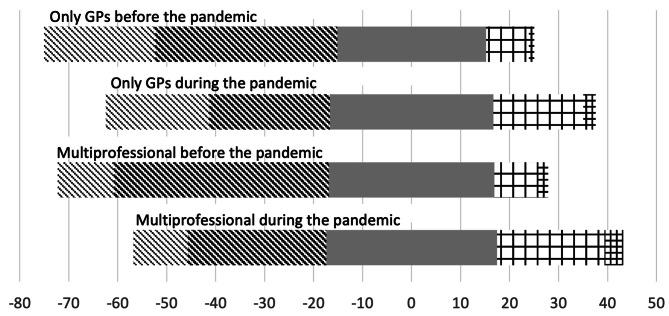
Both categories of practices improved in infection control routines when compared before and during the COVID-19 pandemic. A larger proportion of the multiprofessional practices changed their routines to protect vulnerable patients. Telephone triage was used in more "Multiprofessional" practices, whereas "Only GPs" were more likely to perform video consultations as an alternative to physical visits. Both types of practices reported that the time to review new guidelines and scientific literature decreased during the pandemic. However, both had more meetings to discuss directives than before the pandemic.
CONCLUSIONS
Multiprofessional teams were keener to introduce changes to the care organization to protect vulnerable patients. However, practices with only GPs were found to be more aligned with video consultations, perhaps reflecting the close patient-doctor relationship. In contrast, telephone triage was used more in multiprofessional teams.
背景
人口老龄化、非传染性疾病发病率上升导致疾病谱变化,以及从医院护理向家庭护理的转变,对基层医疗保健提出了需求,这需要多专业合作和基于团队的工作组织。COVID-19 大流行以各种方式影响着医疗保健,例如加强感染控制措施、改变工作实践和增加工作量。
目的
本研究旨在调查 COVID-19 大流行期间基层医疗保健实践组织与质量和安全变化之间的关联。
设计
该研究的数据来自于一项名为 PRICOV-19 的大型在线调查,来自 38 个国家。在本文中,参与的实践被分为“仅全科医生”和“多专业”两类。“仅全科医生”类包括仅有全科医生(GP)和/或 GP 实习生,没有其他任何医疗保健专业人员的实践(n=1544),“多专业”类包括至少有一名 GP 或 GP 实习生和一名或多名其他卫生专业人员的实践(n=3936)。
结果
与 COVID-19 大流行前相比,这两种类型的实践都改进了感染控制常规。更多的多专业实践改变了常规以保护弱势群体患者。更多的“多专业”实践采用了电话分诊,而“仅全科医生”类则更倾向于将视频咨询作为替代实地就诊的方式。这两种类型的实践都报告称,在大流行期间,审查新指南和科学文献的时间减少了。然而,与大流行前相比,两者都增加了讨论指令的会议次数。
结论
多专业团队更热衷于引入改变护理组织的措施,以保护弱势群体患者。然而,仅由全科医生组成的实践发现更倾向于视频咨询,这可能反映了医患之间的密切关系。相比之下,多专业团队更倾向于使用电话分诊。
 Zotero 插件