
重症肌无力与扁平苔藓并存:一例报告及对1971年至2024年相关病例报告的系统综述
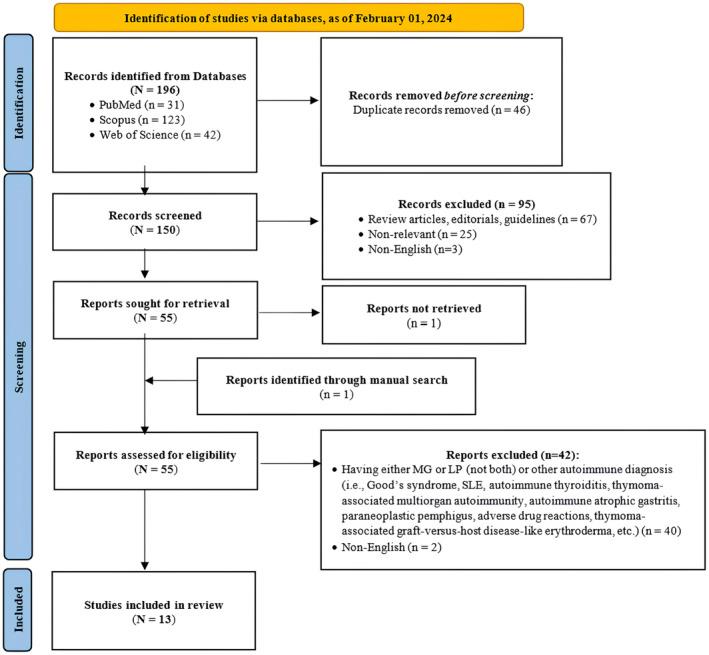
Coexistence of myasthenia gravis and lichen planus: A case report and systematic review of related case reports from 1971 to 2024.
作者信息
Jameie Melika, Amanollahi Mobina, Ahli Bahareh, Farahmand Ghasem, Magrouni Hana, Sarraf Payam
机构信息
Iranian Center of Neurological Research, Neuroscience Institute Tehran University of Medical Sciences Tehran Iran.
School of Medicine Tehran University of Medical Sciences Tehran Iran.
出版信息
Clin Case Rep. 2024 Jun 14;12(6):e9065. doi: 10.1002/ccr3.9065. eCollection 2024 Jun.
KEY CLINICAL MESSAGE
The co-occurrence of myasthenia gravis (MG) and lichen planus (LP) is a rare phenomenon, with only 13 cases reported in the English literature between 1971 and 2024. Patients with MG or LP, regardless of the thymoma status, require close monitoring for other autoimmune diseases.
ABSTRACT
Myasthenia gravis (MG) is an uncommon autoimmune disease, resulting in fatigable muscle weakness in the ocular, bulbar, and respiratory muscles, as well as muscles of the extremities. Lichen planus (LP) is an autoimmune mucocutaneous disease, presenting with pruritic and violaceous plaques on the skin and mucosal surfaces. So far, MG and LP co-occurrence is only reported in anecdotal individuals. This study reports a patient with MG and LP and systematically reviews the English literature on this rare co-occurrence from 1971 to 2024, indicating only 13 cases with similar conditions. A 67-year-old man presented with ocular and progressive bulbar symptoms, a year after being diagnosed with generalized LP. Laboratory evaluations were normal except for the high anti-AchR-Ab titer and a positive ANA titer. Neurologic examinations revealed asymmetric bilateral ptosis, weakness and fatigability in proximal muscles, and a severe reduction in the gag reflex. He was diagnosed with late-onset, seropositive MG. The treatment included pyridostigmine (60 mg, three times daily), intravenous immunoglobulin (25 g daily for 5 days), and oral prednisolone. There was no evidence of thymoma in the chest x-ray and CT scan without contrast. However, a CT scan with contrast was not performed due to the patient's unstable condition. A common autoimmune mechanism may underlie the unclear pathophysiology of MG and LP co-occurrence, with or without thymoma. Patients with MG, LP, or thymoma require close monitoring and assessment for other possible autoimmune diseases.
关键临床信息
重症肌无力(MG)和扁平苔藓(LP)同时出现是一种罕见现象,1971年至2024年间英文文献中仅报道了13例。患有MG或LP的患者,无论是否患有胸腺瘤,都需要密切监测是否患有其他自身免疫性疾病。
摘要
重症肌无力(MG)是一种罕见的自身免疫性疾病,可导致眼部、延髓和呼吸肌以及四肢肌肉出现易疲劳性肌无力。扁平苔藓(LP)是一种自身免疫性皮肤黏膜疾病,表现为皮肤和黏膜表面出现瘙痒性紫斑。到目前为止,MG和LP同时出现仅在个别病例中有报道。本研究报告了一名患有MG和LP的患者,并系统回顾了1971年至2024年间关于这种罕见同时出现情况的英文文献,表明仅有13例类似病例。一名67岁男性在被诊断为全身性LP一年后出现眼部和进行性延髓症状。实验室检查除抗乙酰胆碱受体抗体(anti-AchR-Ab)滴度高和抗核抗体(ANA)滴度阳性外均正常。神经系统检查发现双侧上睑下垂不对称、近端肌肉无力和易疲劳,以及咽反射严重减弱。他被诊断为迟发性、血清阳性MG。治疗包括吡啶斯的明(60毫克,每日三次)、静脉注射免疫球蛋白(每日25克,共5天)和口服泼尼松龙。胸部X线和非增强CT扫描未发现胸腺瘤证据。然而,由于患者病情不稳定,未进行增强CT扫描。MG和LP同时出现的病理生理机制尚不清楚,无论是否伴有胸腺瘤,可能存在共同的自身免疫机制。患有MG、LP或胸腺瘤的患者需要密切监测和评估是否患有其他可能的自身免疫性疾病。
 Zotero 插件