
淀粉样蛋白 PET 成像可预测临床正常个体的功能下降。
Amyloid-PET imaging predicts functional decline in clinically normal individuals.
机构信息
Institute of Neuroscience, UCLouvain, Brussels, Belgium.
Department of Neurology, Cliniques Universitaires Saint-Luc, Brussels, Belgium.
出版信息
Alzheimers Res Ther. 2024 Jun 17;16(1):130. doi: 10.1186/s13195-024-01494-9.
BACKGROUND
There is good evidence that elevated amyloid-β (Aβ) positron emission tomography (PET) signal is associated with cognitive decline in clinically normal (CN) individuals. However, it is less well established whether there is an association between the Aβ burden and decline in daily living activities in this population. Moreover, Aβ-PET Centiloids (CL) thresholds that can optimally predict functional decline have not yet been established.
METHODS
Cross-sectional and longitudinal analyses over a mean three-year timeframe were performed on the European amyloid-PET imaging AMYPAD-PNHS dataset that phenotypes 1260 individuals, including 1032 CN individuals and 228 participants with questionable functional impairment. Amyloid-PET was assessed continuously on the Centiloid (CL) scale and using Aβ groups (CL < 12 = Aβ-, 12 ≤ CL ≤ 50 = Aβ-intermediate/Aβ± , CL > 50 = Aβ+). Functional abilities were longitudinally assessed using the Clinical Dementia Rating (Global-CDR, CDR-SOB) and the Amsterdam Instrumental Activities of Daily Living Questionnaire (A-IADL-Q). The Global-CDR was available for the 1260 participants at baseline, while baseline CDR-SOB and A-IADL-Q scores and longitudinal functional data were available for different subsamples that had similar characteristics to those of the entire sample.
RESULTS
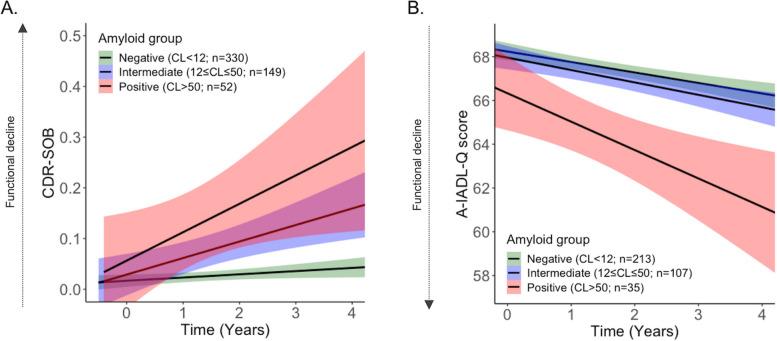
Participants included 765 Aβ- (61%, Mdn = 66.0, IQR = 61.0-71.0; 59% women), 301 Aβ± (24%; Mdn = 69.0, IQR = 64.0-75.0; 53% women) and 194 Aβ+ individuals (15%, Mdn = 73.0, IQR = 68.0-78.0; 53% women). Cross-sectionally, CL values were associated with CDR outcomes. Longitudinally, baseline CL values predicted prospective changes in the CDR-SOB (b = 0.001/CL/year, 95% CI [0.0005,0.0024], p = .003) and A-IADL-Q (b = -0.010/CL/year, 95% CI [-0.016,-0.004], p = .002) scores in initially CN participants. Increased clinical progression (Global-CDR > 0) was mainly observed in Aβ+ CN individuals (HR = 2.55, 95% CI [1.16,5.60], p = .020). Optimal thresholds for predicting decline were found at 41 CL using the CDR-SOB (b = 0.137/year, 95% CI [0.069,0.206], p < .001) and 28 CL using the A-IADL-Q (b = -0.693/year, 95% CI [-1.179,-0.208], p = .005).
CONCLUSIONS
Amyloid-PET quantification supports the identification of CN individuals at risk of functional decline.
TRIAL REGISTRATION
The AMYPAD PNHS is registered at www.clinicaltrialsregister.eu with the EudraCT Number: 2018-002277-22.
背景
有充分的证据表明,淀粉样蛋白-β(Aβ)正电子发射断层扫描(PET)信号升高与临床正常(CN)个体的认知能力下降有关。然而,在这一人群中,Aβ负担与日常生活活动下降之间是否存在关联,尚未得到很好的证实。此外,还没有确定能够最佳预测功能下降的 Aβ-PET Centiloids(CL)阈值。
方法
在欧洲淀粉样蛋白-PET 成像 AMYPAD-PNHS 数据集上进行了横断面和纵向分析,该数据集表型了 1260 个人,包括 1032 名 CN 个体和 228 名有可疑功能障碍的参与者。Aβ-PET 连续在 Centiloid(CL)量表上进行评估,并使用 Aβ 组(CL < 12 = Aβ-,12 ≤ CL ≤ 50 = Aβ- 中间/Aβ±,CL > 50 = Aβ+)。使用临床痴呆评定量表(全球-CDR,CDR-SOB)和阿姆斯特丹日常生活活动问卷(A-IADL-Q)对功能能力进行纵向评估。1260 名参与者在基线时可获得全球-CDR,而基线 CDR-SOB 和 A-IADL-Q 评分以及不同的纵向功能数据可用于具有与整个样本相似特征的不同亚组。
结果
参与者包括 765 名 Aβ-(61%,Mdn = 66.0,IQR = 61.0-71.0;59%为女性),301 名 Aβ±(24%;Mdn = 69.0,IQR = 64.0-75.0;53%为女性)和 194 名 Aβ+个体(15%,Mdn = 73.0,IQR = 68.0-78.0;53%为女性)。在横断面分析中,CL 值与 CDR 结果相关。在纵向分析中,基线 CL 值预测了 CN 参与者的 CDR-SOB(b = 0.001/CL/年,95%CI [0.0005,0.0024],p = 0.003)和 A-IADL-Q(b = -0.010/CL/年,95%CI [-0.016,-0.004],p = 0.002)评分的前瞻性变化。主要在 Aβ+CN 个体中观察到临床进展增加(全球-CDR > 0)(HR = 2.55,95%CI [1.16,5.60],p = 0.020)。使用 CDR-SOB 预测下降的最佳阈值为 41 CL(b = 0.137/年,95%CI [0.069,0.206],p < 0.001),使用 A-IADL-Q 预测下降的最佳阈值为 28 CL(b = -0.693/年,95%CI [-1.179,-0.208],p = 0.005)。
结论
淀粉样蛋白-β PET 定量支持识别有功能下降风险的 CN 个体。
试验注册
AMYPAD-PNHS 在 www.clinicaltrialsregister.eu 上注册,注册号为 EudraCT Number:2018-002277-22。

 Zotero 插件