
身体虚弱、遗传易感性与重度非酒精性脂肪性肝病和肝硬化的风险:一项队列研究
Physical frailty, genetic predisposition, and the risks of severe non-alcoholic fatty liver disease and cirrhosis: a cohort study.
作者信息
Yang Honghao, Ou Fengrong, Chang Qing, Jiang Jinguo, Liu Yashu, Ji Chao, Chen Liangkai, Xia Yang, Zhao Yuhong
机构信息
Department of Clinical Epidemiology, Shengjing Hospital of China Medical University, Shenyang, China.
Liaoning Key Laboratory of Precision Medical Research on Major Chronic Disease, Shenyang, China.
出版信息
J Cachexia Sarcopenia Muscle. 2024 Aug;15(4):1491-1500. doi: 10.1002/jcsm.13506. Epub 2024 Jun 18.
BACKGROUND
Frailty, defined as a phenotype of decreased physiological reserves and diminished ability to respond to stressors, has been linked to the development of chronic diseases. Epidemiological evidence connecting frailty to non-alcoholic fatty liver disease (NAFLD) and cirrhosis risks remain sparse. We aimed to assess the longitudinal associations of frailty with the risks of severe NAFLD and cirrhosis in middle-aged to older adults and further explore the modification role of genetic risk on these associations.
METHODS
This study included a total of 398 386 participants from the UK Biobank. Incident cases of severe NAFLD and cirrhosis were ascertained through linked hospital records and death registries. Frailty status was assessed by a modified version of the frailty phenotype, encompassing five key components: weight loss, tiredness, physical activity, gait speed, and grip strength. Participants were classified as pre-frailty if they met one or two of these criteria, and as frailty if they met three or more. Genetic predisposition to NAFLD and cirrhosis was estimated by genetic risk score (GRS) and further categorized into high, intermediate, and low genetic risk levels according to tertiles of GRSs. Cox proportional hazards regression model was employed to estimate the hazard ratios (HRs) and 95% confidence intervals (CIs) for their associations.
RESULTS
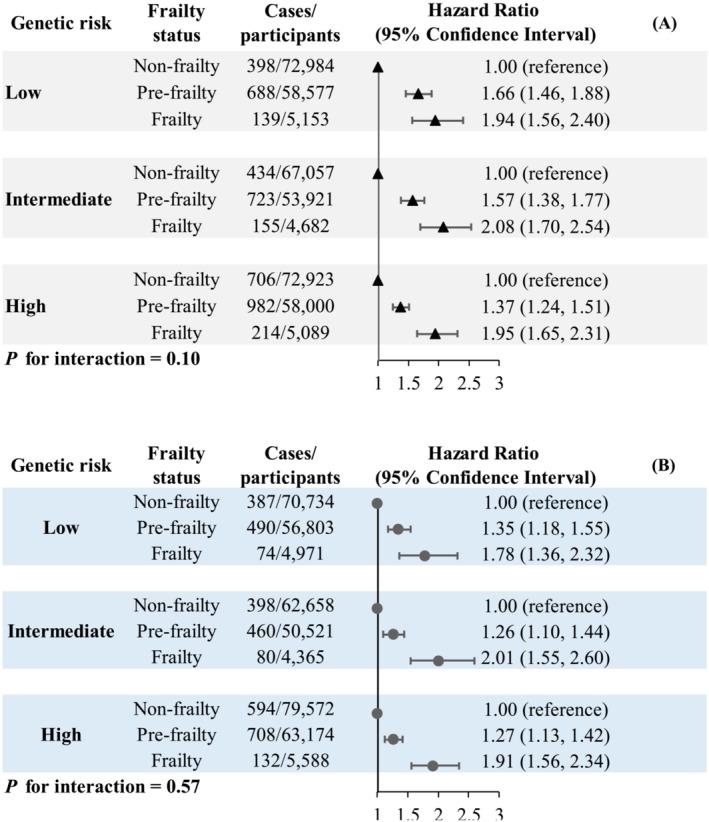
The mean (standard deviation) age of the study population was 56.6 (8.03) years. 214 408 (53.8%) of the participants was female; 14 924 (3.75%) of participants met the criteria for frailty, 170 498 (42.8%) for pre-frailty, and 212 964 (53.5%) for non-frailty. Over a median follow-up of 12.0 years, we documented 4439 incident severe NAFLD and 3323 incident cirrhosis cases, respectively. Compared with non-frailty, both pre-frailty (HR: 1.50; 95% CI: 1.40-1.60) and frailty (HR: 1.98; 95% CI: 1.77-2.21) were associated with increased risk of NAFLD. Similar associations were observed for cirrhosis, the corresponding HRs (95% CIs) for non-frailty, pre-frailty, and frailty were 1.00 (reference), 1.29 (1.20, 1.38), and 1.90 (1.66, 2.18). Such associations were consistent across all genetic risk levels, with no observed interactions between frailty and GRSs (all P for interactions ≥0.10). Compared with participants with frailty and a low level of genetic risk, the greatest risk increasement in developing severe NAFLD (HR: 3.36; 95% CI: 2.83-3.99) and cirrhosis (HR: 2.81; 95% CI: 2.29-3.44) was both observed in those with frailty and a high level of genetic risk.
CONCLUSIONS
Our findings indicate that frailty is a significant predictor of severe NAFLD and cirrhosis, irrespective of genetic predisposition.
背景
衰弱被定义为生理储备下降和应对压力源能力减弱的一种表型,与慢性疾病的发生有关。将衰弱与非酒精性脂肪性肝病(NAFLD)及肝硬化风险联系起来的流行病学证据仍然很少。我们旨在评估衰弱与中老年人群严重NAFLD及肝硬化风险之间的纵向关联,并进一步探讨遗传风险在这些关联中的修饰作用。
方法
本研究共纳入了来自英国生物银行的398386名参与者。通过关联医院记录和死亡登记确定严重NAFLD和肝硬化的发病病例。采用改良的衰弱表型评估衰弱状态,该表型包含五个关键组成部分:体重减轻、疲劳、身体活动、步速和握力。如果参与者符合其中一或两条标准,则分类为衰弱前期;如果符合三条或更多标准,则分类为衰弱。通过遗传风险评分(GRS)评估NAFLD和肝硬化的遗传易感性,并根据GRS的三分位数进一步分为高、中、低遗传风险水平。采用Cox比例风险回归模型估计其关联的风险比(HR)和95%置信区间(CI)。
结果
研究人群的平均(标准差)年龄为56.6(8.03)岁。214408名(53.8%)参与者为女性;14924名(3.75%)参与者符合衰弱标准,170498名(42.8%)符合衰弱前期标准,212964名(53.5%)符合非衰弱标准。在中位随访12.0年期间,我们分别记录了4439例严重NAFLD发病病例和3323例肝硬化发病病例。与非衰弱相比,衰弱前期(HR:1.50;95%CI:1.40 - 1.60)和衰弱(HR:1.98;95%CI:1.77 - 2.21)均与NAFLD风险增加相关。肝硬化也观察到类似关联,非衰弱、衰弱前期和衰弱对应的HR(95%CI)分别为1.00(参照)、1.29(1.20,1.38)和1.90(1.66,2.18)。这些关联在所有遗传风险水平中均一致,未观察到衰弱与GRS之间的相互作用(所有相互作用的P值≥0.10)。与衰弱且遗传风险低的参与者相比,在发展为严重NAFLD(HR:3.36;95%CI:2.83 - 3.99)和肝硬化(HR:2.81;95%CI:2.29 - 3.44)方面,风险增加最大的均是衰弱且遗传风险高的参与者。
结论
我们的研究结果表明,无论遗传易感性如何,衰弱都是严重NAFLD和肝硬化的重要预测因素。
 Zotero 插件