
流感和 COVID-19 疫苗接种后不良事件的性别差异。
Sex and gender differences in adverse events following influenza and COVID-19 vaccination.
机构信息
Department of Molecular Microbiology and Immunology, Johns Hopkins Bloomberg School of Public Health, Baltimore, MD, USA.
Department of Population, Family, and Reproductive Health, Johns Hopkins Bloomberg School of Public Health, Baltimore, MD, USA.
出版信息
Biol Sex Differ. 2024 Jun 18;15(1):50. doi: 10.1186/s13293-024-00625-z.
INTRODUCTION
Active and passive surveillance studies have found that a greater proportion of females report adverse events (AE) following receipt of either the COVID-19 or seasonal influenza vaccine compared to males. In a predominately young adult female population of healthcare workers, we sought to determine the intersection of biological sex and sociocultural gender differences in prospective active reporting of vaccine outcomes, which remains poorly characterized.
METHODS
This cohort study enrolled Johns Hopkins Health System healthcare workers (HCWs) who were recruited from the mandatory annual fall 2019-2022 influenza vaccine and the fall 2022 COVID-19 bivalent vaccine campaigns. Vaccine recipients were enrolled the day of vaccination and AE surveys were administered two days post-vaccination for bivalent COVID-19 and influenza vaccine recipients. Data were collected regarding the presence of a series of solicited local and systemic AEs. Open-ended answers about participants' experiences with AEs also were collected for the COVID-19 vaccine recipients.
RESULTS
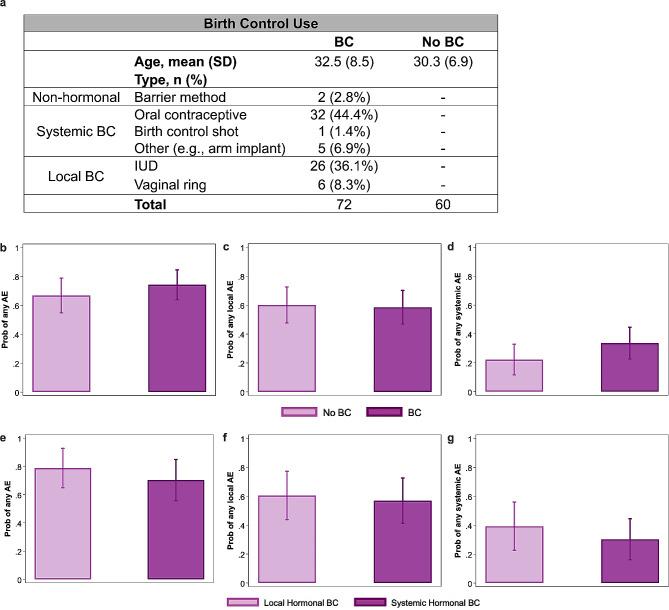
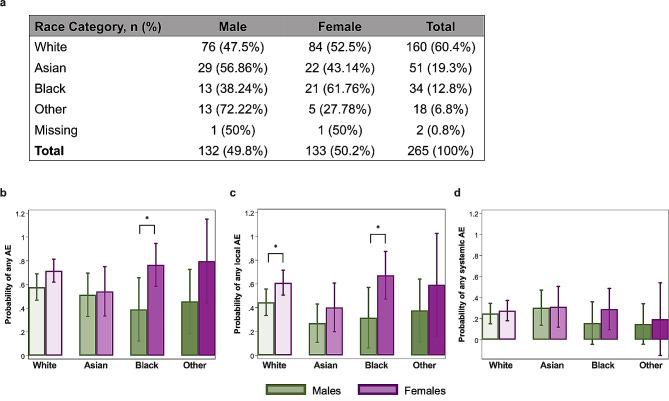
Females were more likely to report local AEs after either influenza (OR = 2.28, p = 0.001) or COVID-19 (OR = 2.57, p = 0.008) vaccination compared to males, regardless of age or race. Males and females had comparable probabilities of reporting systemic AEs after either influenza (OR = 1.18, p = 0.552) or COVID-19 (OR = 0.96, p = 0.907) vaccination. Hormonal birth control use did not impact the rates of reported AEs following influenza vaccination among reproductive-aged female HCWs. Women reported more interruptions in their daily routine following COVID-19 vaccination than men and were more likely to seek out self-treatment. More women than men scheduled their COVID-19 vaccination before their days off in anticipation of AEs.
CONCLUSIONS
Our findings highlight the need for sex- and gender-inclusive policies to inform more effective mandatory occupational health vaccination strategies. Further research is needed to evaluate the potential disruption of AEs on occupational responsibilities following mandated vaccination for healthcare workers, a predominately female population, and to more fully characterize the post-vaccination behavioral differences between men and women.
简介
主动和被动监测研究发现,与男性相比,更多的女性在接种 COVID-19 或季节性流感疫苗后报告不良反应(AE)。在以年轻成年女性为主的医护人员群体中,我们试图确定生物性别和社会文化性别差异在疫苗结果的前瞻性主动报告中的交叉点,而这一点仍未得到充分描述。
方法
这项队列研究招募了约翰霍普金斯卫生系统的医护人员(HCWs),他们是从强制性的 2019-2022 年秋季流感疫苗和 2022 年秋季 bivalent COVID-19 疫苗接种活动中招募的。疫苗接种者在接种疫苗当天入组,bivalent COVID-19 和流感疫苗接种者在接种后两天进行 AE 调查。收集了一系列局部和全身 AE 的存在情况的数据。还为 COVID-19 疫苗接种者收集了有关参与者 AE 经历的开放式回答。
结果
与男性相比,女性在接种流感(OR=2.28,p=0.001)或 COVID-19(OR=2.57,p=0.008)疫苗后更有可能报告局部 AE,无论年龄或种族如何。男性和女性在接种流感(OR=1.18,p=0.552)或 COVID-19(OR=0.96,p=0.907)疫苗后报告全身 AE 的可能性相当。激素避孕的使用不会影响生殖年龄女性 HCWs 接种流感疫苗后的 AE 报告率。与男性相比,女性在接种 COVID-19 疫苗后更有可能中断日常活动,并更有可能寻求自我治疗。与男性相比,更多的女性在接种 COVID-19 疫苗之前就已经安排好了休假,以应对可能出现的 AE。
结论
我们的研究结果强调了需要制定性别包容政策,为更有效的强制性职业健康疫苗接种策略提供信息。需要进一步研究评估强制性接种疫苗对医疗保健工作者(主要是女性)的职业责任的潜在影响,以及更全面地描述男性和女性在接种疫苗后行为差异。


 Zotero 插件